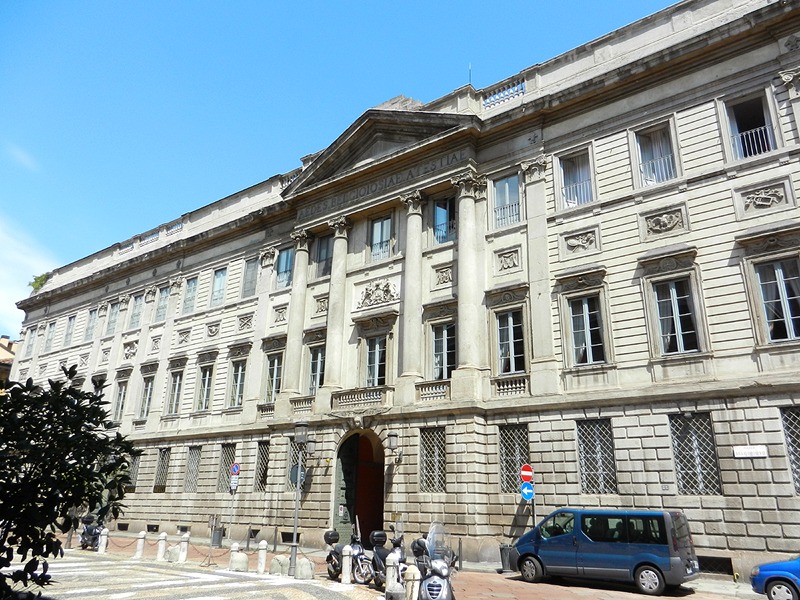
Belgioioso Palace
Europe,
Italy,
citta,
Centro Storico
Palazzo Belgioioso, also known as Palazzo Belgiojoso, is one of the most refined expressions of neoclassical architecture in Milan, located in the square of the same name in the heart of the city. Designed by Giuseppe Piermarini, the architect already famous for the Teatro alla Scala, the palace was completed in 1787 commissioned by Prince Alberico XII of Belgioioso d’Este. Its construction, started in 1772, was inspired by the grand Reggia di Caserta by Luigi Vanvitelli, but with a more simplified and sober approach, typical of neoclassical style.
The facade of the palace is a perfect example of elegance and rigor, characterized by four imposing columns overlooking the entrance door, flat pilasters, and a decorated pediment. The courtyard of honor, porticoed on two parallel sides, represents a space of rare architectural beauty, integrating baroque elements that were gradually giving way to neoclassicism. Inside, the palace is enriched by the decorations of artists such as Giocondo Albertolli and Martino Knoller, who have contributed to creating a sophisticated and harmonious environment.
Palazzo Belgioioso played a significant role in the cultural and social life of Milan. During the 18th and 19th centuries, it was an important meeting place for intellectuals and artists. Figures like Giuseppe Parini and Ugo Foscolo were said to be regular attendees at the evenings organized by Prince Alberico, where poetry and art were at the center of discussions. Additionally, the palace also hosted Napoleon Bonaparte for a brief period during his Italian campaign in 1796, adding another layer of historical charm to the structure.
The location of the palace, next to the house of Alessandro Manzoni, adds another interesting cultural connection. Manzoni, one of the greatest Italian writers, spent much of his life in the nearby Casa Manzoni, now a museum dedicated to his memory. This close link between the two residences highlights the importance of this area of Milan as a hub of culture and literature.
During the 19th century, Palazzo Belgioioso experienced moments of particular political ferment. For example, during the Cinque Giornate di Milano in 1848, the Boeucc, the oldest restaurant in Milan located near the palace, was a meeting point for patriots planning resistance against Austrian troops. This historical episode underscores the role of the palace and the surrounding neighborhood as the focal point of Milanese political and social life.
Today, Palazzo Belgioioso remains one of the most admired buildings in Milan, although public access is limited to rare occasions. Its architectural beauty and rich history continue to make it a symbol of the city, testifying to the mastery of Piermarini and the importance of the Belgioioso family in Milanese history. The square it overlooks, with its balance of elegance and rigor, is one of the most representative of neoclassical Milan.
Read More