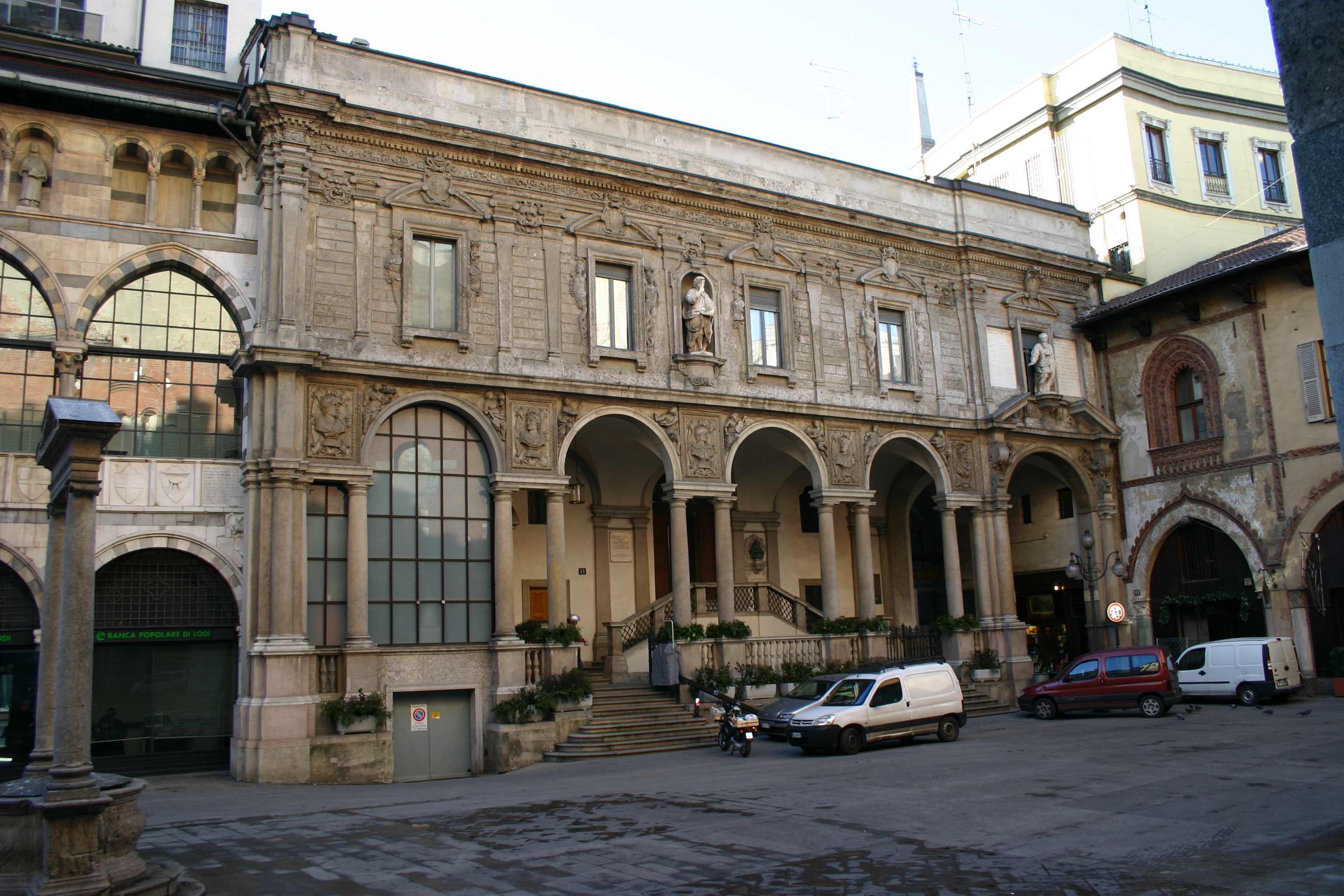
Palace of the Palatine Schools
Europe,
Italy,
citta,
Centro Storico
The Palazzo delle Scuole Palatine, located in Piazza dei Mercanti in Milan, is a historic monument that reflects the city’s rich academic and cultural tradition. This building was constructed in 1644 by the architect Carlo Buzzi, after a fire destroyed the previous structure. The Palatine Schools, originally founded in the 15th century during the duchy of Giovanni Maria Visconti, were intended to educate young nobles in rhetoric, Latin eloquence, Greek, and law.
The name “Scuole Palatine” was given by the Flemish scholar Ericio Puteano, who taught Latin eloquence at the institute in the early 17th century. He was inspired by the ancient palatine schools of Roman times, symbols of high culture and prestige. The Palatine Schools quickly established themselves as an elite institution, preparatory for the University of Pavia, offering a two-year course of studies preparatory for legal and administrative careers.
The building features an elegant architectural structure, with two floors and a raised portico accessible through a series of steps. The paired Tuscan columns with serliana and the pilasters shaped like herms characterize the main entrance. The facade is enriched with imperial busts and female figures in the triangles on the sides of the arches, as well as triangular windows decorated with sirens and heraldic crests. In the center of the facade is a niche with the statue of Saint Augustine, a work by the sculptor Pietro Lasagna.
One of the most interesting features of the Palazzo delle Scuole Palatine is the Orefici portal, which preserves a plaque with an epigram by the Roman poet Ausonius, celebrating the beauties of Milan. This plaque, along with the statue of Decimus Magnus Ausonius erected towards the square, emphasizes the connection between classical and Renaissance culture promoted by the schools.
During the 18th century, under Austrian rule, the Palatine Schools expanded their educational program, including new subjects such as mechanics, hydraulics, astronomy, optics, public law, economics and finance, theology, anatomy, and oriental languages. This transformation reflected the evolution of the institution from an elite school to a training ground open to aspiring bourgeois pursuing public careers.
With the abolition of the Society of Jesus in 1773, the Palatine Schools were transferred to the Brera complex, marking the end of an era for the building in Piazza dei Mercanti. Nevertheless, the palace continued to be a symbol of Milan’s educational tradition.
Today, the Palazzo delle Scuole Palatine is an important example of Milanese Mannerist architecture, well integrated into the historical and urban context of Piazza dei Mercanti, once a bustling center of Milan’s commercial and civil life. The square itself, with the Palazzo della Ragione and other historic buildings, represents a place of great interest for anyone wishing to understand the history and evolution of the city.
The structure, which hides a modern building behind the facade used for offices and residences, maintains its ancient charm thanks to conservative restorations that have preserved its architectural integrity. Visitors can admire the sophistication of the sculptural and architectural details, which testify to the care with which the building was designed and constructed.
Read More