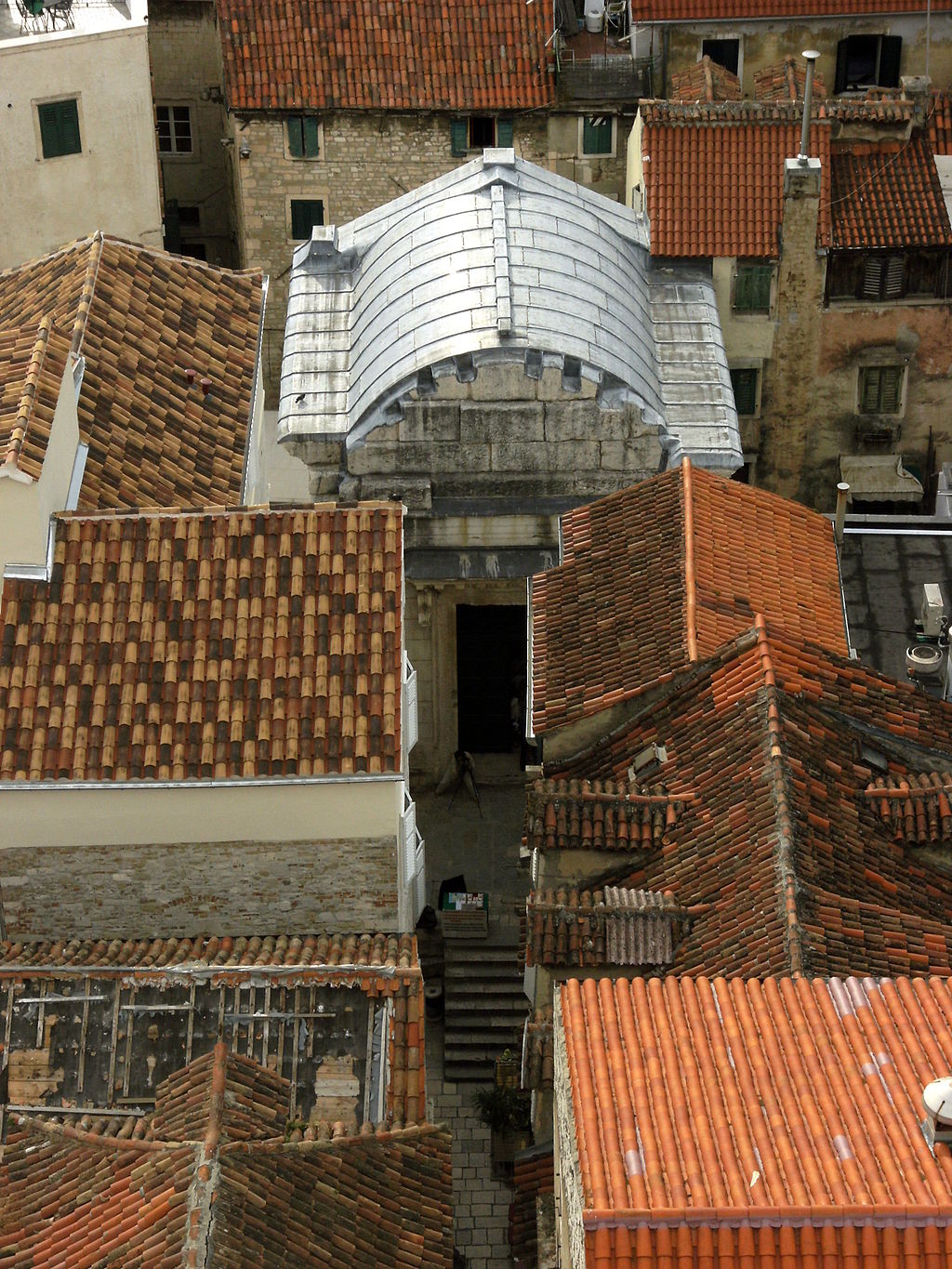
Temple of Jupiter
Europe,
Croatia,
Split,
Diocletian’s Palace
The Temple of Jupiter, located in the heart of Diocletian’s Palace in Split, is one of the most fascinating and well-preserved ancient buildings in the city. Built in the early 4th century AD as part of Diocletian’s palace complex, this temple is an extraordinary example of Roman religious architecture and reflects the importance of the cult of Jupiter in the Roman Empire.
Diocletian’s Palace was built between 295 and 305 AD as an imperial residence for Emperor Diocletian after his retirement from public life. Within the palace, the Temple of Jupiter was dedicated to the supreme deity of the Roman pantheon, the god of the sky and thunder, symbol of power and imperial authority. The choice to dedicate a temple to Jupiter within the palace emphasizes Diocletian’s desire to legitimize his power through association with the supreme deity.
The temple has a rectangular plan with a pronaos (front portico) supported by Corinthian columns. The elegant proportions and detailed decorations testify to the skill of the architects and craftsmen of the time. The facade is characterized by a triangular pediment, typical of Roman temple architecture, decorated with reliefs depicting mythological scenes and vegetal motifs.
A notable feature of the Temple of Jupiter is its vaulted ceiling, decorated with coffered motifs. These coffers, or lacunaria, are adorned with reliefs representing heads of deities and other religious symbols, creating an effect of depth and visual richness. This ceiling is considered one of the finest examples of coffered decoration in Roman architecture.
Over the centuries, the Temple of Jupiter underwent various transformations. With the advent of Christianity and the decline of paganism, the temple was converted into a Christian baptistery in the 6th century, dedicated to St. John the Baptist. This transformation is representative of the religious and cultural changes that the Roman Empire underwent during late antiquity.
The interior of the temple, now a baptistery, houses one of Split’s most significant sculptural works: the sarcophagus of John of Ravenna, the first bishop of Split, dating back to the 7th century. This sarcophagus, decorated with Christian reliefs, reflects the importance of the bishop’s figure in the city’s religious history and the continuity of the site’s sacredness.
Another notable work of art inside the temple is the bronze statue of St. John the Baptist, created by the famous Croatian sculptor Ivan Meštrović in 1952. This modern statue harmoniously integrates with the ancient architecture of the temple, creating a symbolic bridge between past and present.
The history of the Temple of Jupiter is also linked to various local legends and traditions. One of the most fascinating concerns the alleged presence of a crypt beneath the temple, said to contain hidden treasures and ancient artifacts. Although these stories are largely mythical, they contribute to the site’s charm and mystery.
Historically, the Temple of Jupiter is a living testimony to the religious and cultural transformations that have characterized Split over the centuries. Its conversion from a pagan temple to a Christian baptistery reflects the transition from the ancient world to the Middle Ages and the continuity of the site’s sacred use.
Artistically, the temple is an extraordinary example of Roman architecture and sculpture. The harmonious proportions, detailed decorations, and craftsmanship of the works inside the temple make it a masterpiece of Split’s cultural heritage.
The Temple of Jupiter, set within the context of Diocletian’s Palace, is an integral part of the UNESCO site that includes the entire palace complex. This international recognition underscores the historical and cultural importance of the temple and the palace, which continue to attract scholars and tourists from around the world.
Read More