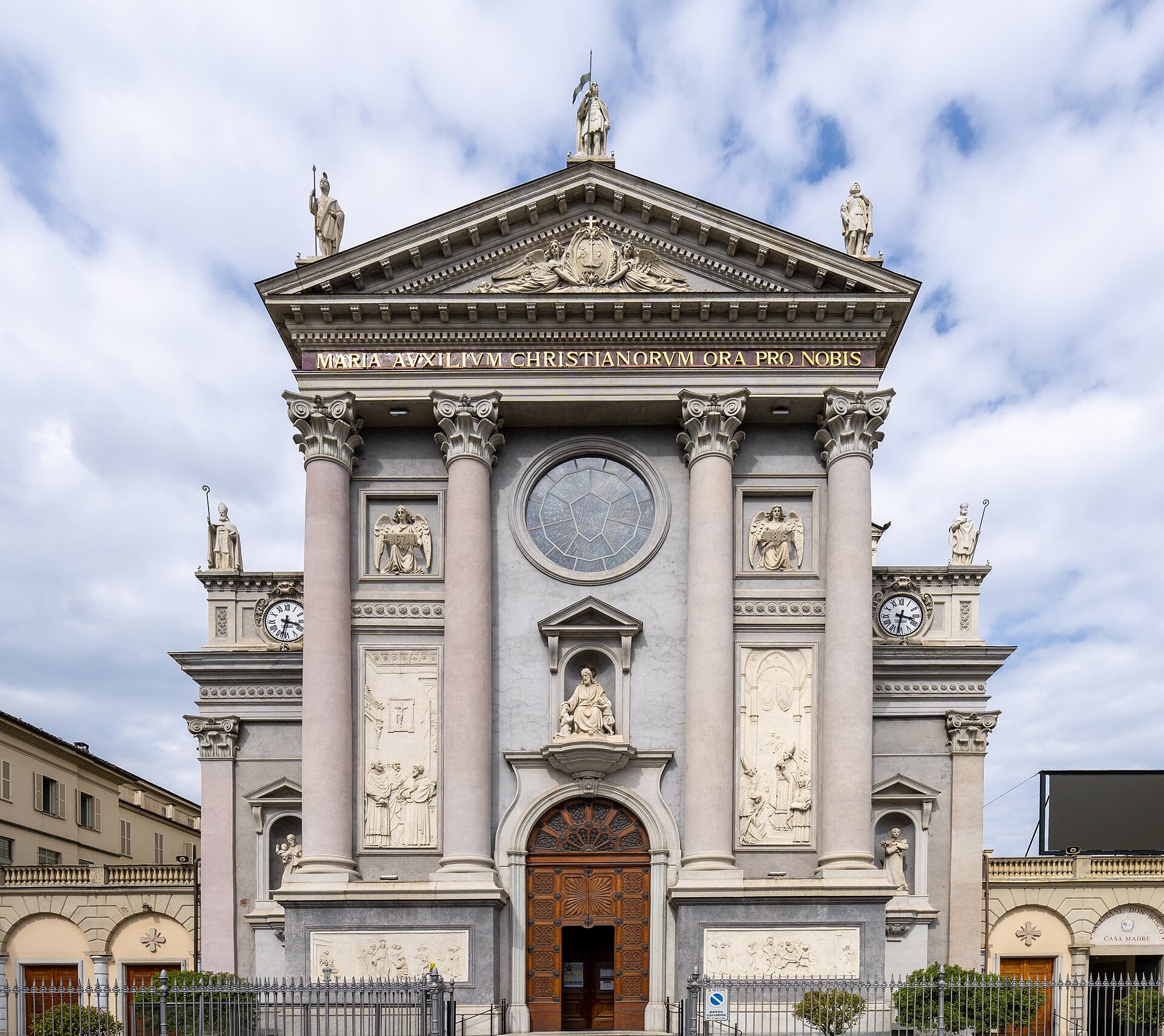
Basilica of Mary Help of Christians
Europe,
Italy,
citta,
Quadrilatero Romano
The Sanctuary of Mary Help of Christians in Turin is one of the most significant and symbolic places of worship in the city, closely linked to the figure of Saint John Bosco and the educational mission of the Salesians. The construction of the sanctuary was strongly desired by Don Bosco, who dedicated the building to the Virgin Mary under the title of “Help of Christians”. The works began in 1865 based on the design of the architect Antonio Spezia and were completed in 1868.
The sanctuary is located in the Valdocco district, an area historically linked to the work of Don Bosco, who founded the first oratory here for the education and support of poor and abandoned boys. The choice to dedicate the church to Mary Help of Christians reflects Don Bosco’s deep Marian devotion and his belief that the Madonna had a protective and guiding role in his mission.The architecture of the sanctuary is characterized by a neo-Palladian style. The imposing and harmonious facade is adorned with a series of Corinthian columns and a triangular pediment. At the top of the 60-meter high dome stands the golden statue of the Madonna, a work by Camillo Boggio, which seems to protect the entire city with her gaze.The interior of the basilica, with a single nave, is richly decorated with polychrome marbles and frescoes that contribute to creating an atmosphere of solemnity and devotion. The vault of the central nave is frescoed by Giuseppe Rollini, who depicted the Glory of the Virgin, a work that celebrates Mary’s role as queen of heaven and earth. The painting on the main altar, created by Tommaso Lorenzone in 1868, represents Mary Help of Christians with a composition that exalts the figure of the Madonna surrounded by angels and saints.In addition to the main altar, the interior of the church houses four other side altars. Upon entering, on the right is the altar dedicated to Saint Maria Mazzarello, co-founder of the Daughters of Mary Help of Christians, while opposite is the altar of Saint Dominic Savio, a young student of Don Bosco and protector of boys. Continuing down the nave, you will encounter the altar dedicated to Don Bosco, which houses the remains of the saint, and finally, the altar of Saint Joseph, the only one left as the founder wanted, with a painting depicting the basilica complex shortly after its construction.A particularly evocative aspect of the sanctuary is the Chapel of Relics, located in the crypt, accessible from the central nave. This space houses the remains of figures relevant to the history of the Salesians, including Giovanni Melchiorre Calosso, Michele Rua, and Filippo Rinaldi. Additionally, the chapel preserves a relic of the wood of the Holy Cross, adding to the spiritual significance of the place.The sanctuary is also known for its pipe organ, built by the Tamburini company in 1941 based on a design by Ulisse Matthey. The organ, equipped with 65 stops and three keyboards, is an instrument of great artistic and musical value, often used for concerts and liturgical celebrations.The connection between the sanctuary and the city of Turin is deeply rooted in history and local culture. The Piedmontese language poem “Maria Ausiliatris” by Nino Costa, dedicated to the church, reflects the popular sentiment and devotion that the people of Turin have towards this sacred place. The poem tells the story of an elderly mother who, afflicted by her children’s problems, goes to church every evening to entrust her prayers to the Madonna of Don Bosco.
Read More