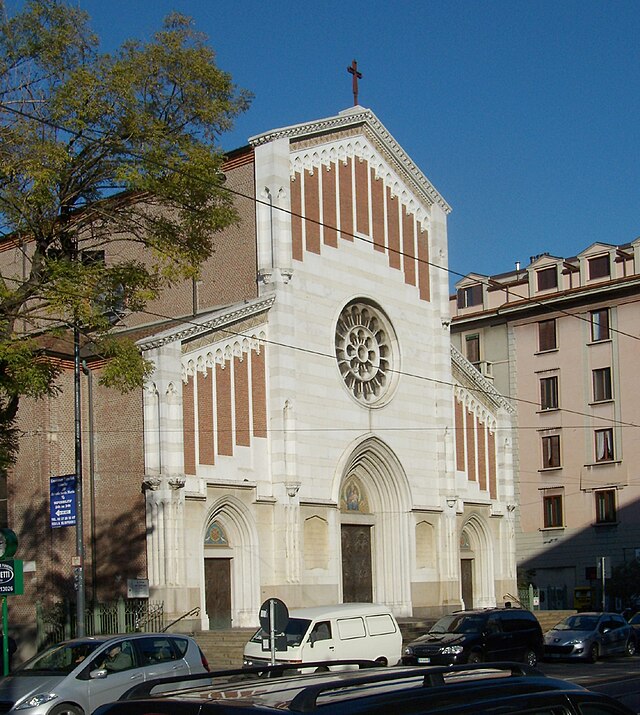
Church of Santa Maria del Suffragio
Europe,
Italy,
citta,
Porta Vittoria
The Church of Santa Maria del Suffragio in Milan, located in Corso XXII Marzo, is a remarkable example of neo-Romanesque architecture. Its construction began in 1894 and was completed in 1896 according to the design of architect Alfonso Parrocchetti. The church was commissioned by Archbishop Andrea Carlo Ferrari to replace the old church in the Calvairate district, which was no longer adequate for the needs of the growing population.
The facade of the church, imposing and richly decorated, is characterized by a wall facing in blocks of light stone with inserts of red bricks. This combination of materials gives the structure a robust yet elegant appearance. The three strombated pointed arch portals, with mosaic lunettes depicting the Madonna enthroned with the Child, created in 1927 by Spirito Maria Chiappetta, welcome the faithful and visitors with a sense of solemnity. The bronze portals, a work by Ercole Franz De Vecchi and inaugurated in 1996 by Cardinal Carlo Maria Martini, depict scenes from the life of Mary, the Annunciation, and the Holy Family.
Inside, the church has a Latin cross plan with three naves divided by round arches resting on polystyrene pillars in red bricks. The ribbed vaults covering the naves give the space a sense of elevation and spirituality. The octagonal lantern, illuminated by Romanesque triforia, overlooks the transept, creating a play of light and shadow that enriches the internal atmosphere.
Particularly noteworthy are the frescoes on the side walls of the presbytery, created by Aldo Carpi in 1946. These frescoes, depicting the Resurrection and the Crucifixion, are imbued with the artist’s personal experience in Nazi concentration camps, making the works full of emotional and spiritual intensity. The modern baptistery, located in the right transept, is a work by Ercole Franz De Vecchi and features a baptismal font in Carrara marble with bronze inserts, representing biblical scenes such as the Samaritan woman at the well and the Resurrection of Lazarus.
The presbytery, occupying the entire space of the choir and the polygonal apse, is adorned with modern sacred furnishings made of Carrara marble and bronze in 2006, on the occasion of the 110th anniversary of the consecration of the church. The ancient high altar, in neo-Romanesque style and decorated with reliefs by Leone Lodi, was moved to the chapel of San Proto. The chapel, built in 1933 to house the relics of the martyr saint, was renovated in 1984 and features a modern presbytery with wooden furnishings and a large crucifix.
Among the notable works of art are the alabaster statue Mater Misericordiae, the Paschal candlestick in marble, and the statue of Saint Anthony, all works by Leone Lodi. The statue of Saint Monica, in patinated terracotta, is instead a work by Valerio Pilon (1985).
The Tamburini pipe organ, located on the choir loft of the left transept, was rebuilt in 1988 using the sound material from the previous instrument of 1950. With three manuals of 61 notes each and a concave-radial pedalboard of 32 notes, the organ has a mixed transmission, mechanical for the manuals and pedal, and electrical for the stops and combinations.
Read More