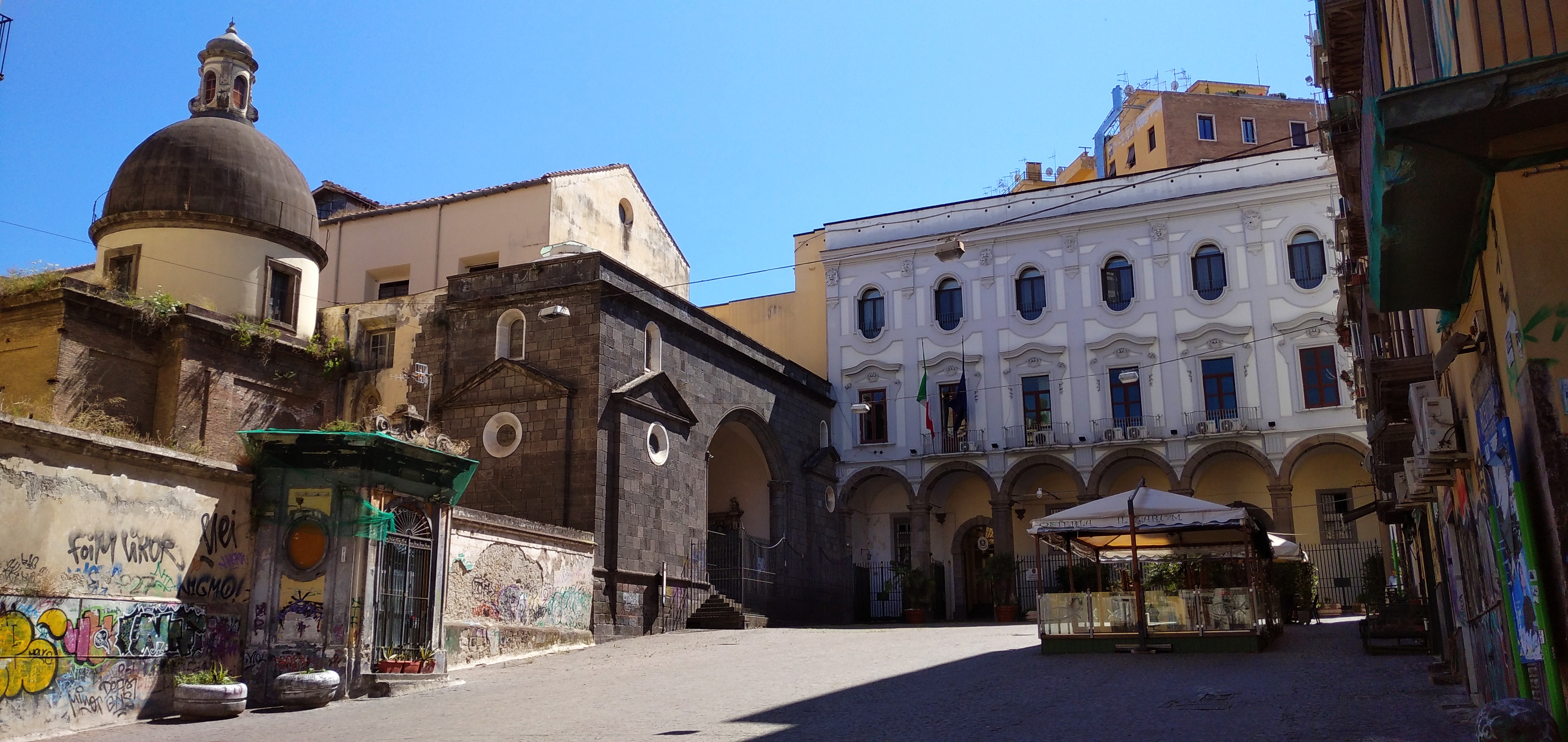
Church of Sant'Anna dei Lombardi
Europe,
Italy,
citta,
Montecalvario
The Church of Sant’Anna dei Lombardi, also known as Santa Maria di Monteoliveto, is a magnificent example of Tuscan Renaissance architecture in Naples. Founded in 1411 by Gurello Origlia, protonotary of King Ladislaus of Durazzo, the church was initially entrusted to the Olivetan fathers. Located in Piazza Monteoliveto, the complex is a treasure trove of artistic masterpieces and testifies to the rich cultural heritage of Naples.
The facade of the church, sober and elegant, leads to a surprising interior. The church has a Latin cross plan, with a central nave and several side chapels housing a series of Renaissance and Baroque artworks. The main altar, designed by Giovan Domenico Vinaccia and executed by Bartolomeo and Pietro Ghetti in the second half of the 17th century, is a magnificent example of Baroque splendor. Behind the altar, the 1591 tribune, a work by Giovan Battista Cavagna, is adorned with frescoes depicting stories of Saint Benedict.
Among the most significant works inside the church is the sculptural group “Lamentation over the Dead Christ” by Guido Mazzoni, a set of eight terracotta statues that intensely depict the grief of those present at the deposition of Christ. This masterpiece, located in the Holy Sepulchre Chapel, is one of the most significant examples of 15th-century sculpture.
The Vasari Sacristy is a true artistic gem. Frescoed by Giorgio Vasari in 1544, the vault of the sacristy is decorated with allegories of virtues, arranged in a pictorial cycle representing Faith, Eternity, and Religion. Each bay is surrounded by virtues and grotesques that add a touch of refinement and symbolic complexity. The wooden inlays by Fra Giovanni da Verona, framing the sacristy, contribute to creating an environment of extraordinary beauty and harmony.
The Correale Mastrogiudice Chapel, built in 1490, is another notable point of interest. Designed by Gerolamo D’Auria, the chapel features the use of colored marbles and houses the tomb of the Correale family. The marble altar, a work by Benedetto da Maiano, includes the high relief of the Annunciation between Saints John the Baptist and Evangelist and tondi with busts of Sibyls, elements that combine pagan and Christian motifs. On the altarpiece, one of the cherubs is attributed to a young Michelangelo Buonarroti, a detail that adds further prestige to the chapel.
The D’Avalos Chapel, with its barrel vault frescoed by Giovanni Antonio Ardito, is another example of Renaissance splendor. The frescoes depict stories from the New and Old Testament, creating an environment rich in spiritual and artistic significance.
The cloister of the complex, renovated by Giovanni Vincenzo Della Monaca and Giovan Battista Cavagna, offers a space of peace and contemplation. The enclosed nuns could enjoy views of the sea and the city thanks to the five belvederes built to make their seclusion less harsh. At the center of the cloister, a fountain with the marble group of Christ and the Samaritan at the well, attributed to Matteo Bottiglieri, adds a touch of serenity and beauty to the place.
Read More