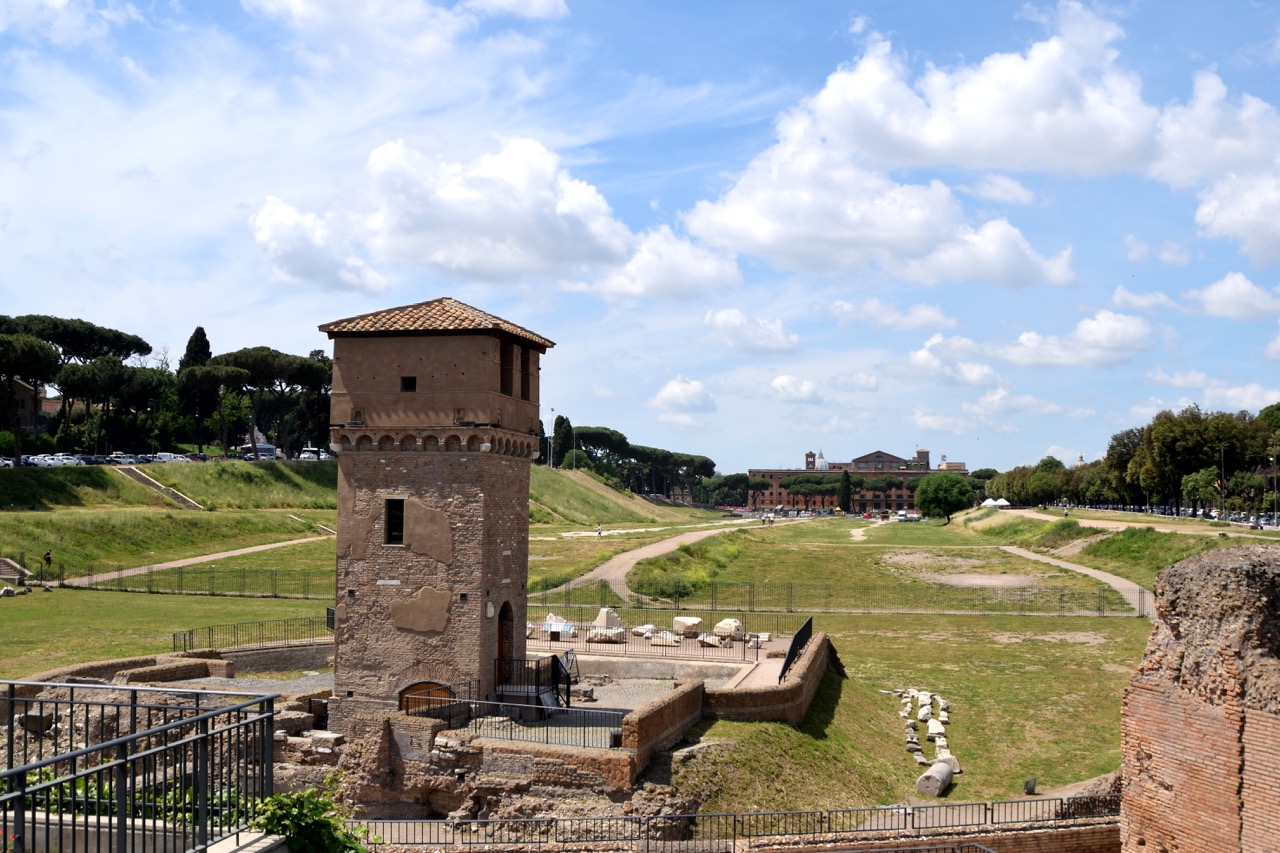
Circus Maximus
Europe,
Italy,
citta,
Rione XIX - Celio
The Circus Maximus is one of the most emblematic monuments of Rome, a place that has crossed millennia of history and has seen the city grow and transform around it. Located in the valley between the Palatine and the Aventine, this ancient Roman circus was the largest entertainment building ever built and one of the most important centers of public life in ancient Rome. Its history is rich in events, architectural changes, and anecdotes that make it a living testimony to the greatness and complexity of Roman civilization.
The origins of the Circus Maximus date back to the legend of the abduction of the Sabine women, a mythical episode that would have taken place right in this valley during the games organized by Romulus in honor of the god Consus. The valley, with its wide flat space near the Tiber River, was the ideal place for market activities, rituals, and socialization. The first structures of the circus were probably made of wood and movable, used for the great Roman Games organized by Tarquin the Elder in the 6th century BC.The transformation of the Circus Maximus into a permanent building began in 329 BC, with the construction of the first carceres, the starting gates for the chariot races. However, it was under Gaius Julius Caesar, in the 1st century BC, that the circus took its final form with masonry structures and permanent seating. Caesar also built a central spine, decorated with various monuments, statues, and two Egyptian obelisks brought to Rome later: the Flaminio obelisk, moved in the 16th century to Piazza del Popolo, and the Lateran obelisk, now at the Basilica of St. John Lateran.The Circus Maximus underwent numerous restorations and expansions during the imperial era. Augustus added another order of seats and further embellished the spine, while Tiberius, Nero, and Trajan contributed with additional structural and decorative improvements. Trajan, in particular, completed the reconstruction of the circus after a devastating fire under Domitian. During the reign of Titus, a monumental arch was erected in the center of the curved side, with three arches and decorated with a bronze quadriga, adding grandeur to the main entrance of the circus.The structure of the Circus Maximus was impressive: 600 meters long and 140 meters wide, it could accommodate between 260,000 and 300,000 spectators, making it the largest entertainment building ever built. The cavea, the area designated for spectators, was divided into three tiers and rested on a complex masonry structure that housed passages, stairs, and service areas. The arena was surrounded by an euripus, a canal almost three meters wide, which was later removed to increase capacity.Chariot races were the main event at the Circus Maximus. Twelve quadrigas, each drawn by four horses, completed seven laps around the central spine, decorated with statues, shrines, and temples. The laps were counted using seven eggs and seven dolphins placed on the spine. The carceres, located on the straight side towards the Tiber, were arranged obliquely to allow for proper alignment at the start and equipped with a mechanism for simultaneous opening.The Circus Maximus was not only the venue for chariot races, but also for other public events and rituals. During the Ludi Apollinares of 212 BC, organized by Publius Cornelius Sulla, the first games were held here. The building remained in use until the last races organized by Totila in 549 AD, after which a slow decline began. In the Middle Ages, the area became agricultural and was occupied by utilitarian constructions, such as the Jewish cemetery in 1645 and the gasometer in 1852.Today, the Circus Maximus is an archaeological area and a green space open to the public, used for large events and manifestations. Despite the passage of time and transformations, the ancient layout is still recognizable. The Capitoline Superintendence for Cultural Heritage has undertaken several restoration projects to preserve and enhance this extraordinary monument. In 1959, the Circus Maximus was supposed to host the filming of the chariot race scene for the movie “Ben Hur”, but the Superintendence refused the authorization and the set was moved to the Circus of Maxentius on the Via Appia Antica.
Read More