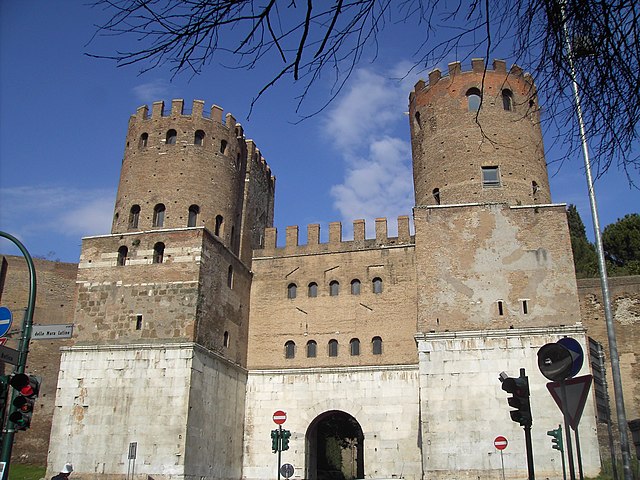
Museum of the Walls
Europe,
Italy,
citta,
Rione XIX - Celio
The Museum of the Walls, located near Porta San Sebastiano in Rome, offers a fascinating journey through the history of the city’s defensive walls, in particular the Aurelian Walls, built between 270 and 275 AD by Emperor Aurelian to protect Rome from barbarian invasions. Inaugurated in 1990, the museum occupies one of the best-preserved monumental entrances of the walls and presents an exhibition path that illustrates the evolution of Roman fortifications through educational panels, models, dioramas, and archaeological finds.
The museum tour begins in the western tower of Porta San Sebastiano, where there is a educational room with a mosaic created between 1940 and 1943, depicting a tiger capturing two deer in a wooded environment. This room is equipped with videos and screens for projections, offering a multimedia introduction to the history of the walls.Going up to the first floor, visitors find the room that connects the side towers, decorated with panels describing the pomerium, the oldest section of the walls, and the Aurelian Walls. Here, the reasons for the construction of the walls, building techniques, different types of gates, and military defense strategies are illustrated. A two-tone mosaic on the floor represents a commander on horseback surrounded by soldiers, dating back to the 1940s.The visit continues in the east tower, where four dioramas reconstruct the walls and a map of Rome shows the entire circuit of fortifications. A small room in the west tower displays panels on the architectural phases of Porta San Sebastiano and other Roman gates, while another room in the same tower includes models of the gates and informative panels on the Appian Way.On the second floor, above the entrance arch, the central room displays panels on the medieval and modern history of the walls, describing the restoration and modification interventions carried out between the 16th and 20th centuries. The east tower houses the diorama of the Ardeatine Bastion, designed by Antonio da Sangallo the Younger to strengthen the walls. On the walls, remains of charcoal drawings are visible, perhaps sketches for the decoration of Porta San Sebastiano made on the occasion of the passage of Charles V in 1536.The terrace and walkway of the walls are directly accessible from room VII of the museum, offering a unique panoramic view of the surroundings and allowing visitors to walk about 350 meters of restored walls for the Jubilee of 2000. Along the walkway, remains of the original pavement and a lunette decorated with a Madonna and Child are visible, evidence of the use of the walls as a hermitage in later periods.
Read More