Non-Catholic Cemetery
Europe,
Italy,
citta,
Rione XX - Testaccio
The Non-Catholic Cemetery of Rome, also known as the Protestant Cemetery, is a place of extraordinary beauty and tranquility, located in the Testaccio district, next to the majestic Pyramid of Caius Cestius and a section of the ancient Aurelian Walls. Founded in the early 18th century, it is one of the oldest continuously used cemeteries in Europe, created to provide a dignified burial for non-Catholics who died in Rome. This cemetery is a place of great historical, artistic, and cultural importance, hosting the tombs of numerous distinguished figures from around the world.
The history of the Non-Catholic Cemetery begins in 1716, when Pope Clement XI granted permission for the burial of Protestants in a plot of land next to the Pyramid of Caius Cestius. This permission was granted following a request from the English king James III Stuart. Before this date, papal laws prohibited the burial of non-Catholics in consecrated ground, forcing many foreigners to seek burial outside the city limits or in unsuitable places. In 1821, the Pope authorized the use of an area adjacent to the original site, which was later expanded to its current size in 1894.
The cemetery is famous for being the final resting place of numerous poets and artists, including John Keats and Percy Bysshe Shelley. John Keats, the young English Romantic poet, arrived in Rome in 1820 hoping that the mild climate would alleviate his tuberculosis. However, he died a few months later, in February 1821, at the age of only 25. His tomb, located in the oldest part of the cemetery, bears the epitaph he himself wanted: “Here lies One Whose Name was writ in Water,” a bitter reflection on the brevity of his life and the desire to be remembered.
Percy Bysshe Shelley, another English Romantic poet and great admirer of Keats, is buried nearby. Shelley tragically died in 1822 in a shipwreck off the Italian coast. His ashes were buried in the cemetery next to Keats’ tomb, in a place he had described as “so sweet a resting place that it makes one in love with death.” His gravestone bears the inscription “Cor cordium” (“heart of hearts”) and a quote from Shakespeare’s “The Tempest.”
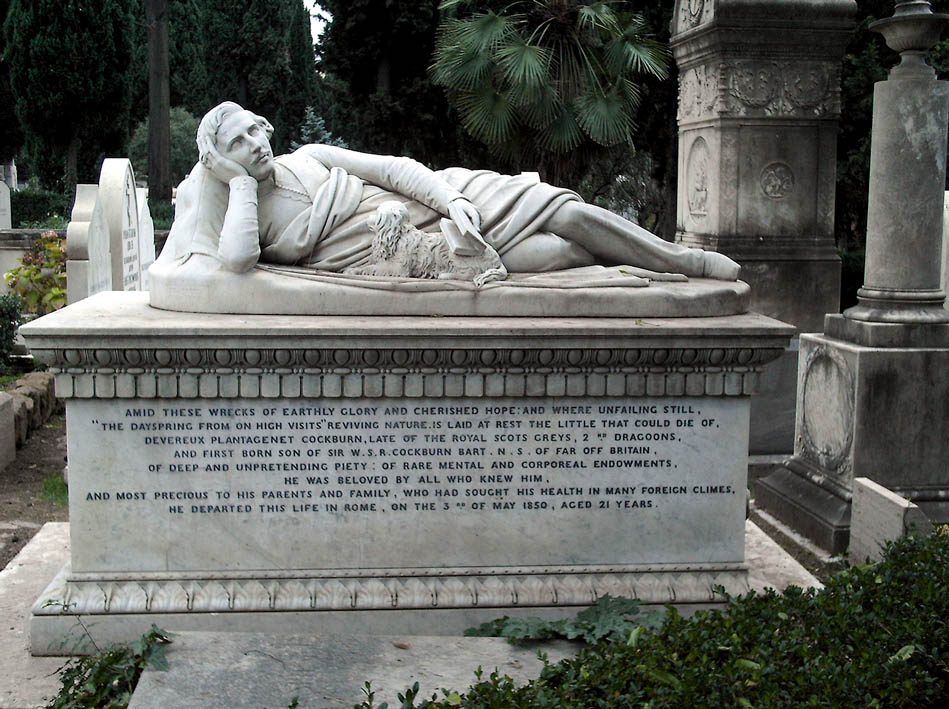
Among the other distinguished figures buried here are Antonio Gramsci, the founder of the Italian Communist Party, and many other artists, diplomats, writers, and scientists of various nationalities and faiths. The cemetery is a veritable open-air museum, with tombs and monuments reflecting a wide variety of artistic styles, from simple gravestones to complex sculptural monuments.
A notable example is the “Angel of Grief” by William Wetmore Story, a touching work that adorns the sculptor’s own tomb and that of his wife. The sculpture depicts an angel kneeling in grief and is considered one of the most moving works in the cemetery. Another significant monument is that of Rosa Bathurst, a young English girl who died in a tragic horse accident in the Tiber River at the age of only 16. Her tomb, adorned with a detailed inscription telling her story, is a poignant reminder of her short life.
Read More