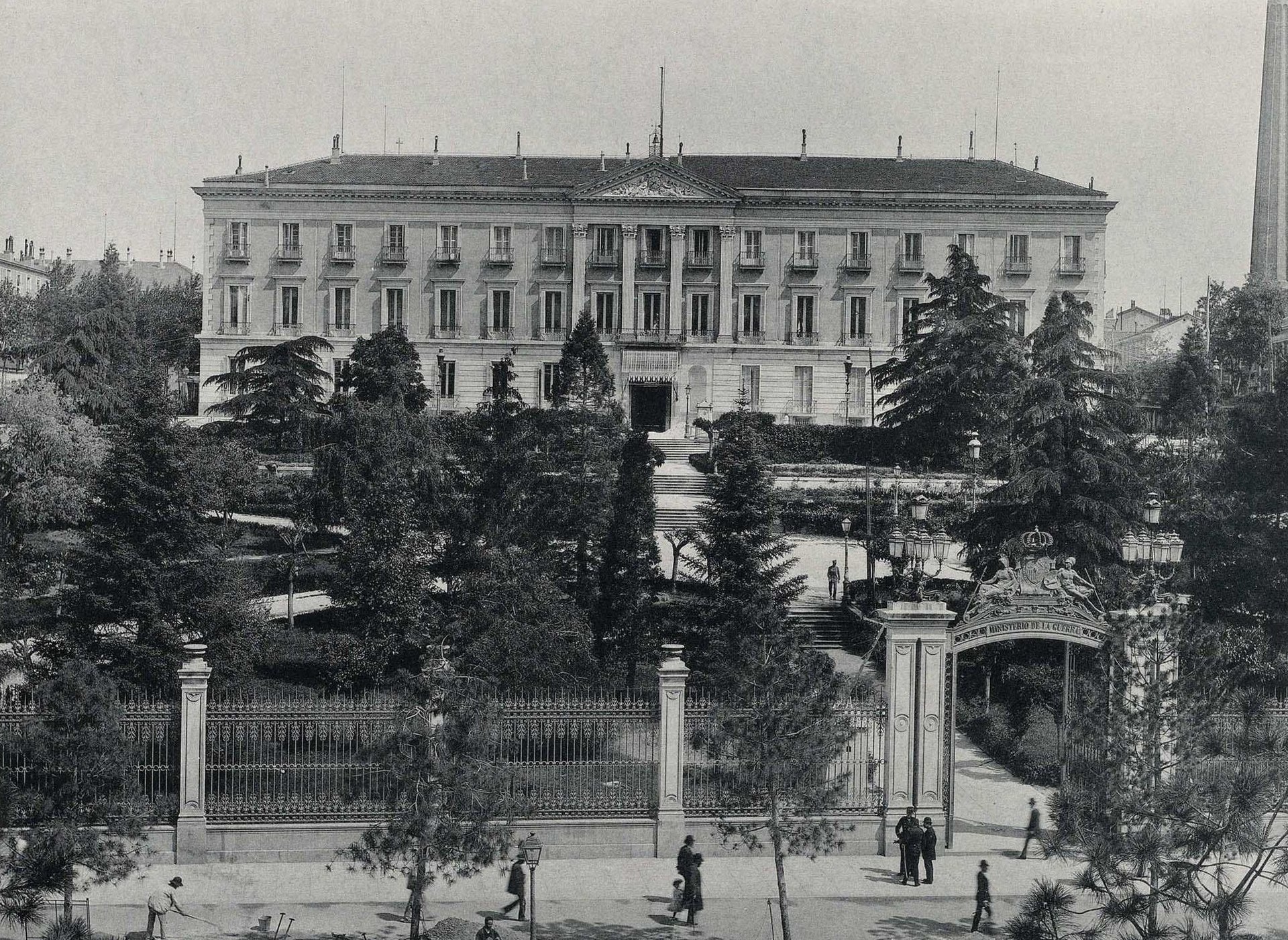
Palace of Buenavista
Europe,
Spain,
citta, Madrid,
Centro
Near the famous Plaza de Cibeles stands the majestic Palacio de Buenavista, a building that represents an important testimony of Spain’s aristocratic and military history. This palace, which now houses the Headquarters of the Spanish Army, boasts a rich and fascinating history, characterized by numerous changes of ownership and architectural transformations.
The site on which the Palacio de Buenavista stands was originally a residence for the Archbishop of Toledo, Gaspar de Quiroga, who donated it to Philip II when he decided to move the court to Madrid, making it the permanent capital of the kingdom. Subsequently, the land passed into the hands of different owners until Isabel de Farnesio, widow of Philip V, established her residence there until her death in 1766. In 1770, Fernando de Silva y Álvarez de Toledo, XII Duke of Alba, purchased the property and commissioned the architect Ventura Rodríguez to redesign the gardens in French style. However, the work was not completed and it was only his niece, María del Pilar Teresa Cayetana de Silva y Álvarez de Toledo, XIII Duchess of Alba, who commissioned the construction of the current palace to the architect Juan Pedro Arnal in 1777.The Palacio de Buenavista, as we know it today, is a perfect example of neoclassical architecture with Italian and French influences. The main facade, facing north, is characterized by a sober elegance and harmonious proportions, reflecting the status and sophistication of the House of Alba. Inside, the palace housed a collection of priceless art, including masterpieces such as Velázquez’s “Venus at her Mirror” and Raphael’s “Madonna Alba,” which are now respectively located at the National Gallery in London and the National Gallery of Art in Washington.In 1802, after the death without direct heirs of the XIII Duchess of Alba, the palace passed into the hands of the House of Berwick and shortly after, in 1807, it was expropriated and donated to Manuel Godoy, the powerful minister of Charles IV. Godoy undertook renovation works, but never resided there. Subsequently, the palace was confiscated and returned to the crown.During the reign of Joseph Bonaparte, the palace was intended to become the Museum of Royal Paintings, the future Prado Museum. However, with the fall of Bonaparte, the project was abandoned and in 1816 the palace was handed over to the Spanish army, becoming the headquarters of the Ministry of War in 1847. Since then, the palace has undergone numerous expansion and restoration works, including the addition of a fourth floor.The garden of the Palacio de Buenavista, which extends over a green area elevated above the street, is another element of great charm. Originally designed by Ventura Rodríguez, the garden still retains its neoclassical structure with geometric flower beds and well-kept pathways. This oasis of tranquility in the center of Madrid offers a panoramic view of the city and represents a perfect example of Italian-influenced gardening with French style. The evolution of the Palacio de Buenavista, from aristocratic residence to institutional headquarters, reflects the social and political transformations that have marked the history of Madrid and Spain. Its preservation as the Headquarters of the Army ensures that this monument continues to be a living symbol of the past, harmoniously integrating into the contemporary life of the city.
Read More