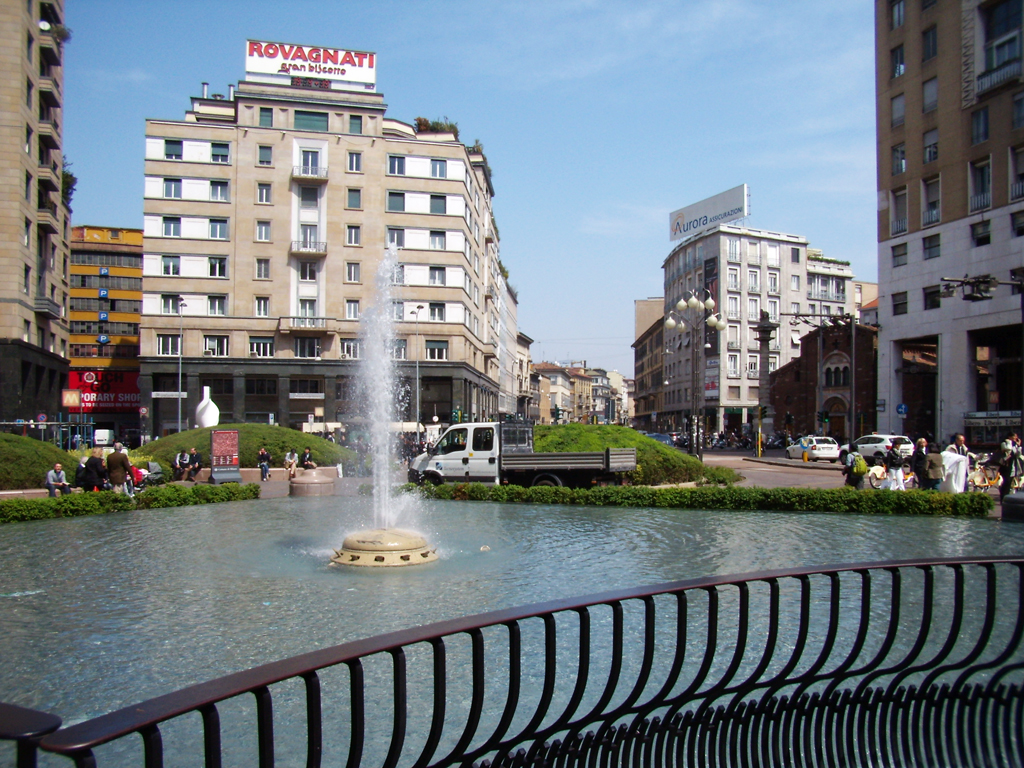
Saint Babila Square
Europe,
Italy,
citta,
Centro Storico
Piazza San Babila, located in the heart of Milan, is a place that encapsulates centuries of history and urban transformations. This square, named after the nearby Basilica of San Babila, is one of the nerve centers of the city, connecting the historic center with the modern and commercial district of Corso Vittorio Emanuele II.
The history of Piazza San Babila dates back to Roman times, when the area was part of the most prestigious district of Mediolanum, ancient Milan. The square’s name comes from the homonymous basilica, one of the oldest churches in the city, built in the 9th century and dedicated to San Babila, bishop of Antioch. The basilica, with its Romanesque bell tower, is an important testimony to Milan’s religious history.During the Middle Ages, the area around Piazza San Babila was a lively center of trade and craftsmanship. With the advent of the Renaissance and later the modern era, the square underwent numerous changes, reflecting the architectural and urban evolution of Milan. In the 19th century, with the Unification of Italy, the area became a reference point for the city’s development, thanks to its strategic location near Corso Vittorio Emanuele II, one of Milan’s main commercial arteries.The square, as we know it today, took shape during the 20th century, with a series of urban interventions that redesigned the area. In the 1930s, architect Piero Portaluppi designed the Palazzo del Toro, a monumental rationalist-style building that dominates the square with its grandeur and clean lines. This building, which houses offices and commercial spaces, is an emblematic example of Milanese modern architecture.In the 1950s and 1960s, Piazza San Babila became a symbol of Milan’s economic and cultural revival. It was during this period that the area was further developed, with the construction of new buildings and the creation of pedestrian spaces. The square became a meeting point for Milanese people, a place to shop, meet, and enjoy the vibrant atmosphere of the city.A distinctive feature of Piazza San Babila is the central fountain, designed by architect Luigi Caccia Dominioni and inaugurated in 1997. This fountain, with its minimalist design and geometric lines, has become a symbol of the square and a reference point for visitors. The flowing water creates a pleasant background sound that helps make the environment welcoming and relaxing.Piazza San Babila is also an important hub for Milan’s public transport. The San Babila metro station, located on the red line (M1), is one of the busiest in the city, quickly connecting the square to other areas of Milan. This makes Piazza San Babila an essential transit point for anyone moving around the city.The square is surrounded by historic and modern buildings housing luxury shops, offices, restaurants, and cafes. Among these, the Palazzo Durini, an elegant 17th-century building, and the modern Rinascente building, one of Milan’s most important department stores, overlooking Corso Vittorio Emanuele II. This combination of historical and contemporary elements creates a unique environment where tradition and modernity harmoniously meet.From a cultural perspective, Piazza San Babila has always played a central role in the city’s life. In the 1960s and 1970s, the square was a reference point for young people and cultural movements, a meeting place for artists, intellectuals, and musicians. Even today, the square continues to be a lively and dynamic place, hosting cultural events, demonstrations, and artistic performances.An interesting anecdote concerns the origin of the name “San Babila.” According to legend, during the Middle Ages, the square was frequented by a colony of “babbioni,” a species of monkeys said to have been brought to Milan by the Crusaders. This bizarre anecdote, although probably a product of popular imagination, adds a touch of curiosity to the square’s history.
Read More