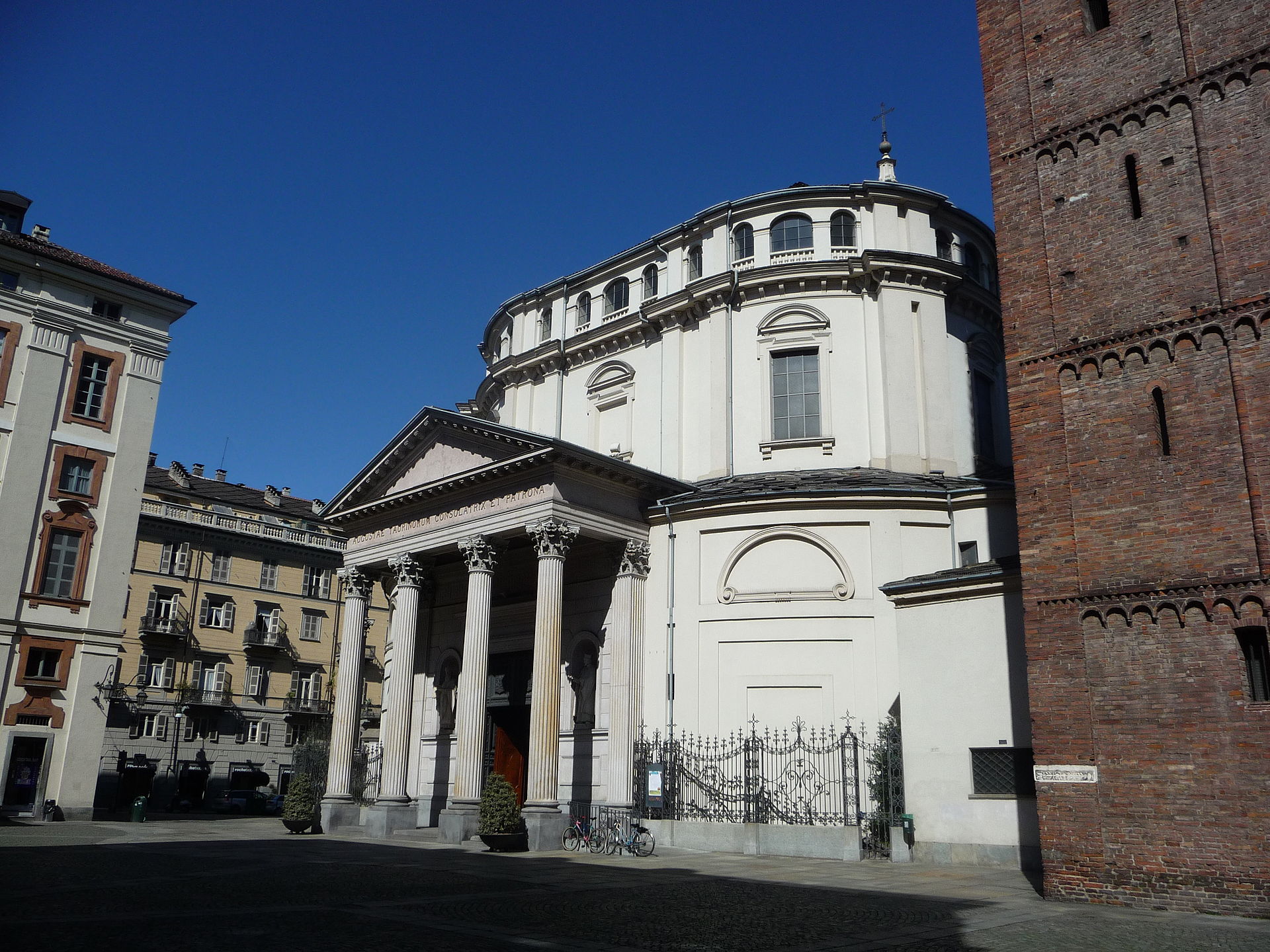
Sanctuary of the Consolata
Europe,
Italy,
citta,
Quadrilatero Romano
The Sanctuary of the Consolata in Turin, affectionately known as “La Consolata” by the people of Turin, is a place of worship of extraordinary historical and spiritual importance. Located in the heart of the city, the sanctuary is dedicated to the Madonna Consolatrice, a figure deeply revered by the faithful of Turin.
The origins of the sanctuary date back to the 10th century, when a church dedicated to Saint Andrew stood on the current site. From that period, the Romanesque bell tower and the underground chapel of the Madonna delle Grazie remain. The church underwent numerous transformations and expansions over the centuries, reflecting the evolution of architecture and Marian devotion.One of the most significant events in the history of the sanctuary occurred in 1678, when the Royal Madama Maria Giovanna Battista di Savoia-Nemours commissioned a complete renovation of the building to the architect Guarino Guarini. Guarini transformed the church into a splendid example of Baroque architecture, characterized by an elliptical plan and a new hexagonal chapel intended to house the venerated icon of the Madonna Consolatrice. Guarini’s intervention, completed in 1703, defined the current forms and layout of the sanctuary.Filippo Juvarra, another architect of great talent, further contributed to the magnificence of the sanctuary between 1729 and 1740. Juvarra added an oval presbytery to accommodate the new high altar and reworked the dome, enriching the interior with Baroque decorations. Juvarra’s altar, with two white marble angels sculpted by Carlo Antonio Tantardini, is one of the focal points of the sanctuary, emphasizing the centrality of Marian devotion.The sanctuary experienced difficult moments, especially during the Napoleonic period, when it was transformed into a military barracks. After Napoleon’s fall in 1815, the church was entrusted to the Oblates of the Virgin Mary, who oversaw its reconstruction and preservation. Another important architectural intervention was led by Carlo Ceppi between 1899 and 1904, adding four chapels and completing the current appearance of the sanctuary.A miraculous event is associated with the history of the sanctuary: in 1104, a blind man named Giovanni Ravacchio claimed to have rediscovered the icon of the Madonna Consolatrice thanks to a vision. After recovering the icon, it is said that the man regained his sight, a miracle that significantly increased popular devotion to the Madonna Consolatrice and helped transform the church into a Marian sanctuary.The interior of the sanctuary is a riot of colors and Rococo decorations, with polychrome marbles and twisted columns creating an atmosphere of solemn beauty. The dome, frescoed by Giovanni Battista Crosato, adds another level of magnificence to the interior. The side chapels, designed by Carlo Ceppi, house relics and altars dedicated to various saints, making the sanctuary a place of deep spirituality and prayer.The Sanctuary of the Consolata is not only a place of worship, but also a center of community life and religious events. Every year, on June 20th, a procession in honor of the Madonna Consolatrice takes place, during which the icon is carried through the streets of Turin, attracting thousands of faithful. This event, along with the numerous masses and celebrations that regularly take place in the sanctuary, testifies to the continued relevance of the sanctuary in the religious and social life of the city.
Read More