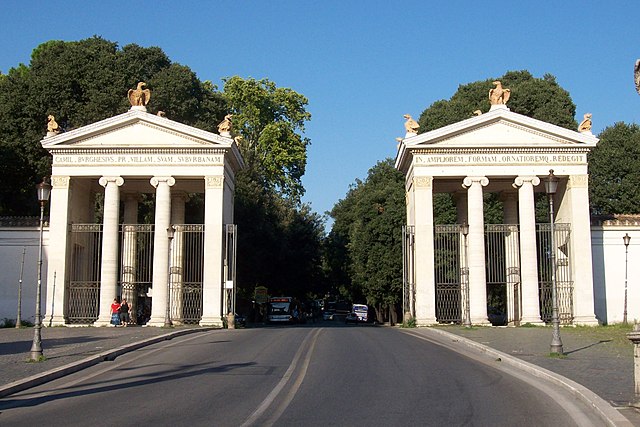
Villa Borghese
Europe,
Italy,
citta,
Rione XVI - Ludovisi
Villa Borghese, one of the largest and most charming parks in Rome, is a true green gem located in the heart of the city. This immense public garden, spanning about 80 hectares, offers a unique combination of natural beauty, artworks, history, and culture. The history of Villa Borghese dates back to the 17th century, when Cardinal Scipione Borghese, nephew of Pope Paul V, purchased the land to create a monumental park that would celebrate the power and wealth of his family.
The villa’s project was entrusted to the architect Flaminio Ponzio, who transformed the agricultural land into a splendid Italian garden, enriched with fountains, statues, and pavilions. The heart of the park is the magnificent Borghese Gallery, a palace built to house the cardinal’s private art collection. The gallery, completed in 1633, is one of the most important museums in Rome, featuring works by artists such as Caravaggio, Bernini, Raphael, and Titian. Among the most famous masterpieces in the Borghese collection are Bernini’s “Apollo and Daphne,” Titian’s “Sacred and Profane Love,” and Caravaggio’s “Boy with a Basket of Fruit.”
In addition to the Borghese Gallery, the park is home to numerous other buildings and monuments of great interest. Among these is the Casino Nobile, also known as Villa Pinciana, designed by Giovanni Vasanzio and housing some of the most significant works from the Borghese collection. The Aviary Casino, a small pavilion used as a birdcage, and the Temple of Aesculapius, an elegant neoclassical temple located on an artificial island in the park’s lake, are other must-see attractions.
Villa Borghese is also a place of great botanical importance. The park is a perfect example of an Italian garden, with tree-lined avenues, flower beds, and well-kept lawns. The park’s flora includes a wide range of species, from centuries-old oaks to maritime pines, from holm oaks to olive trees, creating a natural environment that provides refuge for numerous bird species and other wildlife. The arrangement of plants and trees, along with the presence of numerous fountains and ponds, helps create an atmosphere of tranquility and beauty.
The park is an ideal place for walks, picnics, and outdoor activities. Visitors can rent bicycles or rickshaws to explore the park, or simply relax on a bench in the shade of the trees. Villa Borghese also offers numerous opportunities for sports, with tennis courts, running tracks, and playground areas for children.
Another attraction of Villa Borghese is the Bioparco di Roma, one of the oldest zoos in Italy. Founded in 1911, the Bioparco is home to a wide range of animals from around the world, from big cats to elephants, from monkeys to exotic birds. The Bioparco is committed to the conservation of endangered species and environmental education, offering visitors a unique opportunity to learn more about the fauna of our planet.
The park also houses the Carlo Bilotti Museum, located in the Orangery of Villa Borghese, which displays a collection of contemporary art donated by entrepreneur and collector Carlo Bilotti. The museum includes works by artists such as Giorgio de Chirico, Gino Severini, and Andy Warhol. The park also hosts the Casa del Cinema, a cultural center dedicated to the seventh art, where screenings, exhibitions, and meetings with directors and actors are held.
An interesting anecdote concerns the Fountain of the Seahorses, located near the entrance of Piazzale Flaminio. The fountain, built in 1791 by architect Cristoforo Unterperger, is decorated with four seahorses emerging from the waves. Legend has it that the fountain was inspired by a dream of Cardinal Borghese, in which he saw seahorses dancing in the waters of the Tiber.
Read More