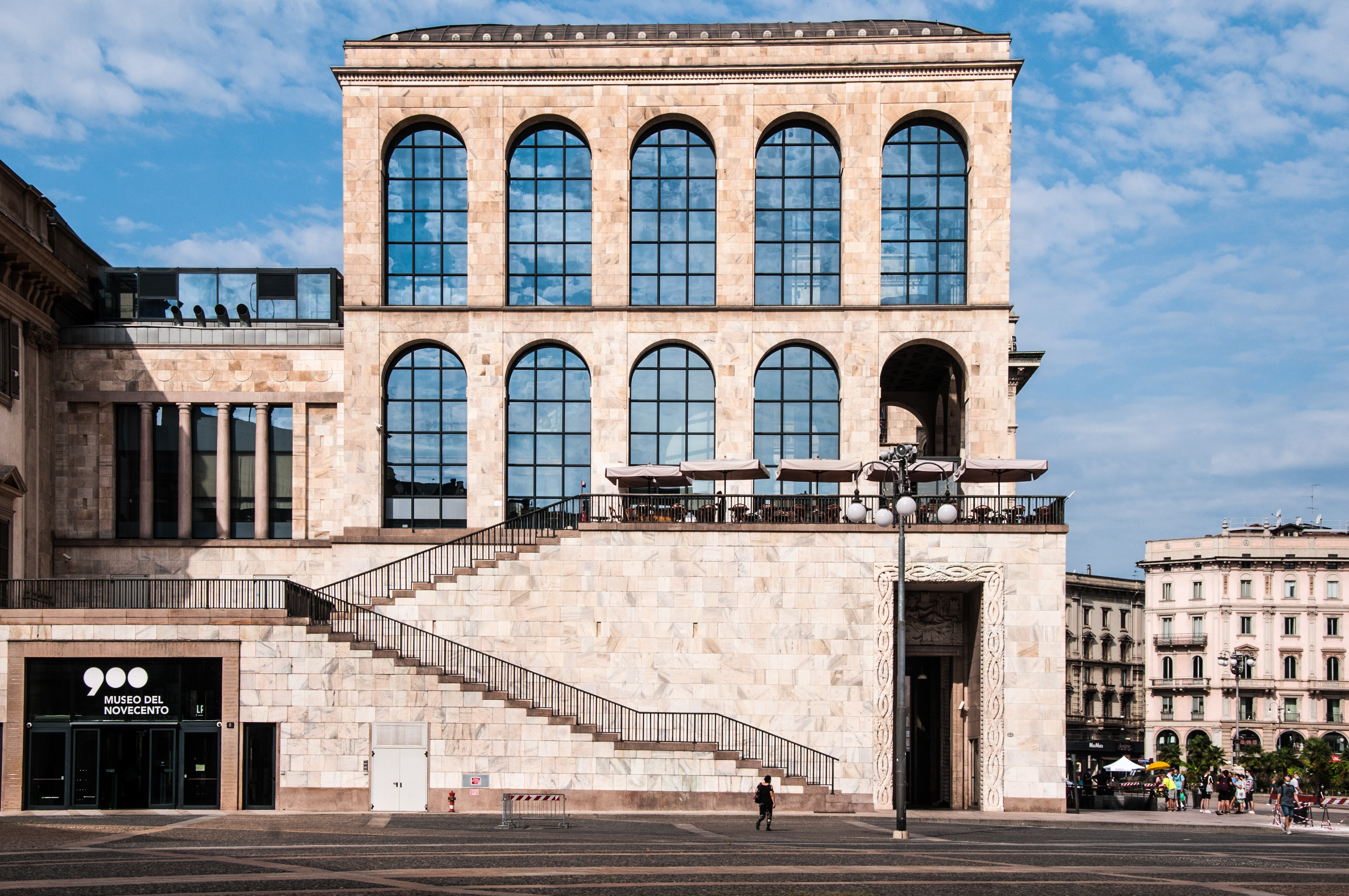
Museum of the Twentieth Century
Europe,
Italy,
citta,
Centro Storico
The Museum of the Twentieth Century in Milan is one of the city’s most important cultural institutions, dedicated to Italian art of the 20th century. Inaugurated in December 2010, the museum is located in the Arengario Palace, in Piazza del Duomo, a historic building that has been completely renovated to house an extraordinary collection of modern and contemporary art. This museum not only celebrates 20th-century art, but also offers an overview of the historical, social, and political context that influenced the artists and their works.
The history of the Museum of the Twentieth Century is closely linked to Milan’s desire to establish itself as a cultural and artistic capital. The project to create a museum dedicated to 20th-century art dates back to the 1980s, but it was only with the beginning of the new millennium that the idea took concrete form. The choice of the Arengario Palace, a building designed in the 1930s by architects Griffini, Magistretti, Muzio, and Portaluppi, allowed for the harmonious integration of the museum into the urban fabric of Milan’s historic center.
The museum’s layout, curated by architect Italo Rota, was designed to maximize the display of the exhibited works and to create a fluid and engaging exhibition path. The museum’s rooms follow a chronological and thematic path, starting from the early 20th century with the historical avant-gardes and reaching the most recent trends in contemporary art. Among the represented artists are prominent names such as Umberto Boccioni, Giacomo Balla, Giorgio de Chirico, Lucio Fontana, and Piero Manzoni.
One of the museum’s most famous masterpieces is “The Fourth Estate” by Giuseppe Pellizza da Volpedo, an iconic work representing the march of a group of workers and symbolizing the social and political struggles of the early last century. This painting, located at the entrance of the museum, introduces visitors to a journey through the cultural and artistic transformations of the 20th century.
The exhibition path continues with the works of Futurism, an artistic and cultural movement that originated in Italy at the beginning of the 20th century. Among the exhibited works, those of Umberto Boccioni stand out, such as “Unique Forms of Continuity in Space,” a sculpture representing dynamism and speed, central themes of Futurism. The works of the Futurists, with their vibrant colors and dynamic forms, testify to the desire to break with the past and celebrate modernity and progress.
Another significant section of the museum is dedicated to Arte Povera, an artistic movement of the 1960s and 1970s that revolutionized the concept of artwork, using poor and recycled materials to create installations and sculptures. Among the artists represented in this section are Michelangelo Pistoletto, with his famous “Mirror Paintings,” and Jannis Kounellis, known for his works combining natural and industrial elements.
The museum also houses a rich collection of works by Lucio Fontana, one of the most influential artists of the 20th century and founder of the Spatialist movement. His famous “Spatial Concepts,” monochrome canvases cut with a decisive gesture, reflect on the spatiality and materiality of the artwork. Fontana’s works, with their radical simplicity and expressive force, are one of the museum’s strengths.
The collection of the Museum of the Twentieth Century also includes works by international artists, demonstrating Milan’s openness to global artistic trends. Among these, the works of Pablo Picasso, Wassily Kandinsky, and Piet Mondrian stand out, offering a comparison between Italian art and European avant-gardes.
Read More