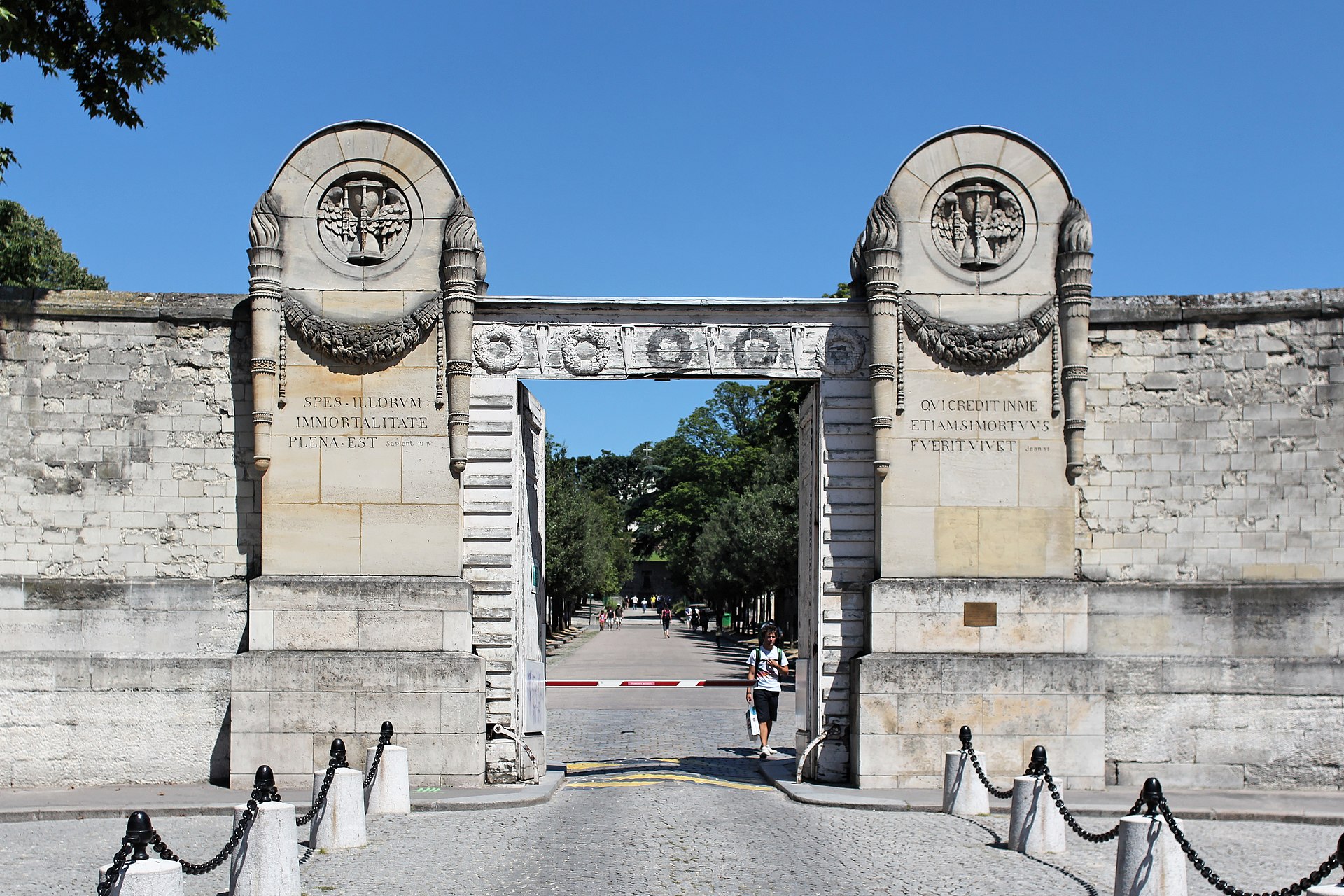
Père-Lachaise Cemetery
Europe,
France,
citta,
XX arrondissement
The Père-Lachaise Cemetery, inaugurated in 1804, is the largest cemetery in Paris and one of the most famous in the world. Located in the 20th arrondissement, it covers 44 hectares and houses over 70,000 tombs, making it a place of eternal rest for many of the most famous personalities in history. Its foundation was a response to the need to create new burial spaces outside the city center, as the Parisian cemeteries were overcrowded and a source of hygienic concerns.
The cemetery is named after François d’Aix de La Chaise, known as Père La Chaise, the confessor of Louis XIV, who lived in the house that once stood on the site. The project was entrusted to the architect Alexandre-Théodore Brongniart, whose design envisioned a garden cemetery with wide tree-lined avenues, flower beds, and commemorative sculptures, inspired by English cemeteries. This innovative approach transformed Père-Lachaise into a place of beauty and serenity, intended not only to be a burial place but also a public space for reflection and strolling.
From a historical perspective, Père-Lachaise has undergone many transformations and played a significant role in the history of Paris. During the French Revolution, Parisian cemeteries were suppressed and many remains were transferred to the catacombs. With the founding of Père-Lachaise, the cemetery quickly became a symbol of the new era, welcoming the remains of illustrious figures such as the poet Jean de La Fontaine and the playwright Molière, whose bones were transferred here to enhance the prestige of the place.
The cemetery is known for its extraordinary collection of monumental tombs and funerary art. Among these, the tomb of Oscar Wilde stands out, the famous Irish writer, whose burial is marked by a huge sphinx sculpted by Jacob Epstein. Wilde’s tomb was covered for years with kisses left by fans with lipstick, a tradition that led the authorities to install a glass barrier to protect it.
Another significant monument is the tomb of Jim Morrison, the legendary singer of The Doors, who died in Paris in 1971. His tomb, simple but frequently visited, has become a pilgrimage site for fans from around the world. The inscription on the tombstone, “ΚΑΤΑ ΤΟΝ ΔΑΙΜΟΝΑ ΕΑΥΤΟΥ” (“True to his own spirit”), reflects the rebellious soul of the singer.
Père-Lachaise also houses the tombs of other illustrious personalities such as Edith Piaf, the legendary French singer, and Marcel Proust, the author of “In Search of Lost Time.” Both are buried in tombs that attract visitors eager to pay homage to their cultural idols.
The cemetery is divided into 97 sections, each with its unique characteristics and stories to tell. A visit to Père-Lachaise can be a true artistic and historical exploration, with tombs ranging from neoclassical to Gothic to modern. Some of the most notable monuments include the chapel of Héloïse and Abelard, the famous medieval lovers whose story has been passed down as a sort of French Romeo and Juliet. Their tomb, adorned with sculptures depicting them together, symbolizes eternal love.
From a political perspective, Père-Lachaise has been the scene of significant historical events, such as the battle of the Paris Commune in 1871. The fighting between the Communards and government forces culminated in the so-called “week of blood,” during which many Communards were killed and buried in the cemetery. The wall of the Fédérés, where the Communards were shot, is now a memorial that commemorates this tragic episode in French history.
Read More