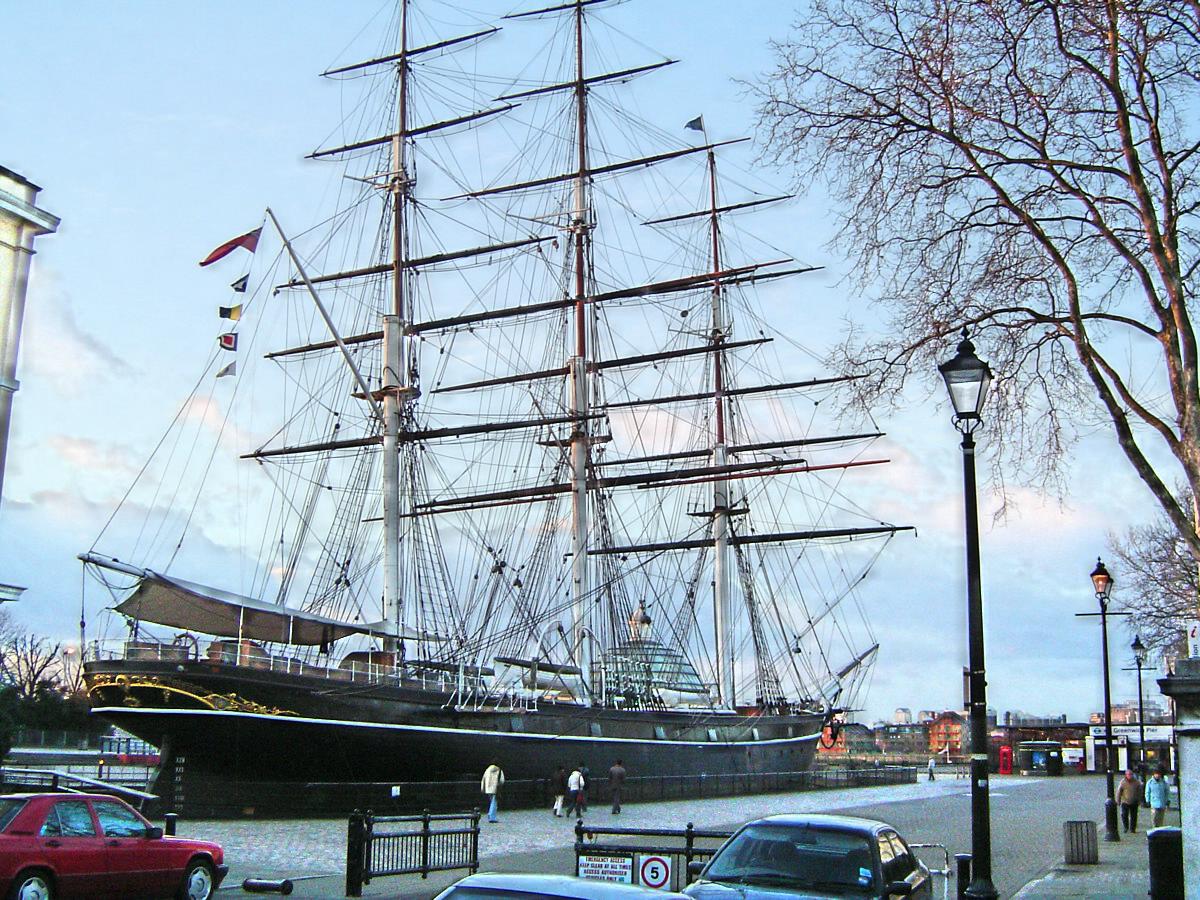
Cutty Sark
Europe,
United Kingdom,
citta,
Greenwich
The Cutty Sark, one of the last and most famous sailing clippers ever built, represents not only a masterpiece of 19th-century naval engineering, but also a symbol of the trade and maritime exploration of the time. Built in 1869 at the Scott & Linton shipyards in Dumbarton, Scotland, the Cutty Sark was designed to dominate the tea market, competing with other clippers to bring the precious cargo from China to England in the shortest time possible.
The name “Cutty Sark” comes from a poem by Robert Burns, “Tam o’ Shanter”, in which a witch, Nannie, wears a short linen shirt, or “cutty sark”. The ship was commissioned by John Willis, an ambitious shipowner who dreamed of building the fastest clipper in the world. Speed was indeed essential: during the golden age of the tea race, the first ship to return with the new harvest received a premium price, and the reputation of the captain and shipowner benefited greatly.
At 64 meters long with a main mast of 46 meters, the Cutty Sark was a giant of the seas, designed for speed and cargo capacity. Its elegant lines, narrow hull, and generous sails allowed it to cut through the waves with impressive grace and power. Its first voyage to Shanghai took place in 1870, but the ship never managed to win the prestigious tea race, despite its speed and efficiency. With the advent of steamships, which were not bound by the winds, the era of clippers began to decline.
Nevertheless, the Cutty Sark found a new life in the wool trade between Australia and the UK, setting speed records that strengthened its legend. During this period, under the command of skilled captains like Richard Woodget, the ship demonstrated its capabilities, often traveling at speeds exceeding 17 knots and setting the record for the fastest journey between Sydney and London, completing the route in just 73 days.
After a long period of service, the Cutty Sark was sold in 1895 to Norwegian captain Christian Sail, who renamed it “Maria do Amparo” and used it for the transport of general goods. The ship changed ownership again in 1922 when it was purchased by Wilfred Dowman, a former merchant navy captain who restored it and turned it into a training ship. Dowman recognized the historical value of the clipper and worked tirelessly to preserve it.
In 1954, the Cutty Sark was moved to a specially built dry dock in Greenwich, where it was restored and transformed into a floating museum. This new life as a tourist attraction has allowed generations of visitors to immerse themselves in maritime history and appreciate the elegance and power of one of the last sailing ships of the golden age of trade.
The Cutty Sark is not only a testament to 19th-century naval technology, but also a symbol of global connections and economic transformations of the time. The tea and wool trade were vital to the British economy, and clippers like the Cutty Sark were at the forefront of a commercial system that connected continents and contributed to globalization.
The historical and cultural importance of the Cutty Sark is further reinforced by the stories of the people who sailed on it. Tales of dangers faced on the open sea, fierce storms, and daring maneuvers evoke an era of adventure and discovery. The ship is also a tribute to the highly skilled craftsmen who built and maintained it, a lasting example of naval engineering and craftsmanship.
Read More