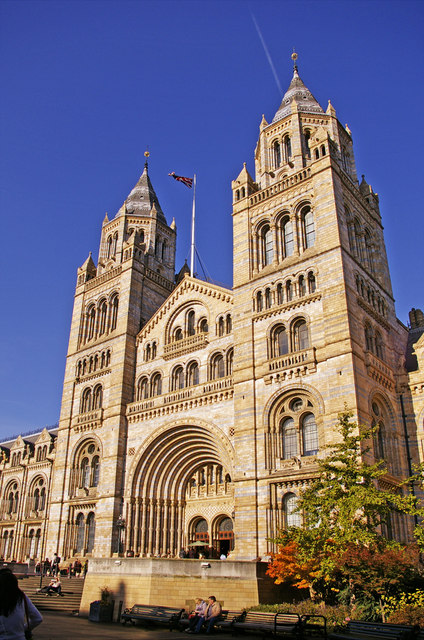
Natural History Museum
Europe,
United Kingdom,
citta,
South Kensington
The Natural History Museum in London, located in the South Kensington district, is one of the most fascinating and important museum institutions in the world, dedicated to natural history. Founded in 1881, the museum originated from the collections of Sir Hans Sloane, which were initially housed in the British Museum. However, the increasing amount of natural specimens made it necessary to build a separate building, giving rise to the Natural History Museum.
The museum, designed by architect Alfred Waterhouse, is an extraordinary example of Victorian Romanesque architecture. The use of terracotta for the facade not only adds aesthetic beauty, but also provides lasting protection against the London climate. Every detail of the building is decorated with sculptures of animals and plants, reflecting the essence of the museum as a “cathedral of nature,” a vision desired by Sir Richard Owen, the museum’s first director. Owen envisioned a place accessible to all, where the public could admire and learn from the natural wonders collected by travelers and scientists of the time.
Inside the museum, the Hintze Hall welcomes visitors with the majestic skeleton of a blue whale, named “Hope,” suspended from the ceiling. This symbol represents the importance of biodiversity and the crucial role of the museum in species conservation. Previously, the space was dominated by “Dippy,” a plaster model of a Diplodocus, which now travels in a touring exhibition.
The museum is divided into different thematic areas covering a wide range of scientific topics. The Earth Hall explores the dynamics of the Earth, from earthquakes to volcanoes, with interactive displays that make science accessible and engaging. Among the main attractions is a piece of moon rock collected during the Apollo 17 mission in 1972, offering a unique glimpse into space exploration.
Another focal point of the museum is the Darwin Centre, opened in 2009. This state-of-the-art facility houses millions of specimens, including some of the most important in the history of biology, and offers visitors the opportunity to observe researchers at work in the laboratories. The center pays tribute to Charles Darwin, whose observations on pigeons contributed to the development of the theory of evolution. Darwin’s pigeon collection, preserved in the museum, is a tangible testament to his revolutionary work.
The Cast Courts are another must-see attraction, with plaster replicas of sculptural and architectural masterpieces from around the world, created in the late Victorian period. These casts allow visitors to admire works such as Michelangelo’s David without leaving London.
The museum’s collection includes over 80 million specimens, ranging from fossils to minerals, from insects to mammals. Among the most fascinating specimens are the remains of the Moa, a giant prehistoric bird from New Zealand, and the famous “Tipu’s Tiger,” an Indian automaton from the 18th century depicting a tiger attacking a European soldier.
Read More