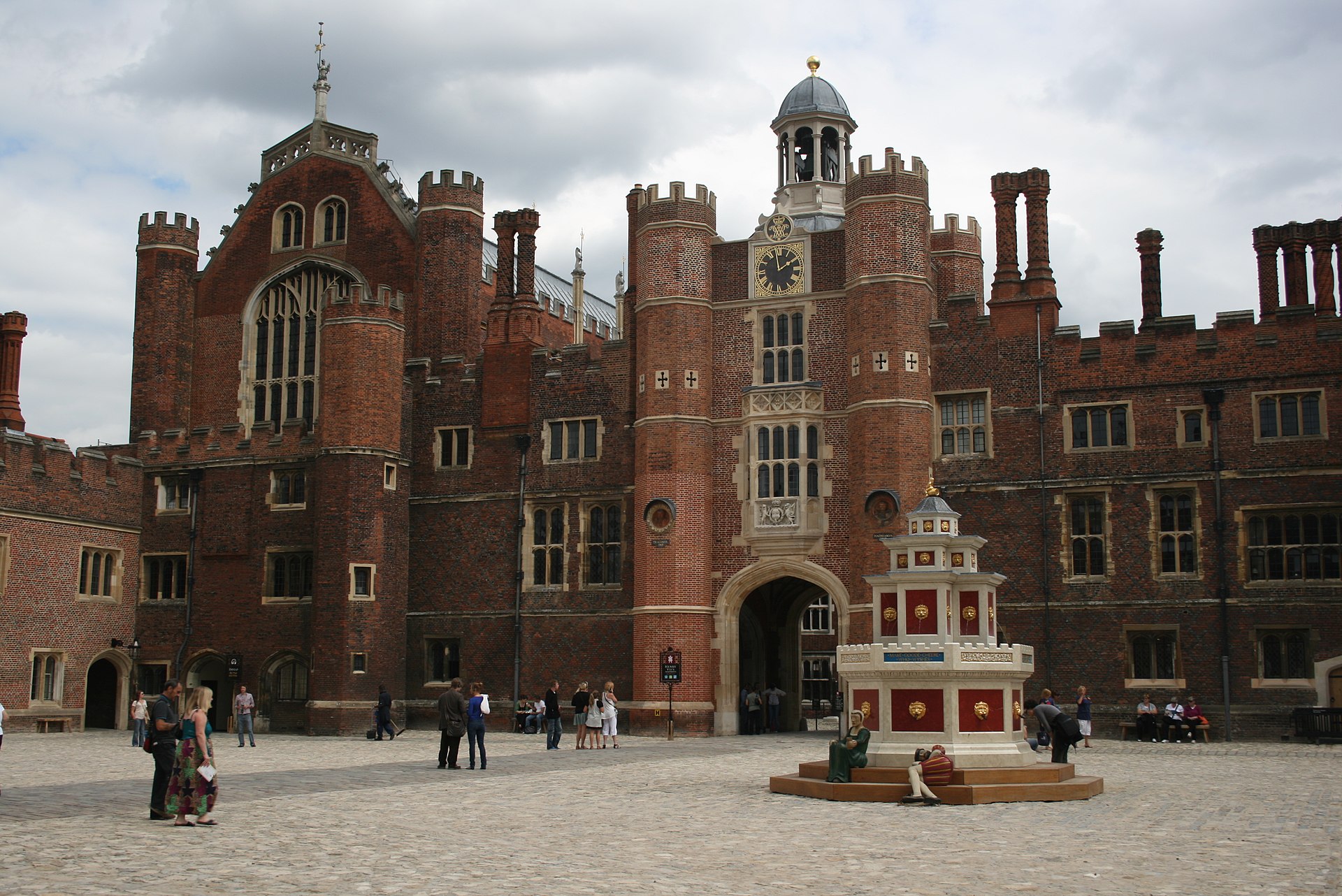
Hampton Court Palace
Europe,
United Kingdom,
citta,
Richmond upon Thames
Hampton Court Palace, located on the banks of the Thames southwest of London, is one of the most emblematic symbols of English history and architecture. Its history is intrinsically linked to prominent historical figures, starting from its founder, Cardinal Thomas Wolsey, to the Tudor and Stuart monarchs who made it their residence.
The palace was initially built in the early 16th century at the behest of Cardinal Wolsey, the powerful Lord Chancellor of Henry VIII. Wolsey envisioned a sumptuous palace to host the king and other European monarchs, a symbol of his influence and wealth. However, in 1528, Wolsey fell from grace and had to cede Hampton Court to Henry VIII, who further expanded the palace, turning it into one of his main residences.
During Henry VIII’s reign, Hampton Court became a center of power and splendor. The king used the palace to showcase his magnificence through opulent banquets, sumptuous receptions, and a luxurious court. The Great Hall, with its imposing decorated ceiling and intricate details, remains one of the most impressive examples of Tudor architecture. It was during this period that the palace was the scene of crucial events, such as the long-awaited birth of Henry’s son, Edward VI, and the arrest of his fifth wife, Catherine Howard, who was later executed for adultery.
The importance of Hampton Court did not end with the Tudors. During the reign of William III and Mary II, at the end of the 17th century, the palace underwent a significant transformation under the direction of architect Sir Christopher Wren. He added Baroque elements to the complex, creating a unique fusion of Tudor and Baroque styles that can still be admired today.
The palace is also famous for its spectacular gardens, including the renowned maze, one of the oldest in the UK, and the Great Vine, the world’s longest vine. These gardens, designed to amaze and delight visitors, reflect the attention to detail and grandeur that characterize the entire complex.
In addition to its architecture and gardens, Hampton Court houses a collection of priceless art. Among the most significant works are the Abraham tapestries, commissioned by Henry VIII to celebrate the birth of his only male heir. These tapestries, made with gold threads, are considered among the finest examples of decorative art from the Tudor period. Furthermore, the recently opened Cumberland Art Gallery displays masterpieces by artists such as Holbein, Van Dyck, Rembrandt, and Caravaggio, showcasing royal patronage through the centuries.
Hampton Court was not only a center of power, but also a place of intrigue and personal tragedies. Queen Elizabeth I, daughter of Henry VIII and Anne Boleyn, spent part of her childhood in the palace and returned as queen, solidifying her image as a strong and independent sovereign. Her story is marked by episodes of imprisonment and suspicions of conspiracy, reflecting the political and religious tensions of the time.
The palace continued to be used by the English monarchs until the 18th century, when the royal family permanently moved elsewhere. In 1838, Queen Victoria opened the palace to the public, turning it into one of London’s main tourist attractions. Today, Hampton Court welcomes millions of visitors each year, drawn by its fascinating history, magnificent architecture, and stories of the ghosts said to haunt its halls.
Read More