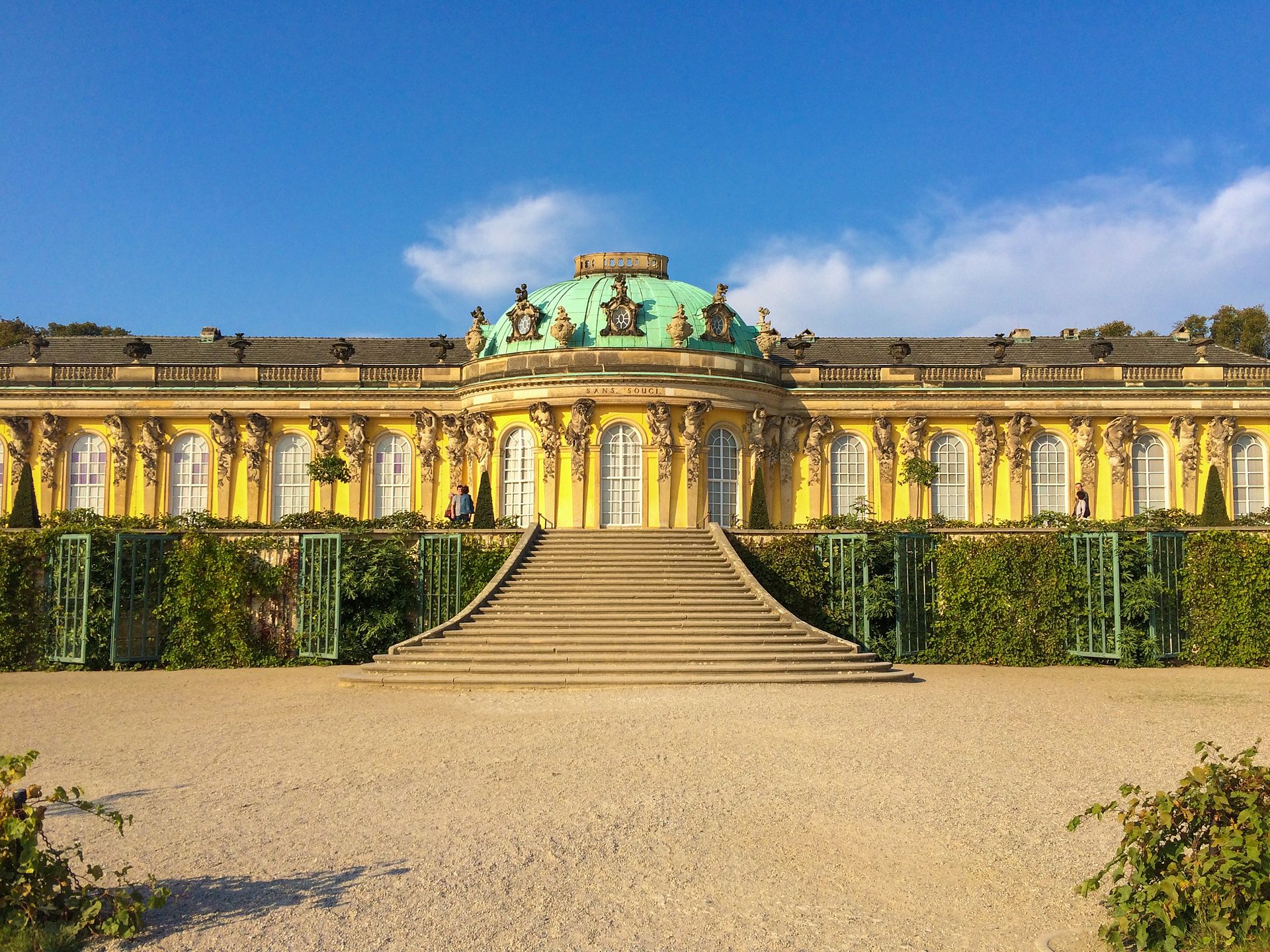
Sanssouci Castle
Europe,
Germany,
citta,
Potsdam
Schloss Sanssouci, located in Potsdam, is one of the most emblematic palaces in Germany and a masterpiece of German Rococo. Built for King Frederick II of Prussia, known as Frederick the Great, this palace was intended as a summer residence where the king could retreat “sans souci”, meaning “without worries”. The name itself reflects the intention to create a refuge away from the political concerns and wars that marked his reign.
The project of Sanssouci began in 1745 and was completed in 1747. Frederick the Great personally chose the site, located on a hill overlooking Potsdam. The architect Georg Wenzeslaus von Knobelsdorff was tasked with creating the palace according to the king’s wishes, who wanted a residence that combined elegance and simplicity, inspired by French models. The result was a single-story building, decorated with refined stuccoes, gilding, and frescoes, surrounded by splendid gardens.
Sanssouci Palace is often compared to Versailles for its magnificence and style, but unlike the gigantic French palace, Sanssouci retains a more intimate and personal atmosphere. Frederick the Great desired a place where he could philosophize, compose music, and converse with intellectuals such as Voltaire, who lived for a period at Sanssouci as a guest of the king. This intellectual and artistic spirit permeates every corner of the palace.
One of the most fascinating aspects of Sanssouci is its park, which covers approximately 290 hectares and includes not only Italian and English gardens but also numerous buildings and pavilions. Among these, the Picture Gallery, one of the first public museums in Europe, the Temple of Friendship, dedicated to Frederick’s sister, Wilhelmine of Bayreuth, and the Ruins of the Roman Baths, a romantic evocation of the ancient world.
The terraced garden of Sanssouci is one of its most distinctive features. Designed in Rococo style, the garden is organized on six levels of terraces gently descending from the hill on which the palace stands. Each terrace is adorned with classical statues and vineyards, reflecting Frederick’s passion for viticulture. At the center of the lower terrace is a large fountain, surrounded by flower beds arranged in intricate geometries.
Inside the palace, the rooms are a reflection of the king’s personality and tastes. The most famous room is Frederick’s Library, a small but elegant room decorated with shelves of gilded wood and frescoes on the ceiling depicting Apollo and the Muses. The library originally contained about two thousand volumes, many of which were works of French philosophy and literature, a testament to Frederick’s admiration for French culture.
The Music Room is another gem of the palace, decorated with panels of gilded wood and mirrors that reflect the candlelight, creating a magical atmosphere during concerts. Frederick himself was a skilled flutist and composer, and this room was where he performed for his guests, often accompanied by court musicians.
An interesting anecdote concerns the tomb of Frederick the Great. Although he had expressed the desire to be buried in the garden of Sanssouci next to his greyhound dogs, at his death in 1786 he was buried in the crypt of the Garnisonkirche in Potsdam. Only in 1991, after the reunification of Germany, were his remains transferred to Sanssouci and buried according to his wishes.
Today, Sanssouci is one of the main tourist attractions in Germany and a UNESCO World Heritage Site.
Read More