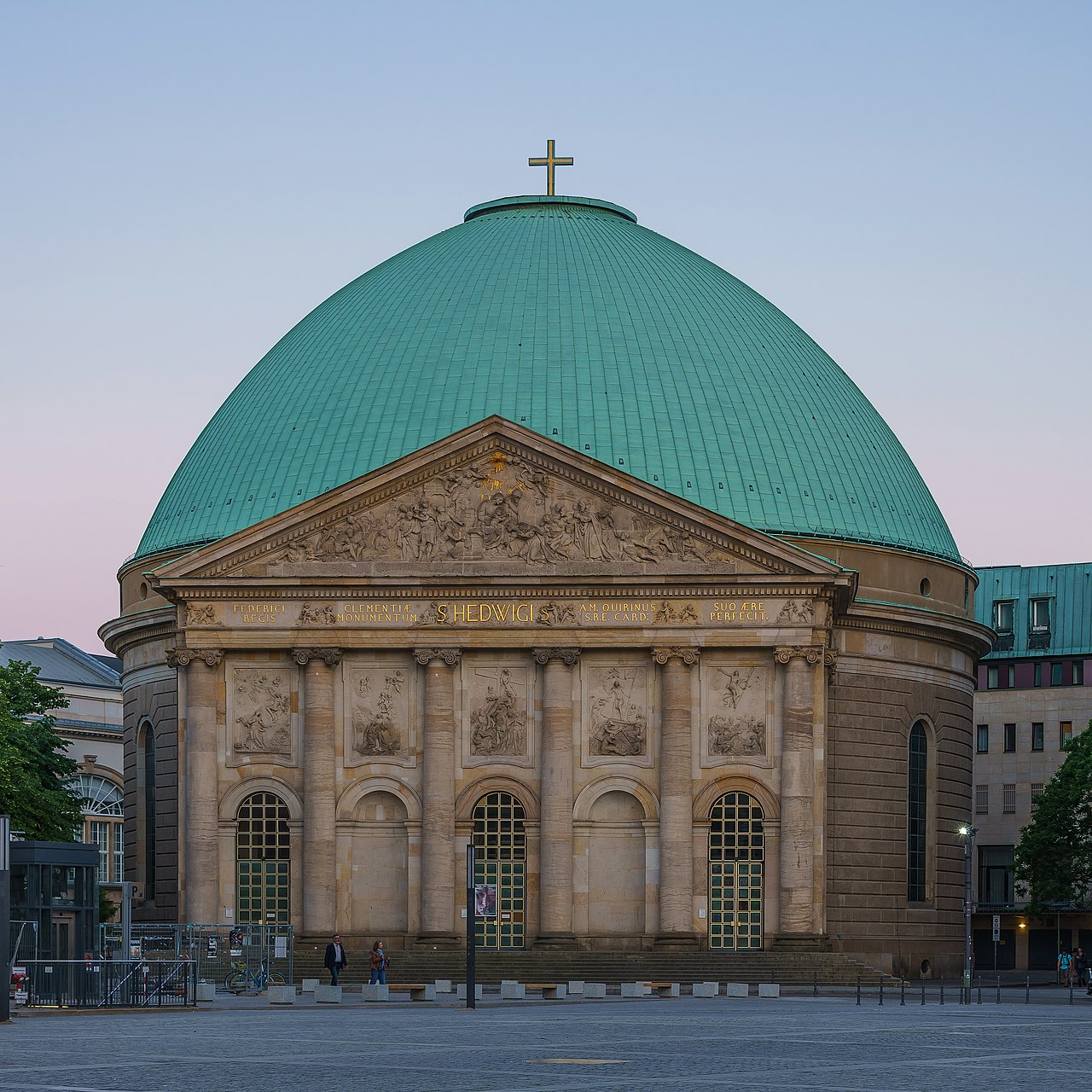
St. Hedwig's Cathedral (St. Hedwigs-Kathedrale)
Europe,
Germany,
citta,
Plänterwald
The Sankt-Hedwigs-Kathedrale in Berlin, located in the heart of the city on Bebelplatz, is one of the oldest and most significant churches in the German capital. Dedicated to Saint Hedwig of Silesia, the cathedral represents a focal point of the Berlin Catholic community and a historical testimony to the resistance and perseverance of the Catholic faith in Germany.
The origin of the cathedral dates back to the 18th century, when Frederick II the Great, known for his policy of religious tolerance, granted permission for the construction of a Catholic church in the Prussian capital. Construction began in 1747 and was completed in 1773, making it the first Catholic church erected in Berlin after the Protestant Reformation. The architectural project was entrusted to Georg Wenzeslaus von Knobelsdorff, who drew inspiration from the Pantheon in Rome for the imposing dome and circular plan of the church.
The architecture of the Sankt-Hedwigs-Kathedrale is a masterpiece of neoclassical style. The exterior, with its imposing facade and Corinthian columns, gives the cathedral a sense of grandeur and solemnity. The interior is characterized by an elegant and sober design, with high ceilings, stained glass windows, and marble decorations, creating an atmosphere of serenity and reflection. The 33-meter high dome is one of the most distinctive architectural elements of the cathedral, symbolizing eternity and divinity.
A prominent feature inside the cathedral is the organ, built by the famous organ builder Wilhelm Sauer. This instrument, one of the finest examples of late-Romantic organ in Germany, enriches the spiritual atmosphere of the cathedral with its evocative melodies and complex design. The organ is often used for sacred music concerts, offering visitors an extraordinary acoustic experience.
During World War II, the cathedral suffered severe damage from bombings, but fortunately its structure was rebuilt in the 1950s and 1960s. The reconstruction, led by architect Hans Schwippert, maintained the original form of the cathedral while also introducing modern elements to meet contemporary liturgical needs. The new reinforced concrete dome and the addition of eight new chapels are testimonies to the architectural evolution of the cathedral over time.
In addition to its religious function, the Sankt-Hedwigs-Kathedrale is a symbol of tolerance and interfaith dialogue. The cathedral regularly hosts joint religious services with other Christian denominations, promoting unity and understanding among different religious communities. This commitment to ecumenical dialogue is one of the distinctive features of the cathedral and reflects its role as a center for cultural and spiritual exchange.
A significant event in the recent history of the cathedral was the visit of Pope Benedict XVI in 2011. During his visit, the Pope celebrated a mass in the cathedral, emphasizing the importance of the Catholic faith in Berlin and throughout Germany. This event strengthened the cathedral’s ties with the global Catholic community and drew attention to this important place of worship.
The Sankt-Hedwigs-Kathedrale is also known for its role in promoting culture and the arts. The cathedral regularly hosts concerts, art exhibitions, and conferences, offering a rich cultural program for the Berlin community and visitors. Its excellent acoustics make it a privileged venue for musical performances, creating a unique environment where the beauty of music merges with the grandeur of architecture.
An interesting anecdote concerns the origin of the cathedral’s name. Saint Hedwig of Silesia, to whom the church is dedicated, was a German princess and religious figure from the 13th century, known for her charity and devotion. Her figure is particularly venerated in Silesia, and her choice as the patroness of the cathedral reflects the historical and spiritual importance of her legacy.
Recently, the cathedral has undergone further restoration work to ensure its preservation and adaptation to modern liturgical needs. These interventions included the closure of a large circular opening in the floor and the reorganization of the interior space to improve usability during celebrations. These works, completed in 2024, have allowed for the preservation and further enhancement of this extraordinary monument.
Read More