EYE Film Institute
Europe,
Netherlands,
Amsterdam, citta,
Overhoeks
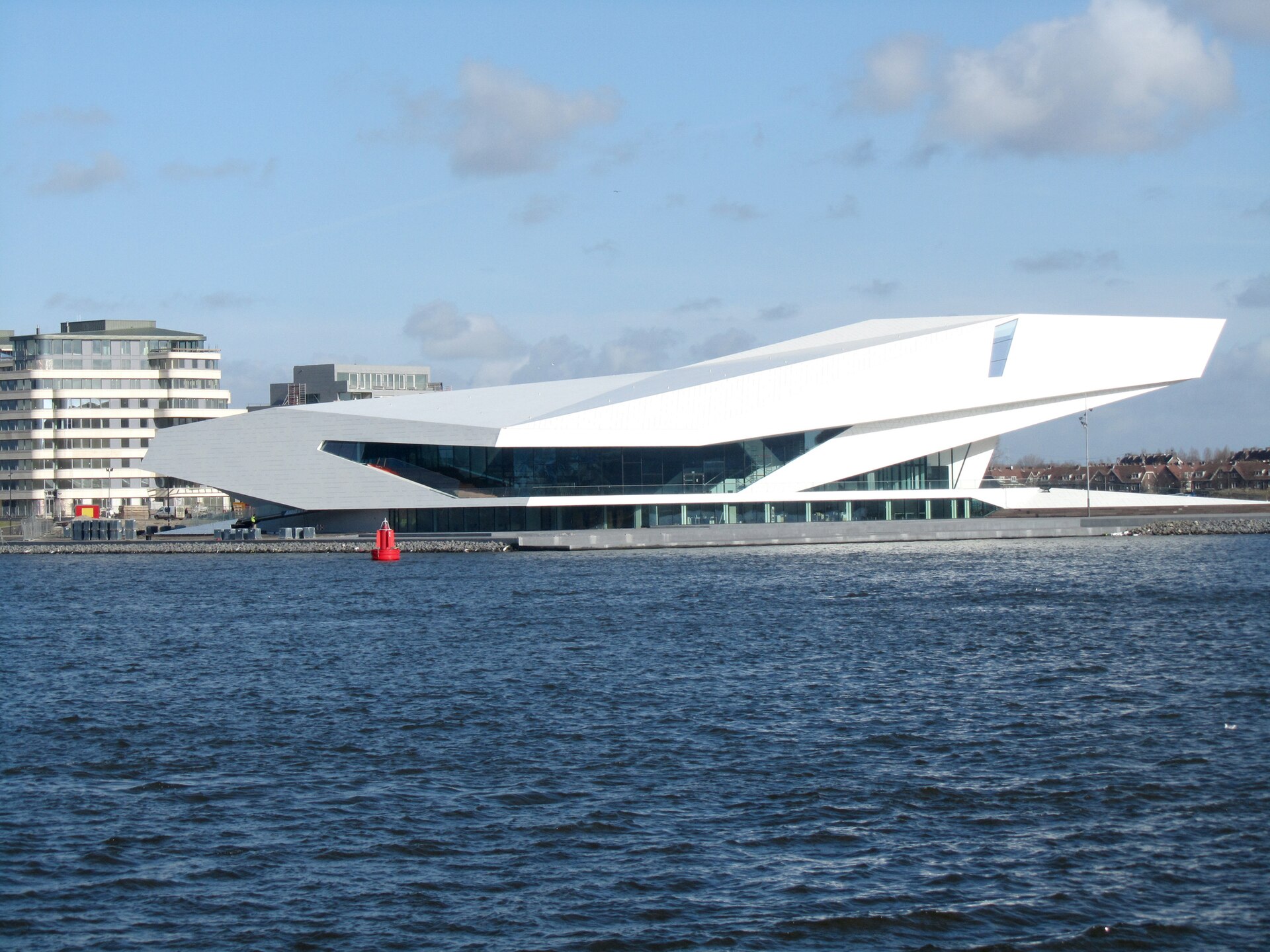
The EYE Film Institute, located on the IJ waterfront in Amsterdam, is an institution dedicated to the celebration and preservation of Dutch and international film culture. This extraordinary building, designed by the Viennese studio Delugan Meissl Associated Architects, was inaugurated on April 5, 2012, marking a significant change in the urban landscape of Amsterdam-Noord. The structure, with its dynamic geometric shapes, represents the interaction between light, space, and movement, themes intrinsic to the art of cinema.
The history of the EYE Film Institute dates back to 1946, with the founding of the Dutch Historical Film Archive by David van Staveren, Felix Halverstad, and the directors of the Filmtheater Kriterion, Piet Meerburg and Paul Kijzer. Over the years, this institution evolved, becoming the Nederlands Filmmuseum in 1952. The institute experienced various relocations, from the Stedelijk Museum to the Vondelparkpaviljoen, where it resided from 1972 until 2012. During these years, the Filmmuseum greatly expanded its collection, acquiring unique pieces such as the archive of Jean Desmet, a cinema pioneer who preserved films dating from the period 1907-1916.
The EYE Film Institute boasts an impressive collection of over 55,000 films, ranging from the earliest silent shorts to the latest digital productions. In addition to films, the institute preserves hundreds of thousands of photographs, posters, cinematic devices, and filmmakers’ archives, offering a comprehensive panorama of film history. Among the restored films are masterpieces like “Wan Pipel” by Pim de la Parra, “Zeemansvrouwen” by Henk Kleinmann, and “Karakter” by Mike van Diem. These works reflect the institute’s dedication to preserving and enhancing Dutch and international cinematic heritage. The EYE’s mission is threefold: to preserve, guide, and innovate in the world of cinema. As a custodian of cinematic heritage, the institute is committed to sustainably preserving films and making them accessible to the public. As a guide, the EYE curates programs that highlight historically significant, forgotten, or controversial films, promoting a broader understanding of film history. Finally, as a pioneer, the institute explores new ways to make cinema accessible, including presenting artistic works in VR and exhibitions that blend cinema and visual arts.
The architecture of the building itself is a masterpiece of contemporary design. Positioned in a transitional area between land and water, and between the historic center of Amsterdam and the new urban developments of Amsterdam-Noord, the EYE building seems to change shape depending on the point of view, creating a constant dialogue with the surrounding environment. This characteristic reflects the mutable and dynamic essence of cinema as an art form.
The move from the Vondelparkpaviljoen to the new location represented a significant turning point for the institute. The new structure offers state-of-the-art spaces for film viewing, including four auditoriums of various sizes, and ample spaces for exhibitions and educational events. The EYE’s sunny terrace, overlooking the IJ, also offers a panoramic view of the city, making the museum an ideal place not only for cinema enthusiasts but also for those who wish to enjoy one of the best views of Amsterdam.
Read More