Catacombs of Saints Marcellinus and Peter
Europe,
Italy,
citta,
Tuscolano
The Catacombs of Saints Marcellinus and Peter, located along the Via Casilina, are an archaeological complex of great historical and artistic significance, dating back to the 4th century. These catacombs are named after the martyrs Marcellinus, a priest, and Peter, an exorcist, who were executed during the persecutions of Diocletian in 304 AD. According to tradition, they were forced to dig their own graves before being beheaded. Their remains were then buried in the site we now know as the Catacombs of Saints Marcellinus and Peter.
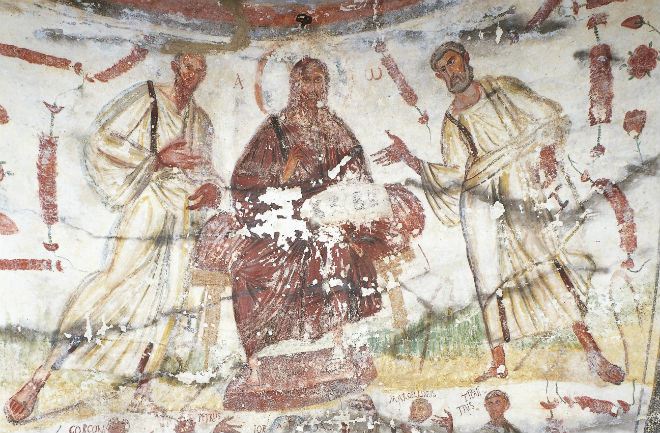
The complex covers an area of about 18,000 square meters and includes numerous cubicula and galleries decorated with frescoes depicting biblical scenes and Christian symbols. Among the most significant paintings is the cycle of frescoes dedicated to the story of Jonah, illustrating episodes such as Jonah being thrown into the sea and his stay in the belly of the great fish. These frescoes are an example of the influence of pagan Roman art on early Christian representations, blending pagan iconographic elements with biblical themes.
The catacombs became an important pilgrimage site during the reign of Constantine, the first Roman emperor to convert to Christianity. Constantine built a large memorial complex that included a basilica above the catacombs and a mausoleum for his mother, Saint Helena, who was a devout Christian. The basilica served as a place of worship and veneration for the faithful, allowing them to pay homage to the martyrs Marcellinus and Peter.
Over the centuries, the catacombs underwent various vicissitudes. During the Middle Ages, they were an important center of worship, but over time they were neglected and fell into ruin. It was only thanks to the excavations of the 19th century that the site was rediscovered and restored, revealing its historical and artistic importance.
Among the most fascinating elements of the catacombs are the numerous inscriptions and graffiti left by pilgrims over the centuries. These signs of devotion offer a window into the spirituality of the early Christians and their veneration for the martyrs. The frescoes, although damaged by time, continue to amaze visitors with their beauty and symbolic meaning.
An interesting episode concerns the discovery in 2006 of over a thousand skeletons, buried one on top of the other and still wrapped in their togas, revealing the funerary practices and living conditions of the Christian community at the time. This discovery has offered new perspectives on burial practices and the daily life of early Christians.
The Catacombs of Saints Marcellinus and Peter are only open for visits during the weekend, allowing visitors to explore the underground labyrinths and admire the frescoes and tombs of the martyrs. This experience offers a fascinating journey into the history of early Christianity and a deeper understanding of the roots of the Christian faith.
Read More