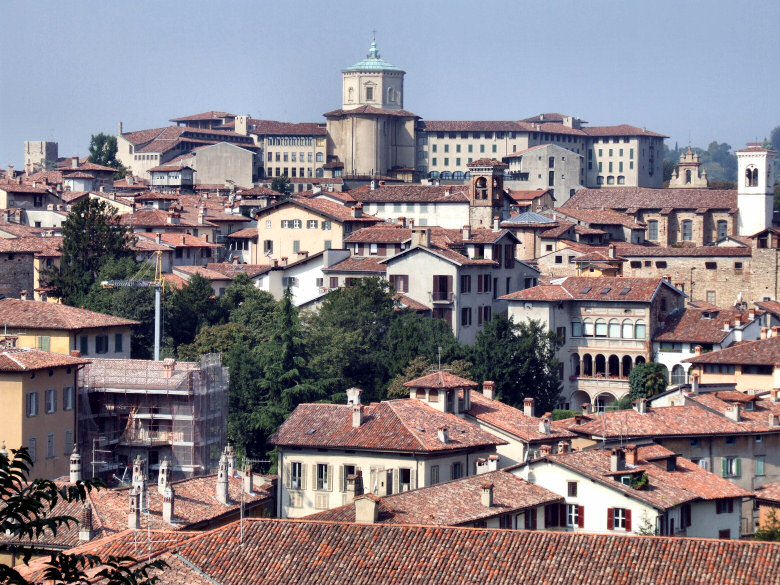
Church of Saints Bartholomew and Stephen - Colleoni Chapel - Bergamo
Europe,
Italy,
Bergamo,
The Church of Saints Bartolomeo and Stefano, a true gem located in the heart of Bergamo. This church plays a fundamental role in the identity of Bergamo, both historically and culturally. Its origins date back to the 12th century, but its current structure is the result of centuries of transformations. The church is especially known for the Colleoni Chapel, one of the most significant works of Lombard Renaissance, which houses the remains of Bartolomeo Colleoni, a general who distinguished himself during the Venetian domination. This place has always been an important point of reference for the local community and an attraction for visitors from all over the world.Origins and HistoryThe Church of Saints Bartolomeo and Stefano, dedicated to the martyr Saints Bartolomeo and Stefano, has a history intertwined with the events of the city of Bergamo. The original construction dates back to 1135, as documented by the discovery of inscriptions in the area. Over the centuries, the church has undergone several transformations. In the 15th century, the architect Giovanni Antonio Amadeo, one of the leading figures of the Lombard Renaissance, undertook significant renovation works.A crucial moment for the church was the testament of Bartolomeo Colleoni, drawn up in 1475. Colleoni, a renowned captain, chose to be buried in this church to emphasize his bond with the city and his historical significance. The Colleoni Chapel, completed in 1486, was designed by Amadeo as a sort of majestic mausoleum for the general. This project expresses not only Colleoni’s grandeur but also the power of the Republic of Venice, which governed Bergamo at that time.In the following centuries, the church has been subject to numerous restoration and improvement efforts, both to preserve its structure and to enhance the art pieces contained within. An important restoration took place in the 20th century, which brought to light forgotten decorative and architectural elements. The works aimed to maintain the authenticity of the medieval building while respecting its past and improving accessibility for visitors.What to ObserveUpon entering the church, one is immediately struck by the façade, characterized by an elegant play of lines and shapes. The façade features a central portal preceded by a wide staircase, with semicircular arches and decorations that hark back to the Gothic style. The columns facing the portal show ornate capitals, a testament to the artistic care devoted to the creation of this work.As you enter, to your left, you can spot the medieval stone holy water font, which attests to the devotion of the faithful since the early years of the church’s life. Continuing, one can admire the precious frescoes that adorn the walls, created by local artists. These frescoes tell biblical stories and are framed by baroque stuccos, the result of renovations that took place in the 17th century.The true masterpiece of the church is undoubtedly the Colleoni Chapel. This chapel is enveloped in a harmony of polychrome marbles and sculptural decorations. The beautifully frescoed dome represents Paradise, and the celestial figures are painted with a realism that captivates the visitor. The tomb of Bartolomeo Colleoni, positioned in the center of the chapel, is a standalone work of art depicting the captain in armor, surrounded by angels who accompany him on his journey to eternity.As you continue your visit, don’t forget to observe the right side of the church, where several minor altars decorated with artworks by 17th-century painters offer further insight into the artistic wealth of the church. Each altar has its own history and significance, and it is worth pausing to appreciate each of them.One of the most fascinating elements is the wooden choir, located above the main entrance. Made from walnut, the choir is a Renaissance work that provides an excellent view of the congregation below, showcasing not only functional design but also artistic beauty.Finally, don’t miss the opportunity to observe the external architectural details. The bell tower, which rises above the church’s roof, is decorated with a frescoed sun dial, a testament to the astronomical and timekeeping traditions of the time. This bell tower, dating back to the 14th century, is a distinctive element of the cityscape.Context and ConnectionsThe Church of Saints Bartolomeo and Stefano is set within a highly appealing architectural and cultural context. We are located in the historic center of Bergamo, which is itself a destination rich in artistic beauty. Just a short walk from the church, we find the Basilica of Santa Maria Maggiore, another symbol of the city, rich in artistic treasures such as the famous frescoes by the masters of the Lombard school.Not far away, the Colleoni Chapel stands out, representing an important point of reference for understanding the history of Bergamo and its connection with the Renaissance. These places, along with the Church of Saints Bartolomeo and Stefano, form a cultural circuit that tells the story of a city that is not only beautiful but rich in meaning.Another point of interest nearby is the Palazzo della Ragione, which has played a central role in the public life of the city. Its charming architecture and the presence of artworks make a visit to Bergamo even more complete.CuriositiesOne of the most interesting aspects of the Colleoni Chapel is the innovative use of polychrome marbles. These marbles come from different locations, making the chapel not just an architectural work, but also a sort of “map” of the materials from the region.Additionally, the church has seen an important musical tradition. Until the 19th century, concerts and celebrations were held there that attracted musicians from all over the Lombardy region.The figure of Bartolomeo Colleoni, to whom the chapel is dedicated, is often remembered in historical literature. He is seen as a symbol of what the captain represents: military skill, but also great generosity towards the local community.Finally, it is estimated that the Church of Saints Bartolomeo and Stefano is visited annually by thousands of tourists, attracted not only by the beauty of the architecture but also by its rich history. It is a place where visitors can not only admire but also experience a significant piece of Bergamo’s history.After completing the tour of this extraordinary church, we invite you to continue your discovery with a visit to the Basilica of Santa Maria Maggiore and the Palazzo della Ragione. Both places, rich in history and art, will further enrich your journey through Bergamo.
Read More