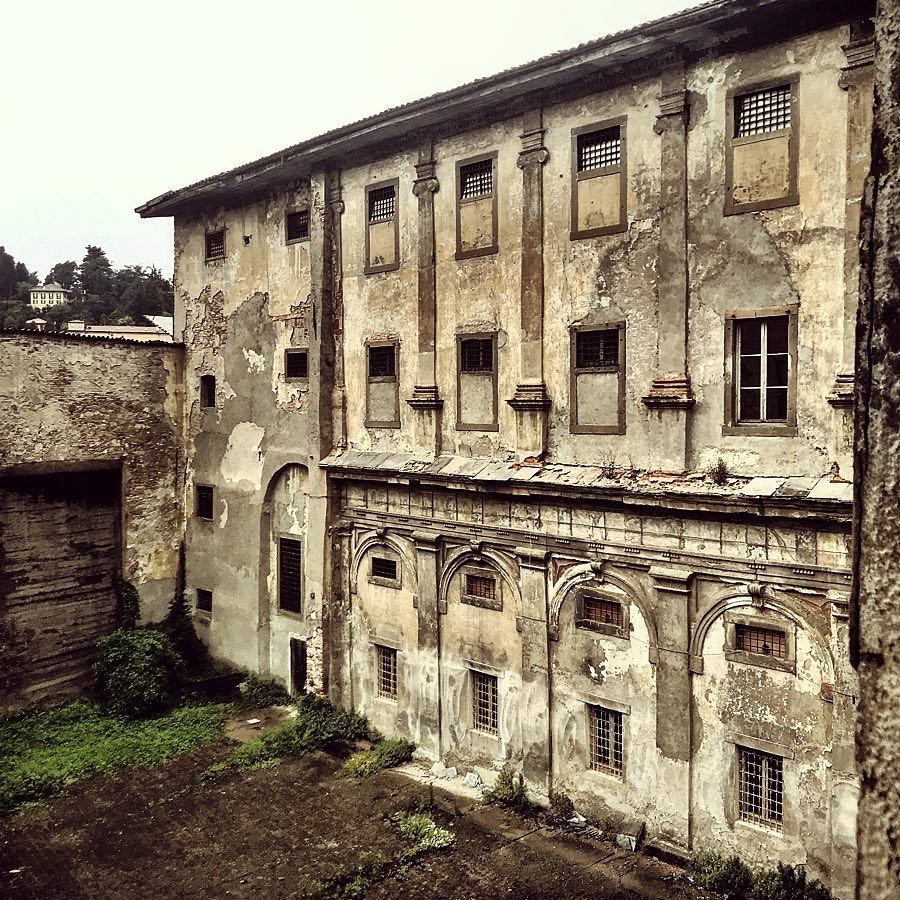
Former Prison of Sant'Agata - Courtyards - Bergamo
Europe,
Italy,
Bergamo,
The Ex Prison of Sant’Agata, a place rich in history located in the heart of Bergamo. This ancient prison, inaugurated in 1874, has transformed its original function to become an important cultural hub of the city today. Despite its history as a penal institution, it now stands out for its fascinating architecture and the cultural events that take place within its walls. The complex, which once housed inmates, has evolved into a space for meetings, exhibitions, and artistic activities. In this journey, we will explore together the origins and history of this place, as well as its most significant architectural elements.Origins and HistoryThe Ex Prison of Sant’Agata has deep roots that trace back to the late 19th century. Its construction began in 1865 at the behest of the city of Bergamo, intending to replace the old prison of Sant’Agostino, which no longer met the penitentiary needs of the time. The architect Giovanni Battista Fuga, who designed the building, followed a neoclassical style, aiming to combine functionality and beauty. Officially inaugurated in 1874, the prison housed around 200 inmates.The prison had a particular organization of spaces, with cells arranged around a central courtyard, a common element in penitentiary buildings of the time. The structure, besides holding prisoners, became famous for its strictness and living conditions, which often raised controversies and debates about the humanity of the penal system.As the years went by, the management methods of prisons changed, and in 1984, the Sant’Agata prison was finally closed. From that moment on, the building abandoned its function as a penal institution and began a long process of renovation and redevelopment. In the 2000s, the complex underwent significant recovery work, transforming into a cultural center open to the public.Today, the Ex Prison of Sant’Agata is an example of how a historical structure can be reused for contemporary purposes while keeping the memory of a complex past alive.What to ObserveNow that we have understood the history of this place, let us discover what it offers to visitors. The visit begins with access to the complex, where one is confronted with the main facade of the prison. This building presents an interesting combination of architectural elements, with large windows that testify to the neoclassical design and the desire to create bright environments, relevant even in penal institutions.At the entrance, we immediately notice the wide central courtyard, a crucial element in the design of 19th-century prisons. This space, now open and livable, was once the beating heart of detainment life, where prisoners spent their days. Today, the courtyard is used for cultural events, concerts, and exhibitions. It’s interesting to see how culture can reclaim a space once dedicated to suffering.As we move towards the sides of the courtyard, we can observe the prison cells. These small rooms, with their cramped spaces and simple furnishings, tell stories of past lives. Some cells have been transformed into exhibition spaces, where contemporary artists seek to express the contrast between freedom and confinement through their works.On our right, we find one of the rooms used for events. This room, once meant for the administrative offices of the prison, features high ceilings and architectural details that reflect the neoclassical style of the time. Here, it is possible to attend conferences, presentations, and cultural activities, drawing in a diverse and curious audience.Another element not to be missed is the small garden attached to the complex. This green space, created during the renovations, is a place for relaxation and contemplation. It is interesting to note how the garden symbolically represents the rebirth and transformation of the place; a former prison that today offers moments of tranquility away from urban chaos.We cannot forget to mention the library, a place of knowledge and culture, located in one of the corners of the complex. Here, visitors can explore a vast collection of books and resources, participating in reading initiatives and studies. The library is a perfect example of how the former prison has transformed into a vibrant and welcoming cultural center.Finally, we invite you to pay attention to the architectural details that characterize the complex. The window frames, solid wood doors, and stucco decorations highlight the neoclassical style, while the modifications of the interiors bear witness to the adaptation of the place to new functions.Context and ConnectionsThe Ex Prison of Sant’Agata is located in an area rich in history and culture, in the center of Bergamo. This part of the city is known for its medieval architecture and traditions. Just a short walk from the former prison, visitors can explore other significant cultural institutions.Among these is the Museum of Santa Giulia, housed in an ancient monastery, offering exhibition paths dedicated to the art and history of Brescia and its province. Moreover, the Accademia Carrara Art Gallery, one of the most important art galleries in Bergamo, is renowned for its collections of artworks from the 14th to the 19th century and is located a short distance away in the historic center.Another place of great interest is the Citadel of Bergamo, an imposing fortified structure dating back to the 15th century. Through a short walk, visitors can immerse themselves in the history of military art and architecture of the city while admiring the historic walls and gates.CuriositiesIf you wish to delve deeper into the history of the Ex Prison of Sant’Agata, know that over the years, the prison has housed important political and social figures. Additionally, throughout its history, it has maintained a high level of security designed to prevent escapes, an aspect that remains in the collective memory of the city.Furthermore, it is interesting to note that the restoration of the complex has been part of an urban regeneration context, thus helping to enhance the entire neighborhood.Finally, let us not forget the significant role that the prison has played in promoting social and cultural initiatives, such as artistic workshops and educational programs aimed at raising awareness of issues related to justice and rehabilitation.Allow yourself to be inspired by the history and culture emanating from this former prison, and do not forget to explore the many treasures that Bergamo has to offer.
Read More