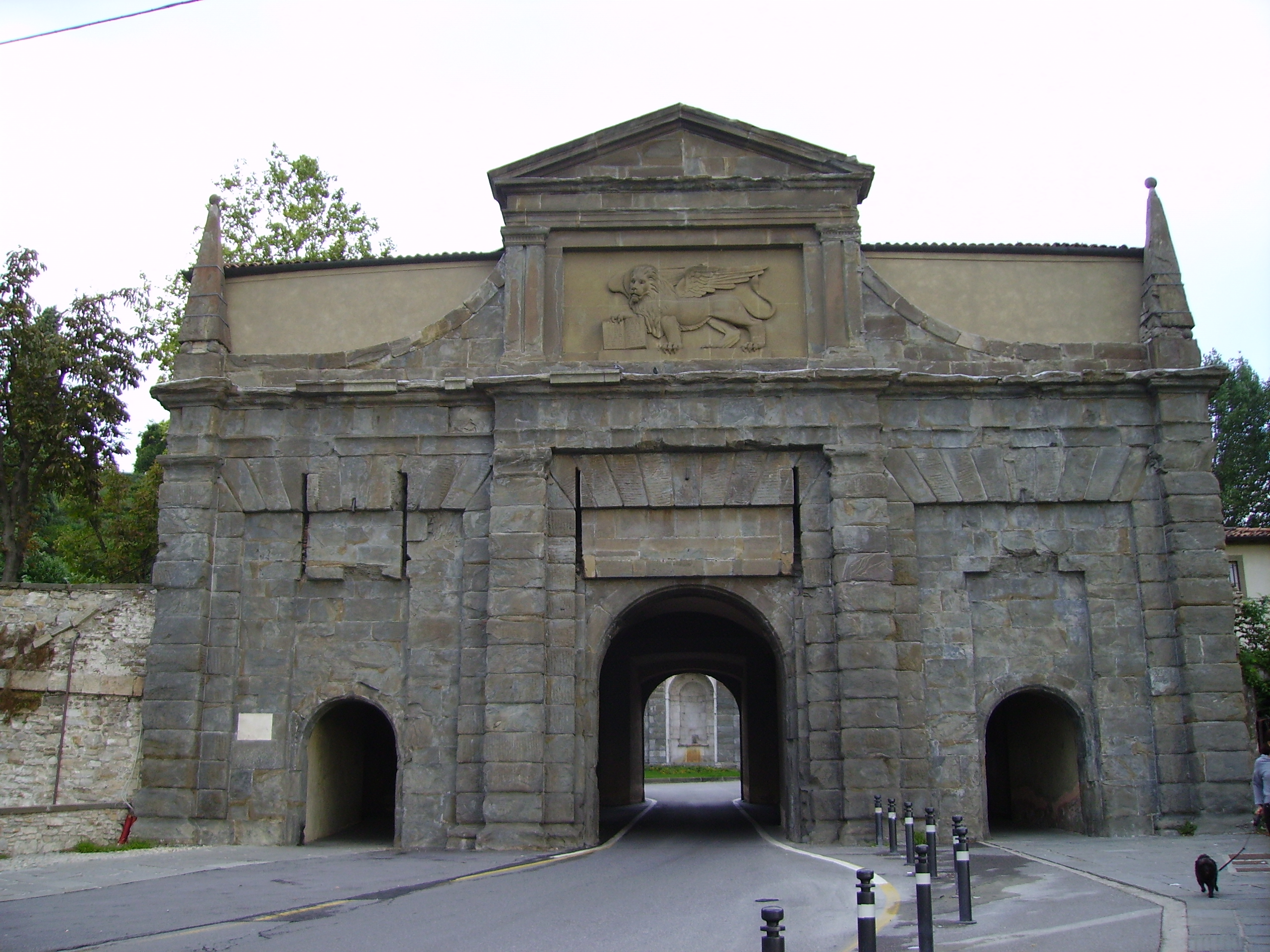
St Augustine Gate - Bergamo
Europe,
Italy,
Bergamo,
Porta Sant’Agostino, one of the iconic monuments of Bergamo, is located along the ancient Venetian walls of the city. This gate, built in the 16th century, is not only an access point to the city but also serves as a symbol of its historical and cultural identity. The walls of Bergamo were declared a UNESCO World Heritage Site in 2017, thus recognizing the importance of this extraordinary architectural asset. Porta Sant’Agostino is famous for its majestic appearance and historical function: it has represented a fundamental transit point between the countryside and the city for centuries.Origins and HistoryThe origins of Porta Sant’Agostino date back to the second half of the 1500s, specifically in 1592, when it was decided to expand and strengthen the city’s fortifications, which had already existed in earlier times. This project was carried out under the direction of the architect Giovanni Battista Lantana, who designed a gate that could serve not only as an access point but also as a defensive element. The choice of the name “Sant’Agostino” is linked to the adjacent convent of Sant’Agostino, which has been active in the area since the 14th century.Over the centuries, Porta Sant’Agostino has undergone several transformations, especially during the Napoleonic period in the early 19th century, when the Venetian walls were adapted to new military needs. At that time, in fact, the fortifications lost their defensive function and began to be used for different purposes.In the decades that followed, especially due to the unification of Italy, the gate assumed greater historical significance, becoming a symbol of the city and its heritage. It is interesting to note that during World War II, the gate and the Venetian walls were damaged, but the commitment to their preservation led to a restoration completed in 1955, restoring the original appearance of the monument.Today, Porta Sant’Agostino is not only a historical structure but also the gateway through which visitors can discover the charm of Bergamo’s Città Alta, a territory rich in history, culture, and architectural beauty.What to ObserveUpon arriving at Porta Sant’Agostino, you will be faced with an imposing façade made of limestone and white marble, which stands out for its elegance and solidity. Visitors are immediately struck by the dimensions of the central portal, topped by an interesting full-arch, typical of 16th-century architecture. If you look closely, you will also notice the side niches that once housed statues of saints, symbols of protection and guidance for those entering the city. Today, these niches are empty, but their presence helps to tell the history of the gate.Inside the gate, on the left, there is an ancient fireplace that was used to heat the spaces and ensure comfort for those passing through this way. Embedded in the walls, you can also discover some ancient graffiti, works of artisans and passersby, who left their mark over the centuries.As you proceed beyond the portal, I suggest you look up at the architectural belts that decorate the upper part of the gate. These details, which include cornices and small arches, reflect an elegance that highlights the importance of the structure not only as a defensive work but also as a representative monument.From the gate, if you turn to the right, you will see one of the guard towers that, along with the walls, served to oversee the traffic coming in and out of the city. These towers, built during the same period, are an important element of the city’s defense system.The Venetian walls, which extend along the gate, are another element to observe closely. Decorated with battlements, these walls represent an expression of military engineering of the time. It is worth crossing the walkway that runs along the walls, where you can enjoy a panoramic view of the city and the surrounding countryside. This path offers a unique way to appreciate not only the architectural beauty but also the context in which Porta Sant’Agostino was built.Finally, do not forget to examine the underpass, which has been recently restored. This vaulted passageway testifies to the strategic importance of the gate, serving as a connection between the Città Alta and the rest of the province. During times of high traffic, this space would have been crowded with people and animals, making it a vibrant center of activity.Context and ConnectionsPorta Sant’Agostino is set in an urban context rich in history and culture. It is located in the Città Bassa district, an area that represents the beating heart of Bergamasque life. Just a short distance away, you will find Parco Montecchio, a green area where you can relax and enjoy views of the historic walls. Moreover, just a few steps from the gate lies the Convent of Sant’Agostino, an ancient monastery that adds further historical depth to the neighborhood.As you continue your visit, I also recommend exploring the Donizettiano Museum, dedicated to the famous Bergamasque composer Gaetano Donizetti. This museum offers a fascinating perspective on the city’s musical history and shows how culture and art are closely tied to the life of Bergamo.Another must-see place is the Basilica of Santa Maria Maggiore, located a short distance from Porta Sant’Agostino. This basilica represents one of the masterpieces of Romanesque and Baroque architecture in Lombardy, enriched by works of art that recount centuries of devotion and culture.CuriositiesDid you know that Porta Sant’Agostino has been chosen as a set for various film productions? Its striking appearance has attracted directors looking for a unique historical setting.The architect Giovanni Battista Lantana, the creator of Porta Sant’Agostino, was also involved in other significant fortification projects in Lombardy, including works in Brescia and Mantua.During the restorations of the 20th century, various historical materials, including ceramics and artifacts, were discovered that testify to the daily activities of those who lived or passed through Porta Sant’Agostino.The gate is connected to a legend according to which pilgrims entering Bergamo to seek blessings from Sant’Agostino would find the city’s protection and receive favors in their lives.If you wish to deepen your exploration, do not forget to visit Parco Montecchio, the Convent of Sant’Agostino, and the Donizettiano Museum for a more comprehensive understanding of the historical and cultural beauty of Bergamo.
Read More