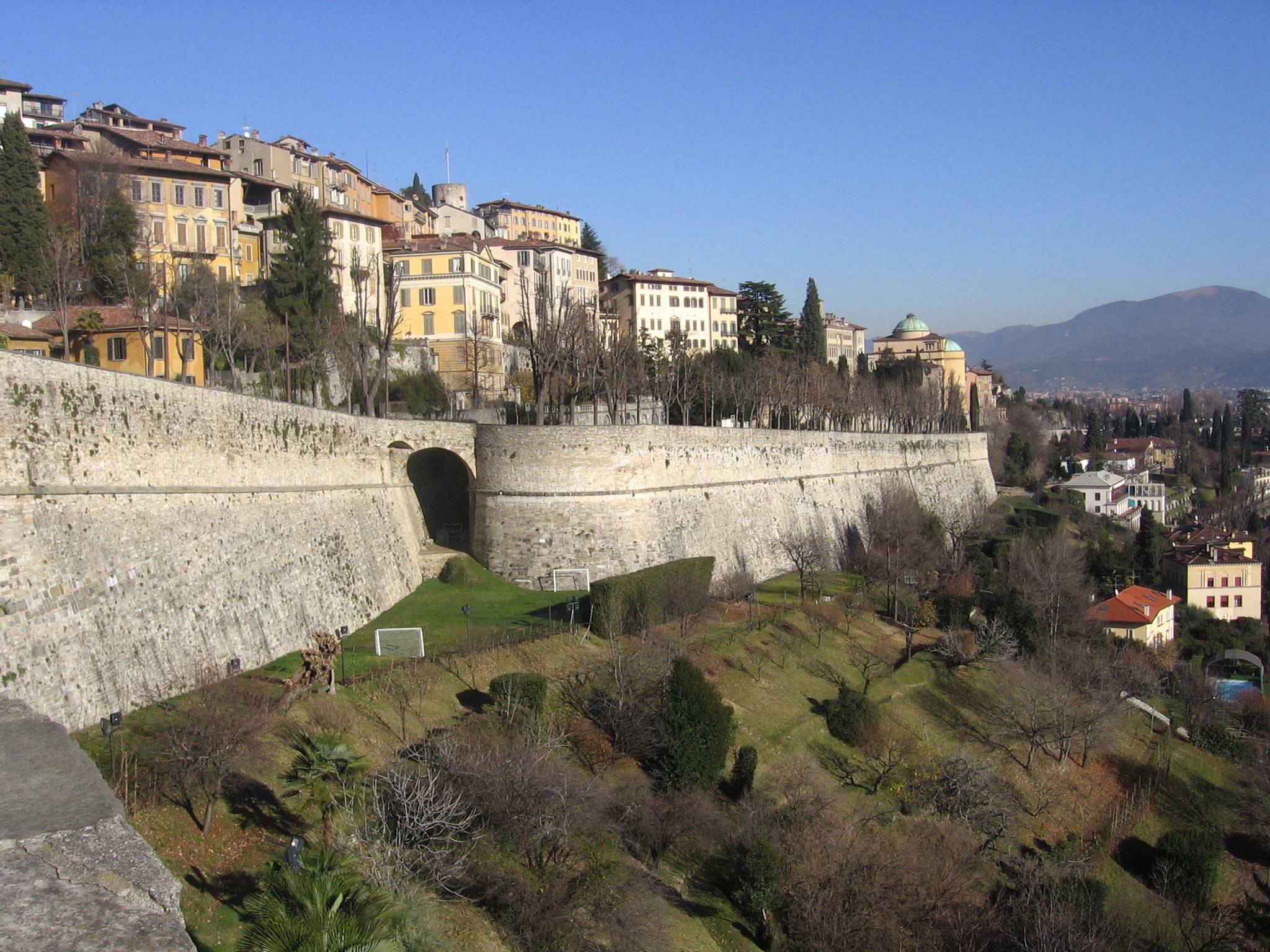
Venetian Walls - Bergamo
Europe,
Italy,
Bergamo,
Welcome to the Venetian Walls of Bergamo, an imposing fortification that tells the story and identity of this Lombard city. These walls, built between the 16th and 17th centuries, are among the best preserved and represent an extraordinary example of Renaissance military architecture. Recognized as a UNESCO World Heritage Site in 2017, the Walls not only protect the city but also testify to an era when Bergamo was an important stronghold of the Republic of Venice. Today, these fascinating structures are not only a testament to history but also a place where the past and present meet.Origins and History The Venetian Walls began construction in 1561, when Bergamo, under the dominion of the Republic of Venice, required a more solid and modern defense. The project was commissioned to the architect Giovanni Battista Lantana, who designed a wall that was not only functional but also aesthetic. The construction of the walls took over twenty years and was completed in 1596.The decision to build walls was part of a defense strategy in response to external threats, particularly from enemy powers of the Republic. The walls were intended to protect the city and control access routes. The defensive system consisted of bastions, curtains, and moats, featuring architecture typical of the Renaissance period, aimed at withstanding assault techniques and new armaments.Over the centuries, the Walls underwent various transformations and restorations. After the fall of Venice in 1797 and the annexation to the Kingdom of Italy, their use changed. During the 19th century, with the arrival of the new Italian state, the fortifications lost their military function and were repurposed for public spaces. The most significant restorations occurred in the 20th century, aiming to recover their historical integrity, leading to the completion of the pedestrian path along the perimeter of the walls, which is now accessible to everyone.The Venetian Walls are not just a simple monument; they are also a symbol of Bergamo, providing a visual and emotional connection to its past.What to Observe Now, as we approach the Walls, let me point out some key elements to observe.Let’s start with the main entrance: the San Giacomo Gate. This gate, located on the western side of the walls, is a magnificent example of military architecture. Built in 1592, it features a large semicircular arch and two side towers. The sculptural decorations, made of marble, represent symbols of the Republic of Venice and invite reflection on the power and beauty of the era.As you walk along the walkway of the walls, you will find yourself traversing paths lined with crenellations – those battlements that characterize the profile of the fortifications. These architectural elements not only had defensive functions but also served as observation points. Here you can enjoy an extraordinary view of the city of Bergamo and the surrounding plain.At this point, I encourage you to look towards the bastions. Their irregular shapes are designed to disorient attackers, making approach difficult. During your walk, you will notice how the uneven terrain and slopes have been strategically utilized to enhance defenses.On your right, do not miss the opportunity to observe the different materials used in the construction of the walls. From bricks to stones, each material tells stories of origins and construction techniques. These variations are the result of centuries of interventions and repairs, each contributing to the current appearance of the Walls.Continuing along the path, let’s take a moment to stop at the watchtowers, which are visible along the walkway. These towers were strategically positioned to monitor the surroundings and signal any dangers. Each tower has its own story, and together they narrate the ongoing threats that Bergamo faced over the centuries.Finally, let’s conclude our walk at the belvedere, where a breathtaking view over Bergamo Alta and Bassa unfolds. Here, the panorama prompts thoughts about the historical and cultural significance of these walls, which not only hold memories of battles and history but also represent a place for gathering and reflection.Context and Connections You are now in the heart of a rich historical and cultural context. The Venetian Walls are not merely a standalone attraction; they are part of a larger fabric of Bergamo’s history. In front of you, Bergamo Alta rises majestically, with its collection of historic buildings, including the Basilica of Santa Maria Maggiore, famous for its frescoes and beautiful marble floor.In close proximity, you will also find Piazza Vecchia, the beating heart of the city, where you can breathe in the atmosphere of a vibrant past. This area is surrounded by historic buildings, including the Palazzo della Ragione and the Campanone, an undisputed symbol of Bergamo.We invite you to discover the Colle di San Vigilio, accessible via a funicular, where you can enjoy a panoramic view that is even more complex and fascinating over the whole city and its surrounding hills. Here, the tranquility of nature blends with historical memories, offering a perfect encounter between architecture and landscape.Curiosities The Venetian Walls, approximately 5 kilometers long, were designed to withstand the cannon fire of the time, innovating the concept of fortification. During World War II, the Walls were used as shelters by citizens to protect themselves from bombings. The Walls host various cultural events and artistic manifestations annually, making them a vibrant and lively place, in addition to being historical.The Venetian Walls of Bergamo are just the starting point for a broader discovery. We invite you to explore the nearby Teatro Donizetti, an important cultural institution dedicated to opera and music, and the Palazzo della Ragione, a symbol of the civil power of the city. Enjoy your exploration!
Read More