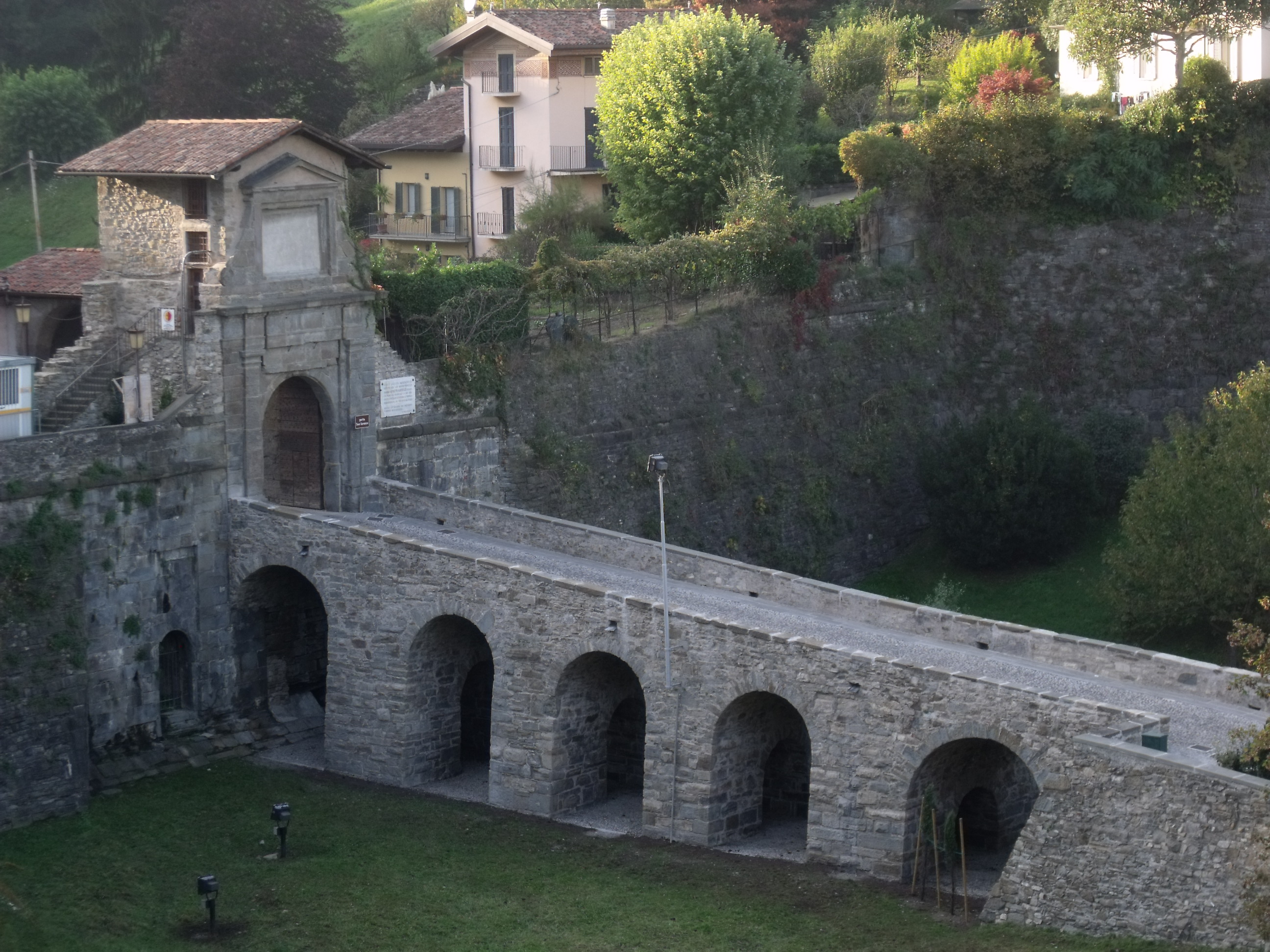
St Lawrence Gate - Bergamo
Europe,
Italy,
Bergamo,
Porta San Lorenzo, one of the historic gates that characterize the city of Bergamo. This monument serves as an entrance to the lower part of the city, revealing not only its strategic role in the medieval defensive system but also its importance in the cultural and historical identity of the area. Built between 1396 and 1401, Porta San Lorenzo is known for the frescoes that adorn its inner walls and for the influence it has had over the centuries in defining urban life in Bergamo. The gate is a symbol of the transition between the upper and lower city, witnessing the architectural development during the medieval period.Origins and HistoryThe history of Porta San Lorenzo has its roots in the 14th century, a time of great political and social upheaval in Bergamo. The construction of the gate was commissioned by the Republic of Venice, which at the time controlled the city and aimed to strengthen its defenses. The choice of the name “San Lorenzo” is linked to the city’s patron saint, whose cult was deeply felt by the population.In 1406, the municipality of Bergamo decided to expand its fortifications, and Porta San Lorenzo became a crucial element in this project. The architecture of the gate presents a mix of styles that reflect the various influences that have characterized the city over the centuries. Under the supervision of local architects, a significant renovation took place in the 17th century, giving it the form that we can appreciate today.In 1864, Porta San Lorenzo underwent further restoration, aimed at restoring its original beauty. During this period, attention was also focused on the preservation of the inner frescoes, which had been neglected for years. These frescoes, dating back to the 15th century, tell religious and mythological stories through vibrant colors and a descriptive technique that attracts numerous visitors.Although the gate has retained its medieval appearance, it has witnessed numerous historical events, including the Napoleonic occupation and Italian unification in the 19th century. Each era has left its mark on this monument, enriching it with stories and meanings.What to ObserveUpon arriving in front of Porta San Lorenzo, it is impossible not to notice its grandeur. The façade is built with local stone, giving the gate a rustic yet elegant appearance. The upper part is adorned with an imposing three-lobed window, an opening supported by columns, representing one of the typical architectural elements of the gates in the area and offering a suggestive view of the street below.Entering the gate, to your right, you will find a series of frescoes depicting the story of San Lorenzo. These paintings, attributed to an anonymous local artist from the 15th century, display a surprising liveliness, despite the passage of time. Their preservation has been perfected during restorations, maintaining the charm of these masterpieces.Continuing our exploration, in front of us opens a wide area that was once used for guard services. This area has been transformed into a small exhibition space, where visitors can admire some historical artifacts recovered during archaeological excavations in the surroundings. These artifacts provide insights into the various cultures that have succeeded one another in the Bergamo territory.In an effort to unveil the secrets of Porta San Lorenzo, pay close attention to the sculptural decorations present on the gate itself. You will notice figures of saints and symbols that evoke the strong connection of the building with religious tradition. These details, often overlooked by hurried visitors, tell ancient stories and testify to the devotion of the city’s community.At the top of the gate, one can observe the famous coat of arms of the Republic of Venice, a symbol of the Venetian power that ruled the city. This emblematic feature is fundamental for understanding the historical context in which Porta San Lorenzo was created and its significance as a bastion of the Republic.Finally, don’t forget to pause and enjoy the view from the gate’s guard post. From here, you can glimpse the surrounding landscape, with the hills embracing Bergamo and, if the weather is clear, the silhouette of the Alps in the distance. This is a place where the past and the present intertwine, and every visitor can feel the call of history.Context and ConnectionsPorta San Lorenzo is not just an isolated monument but fits perfectly into the context of the surrounding area. We are in the Lower City of Bergamo, a zone that shows a fascinating architectural intertwining between medieval works and modern structures. A short walk from the gate is Palazzo Frizzoni, the seat of the Municipality of Bergamo, which represents the heart of the city’s administration. This palace is an important example of neoclassical architecture and constitutes another piece of Bergamo’s history.Moving slightly north, you arrive at Piazza Vittorio Veneto, a meeting and socializing place for citizens and tourists. Here, small cafes and restaurants offer the chance to taste local cuisine, taking advantage of the lively atmosphere that characterizes this square.Another point of interest near Porta San Lorenzo is the Church of San Bartolomeo, which dates back to the 12th century. This church features a marvelous bell tower and fascinating frescoes, making it an ideal destination for those wishing to delve into the art and religious history of Bergamo.CuriositiesDid you know that Porta San Lorenzo has been adapted and used as a venue for temporary art exhibitions? This contemporary reuse has helped keep alive interest in this important symbol of the city, integrating it into the modern cultural life of Bergamo.Another interesting fact concerns the well-known cycle of frescoes inside the gate: it seems that some of them depict not only saints but also historical figures linked to Bergamo and its evolution over the centuries. Art historians have studied these representations extensively, identifying references to key moments in local history.Finally, Porta San Lorenzo is frequently used as a venue for events and outdoor theater performances. This tradition contributes to keeping the history and culture of Bergamo alive, engaging citizens and tourists in a shared experience that unites the past and the present.
Read More