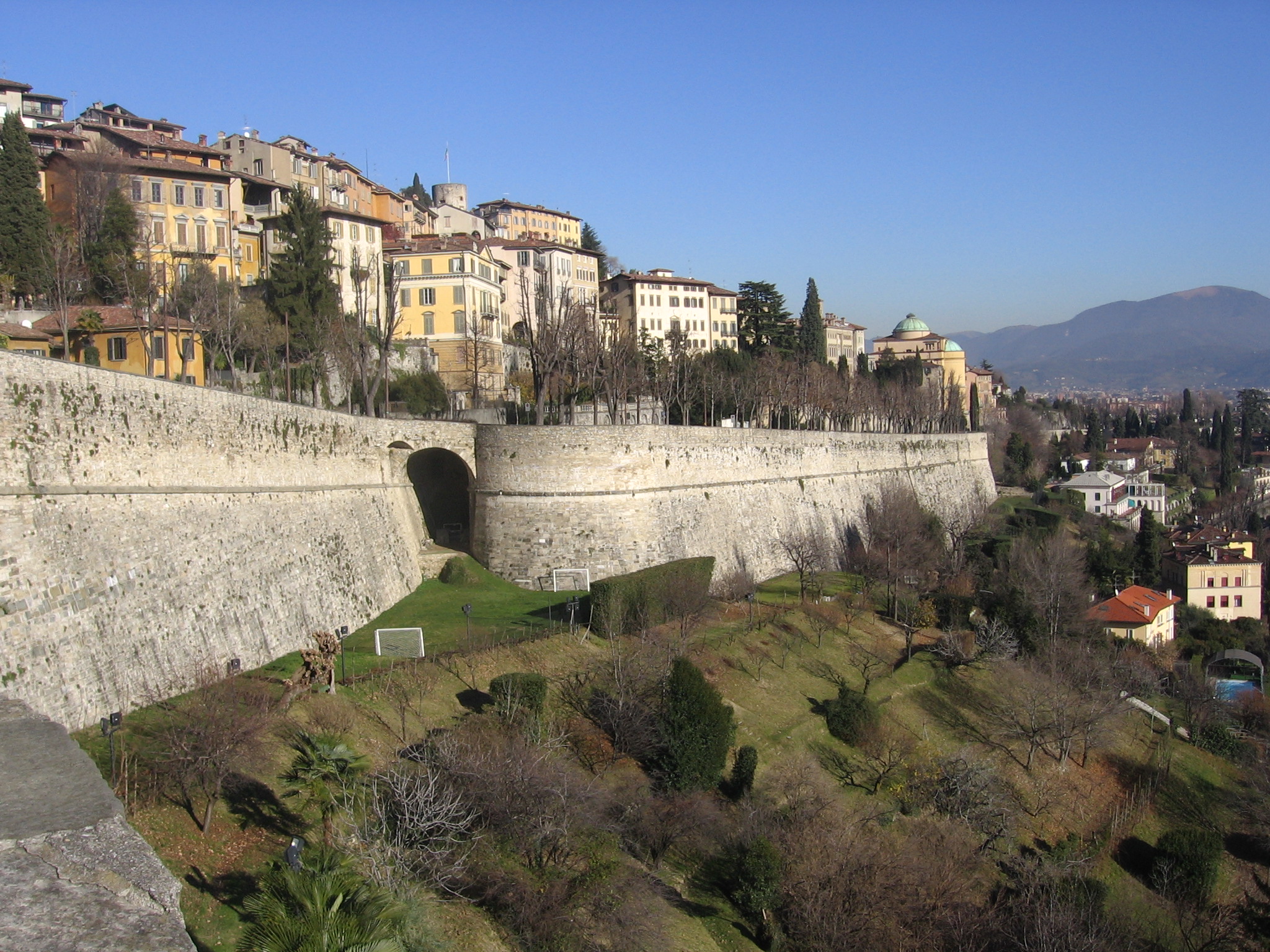
St Alexander Gate - Viewpoint - Bergamo
Europe,
Italy,
Bergamo,
Porta Sant’Alessandro, an important access point to the city of Bergamo, plays a fundamental role in the identity and history of the city. This gate, part of the fortification system of the Città Alta, dates back to the period of Venetian domination in the 17th century and is known for its evocative architecture and the breathtaking panorama it offers over the underlying valley. The construction of the gate began in 1631 and was completed in 1644, a time of great urban and defensive development for Bergamo. Today, Porta Sant’Alessandro not only represents a historical monument but also a place of gathering and contemplation, capable of attracting tourists and locals for its beauty and symbolic significance.Origins and History The origins of Porta Sant’Alessandro are intertwined with the defensive needs of the city of Bergamo. Before the erection of the current gate, the city already had a system of fortifications that protected it from external invasions. Starting from the 1620s, the Venetians decided to expand and modernize these walls, and in 1631, the project for the gate was entrusted to Giovanni Battista Formenti, an architect distinguished for his ability to integrate architectural elegance and defensive functionality.Construction continued until 1644, the year Porta Sant’Alessandro was finally completed. The gate is characterized by an imposing structure, with two lateral towers that give it a majestic appearance. Initially, the gate featured a drawbridge, an essential element for defense, which was later replaced with a more stable structure over the centuries. The choice of the name Sant’Alessandro is not accidental: the city’s patron saint, Alessandro, is a central figure in local devotion, and this gate represented the bond between sacredness and urban life.Over the years, Porta Sant’Alessandro has undergone several restoration and maintenance interventions aimed at preserving its architectural integrity. Among these, one of the most significant restorations took place in the 19th century when some parts of the structure were modernized to adapt to the needs of increasing urban traffic. Today, the gate is not only a testament to the past but also a tribute to Bergamo’s history, reflecting the social and cultural transformations that have characterized the city.What to Observe As you approach Porta Sant’Alessandro, you can notice its imposing façade, made of local stone, which integrates beautifully with the surrounding landscape. A triumphal arch awaits you, whose curvilinear shape is typical of Baroque architecture. The plasterwork and decorations have been skillfully preserved, showcasing the artisan techniques of the time.Upon entering the complex, to the right, you have the opportunity to observe the two lateral towers. These towers are not just decorative elements; they also serve as defensive tools. The interior of the towers features arrow slits, openings designed to allow visibility outside without being seen. This reflects the strategic intelligence of the builders of the time, intended for a city that had to defend itself.Continuing to explore, the lookout point above the gate offers an unrivaled view of the city and the valley. From this vantage point, you can admire the iconic skyline of Bergamo, with its towers and red roofs. This viewpoint is particularly striking at sunset when the sun colors the sky with shades of orange and pink, creating an almost magical atmosphere.Take a moment to also observe the ornamental details present on the façade, such as the statues and bas-reliefs representing symbols of the city. These elements tell stories and legends that date back centuries, encouraging reflection on Bergamo’s culture and traditions.If you proceed to the left side, you can admire an ancient rainwater drainage system, a testament to the care of hydraulic elements in the design of Porta Sant’Alessandro. This architectural feature may not impress you immediately, but it is a valid example of the technical skills of the builders of the time.Finally, don’t forget to observe the inner courtyard, where you can glimpse remnants of ancient pavements and various artifacts that testify to daily life at the time of its construction. Visiting these spaces allows you to get an idea of how life was in 17th-century Bergamo.Context and Connections Porta Sant’Alessandro fits perfectly into the context of Bergamo’s Città Alta, an area rich in history and culture. Its strategic position connects it to important communication routes and other tourist attractions. Strolling nearby, it is easy to reach the Palazzo della Repubblica, another symbol of Bergamo’s history, or the Bergamo Cathedral, which houses extraordinary works of art.Additionally, in the surrounding area, we find the Colle di San Vigilio, easily reachable from Porta Sant’Alessandro. This hill offers another panoramic view of the city and, within it, visitors can explore the San Vigilio fortification and the San Vigilio Castle, an interesting testament to the military history of the city.Finally, we cannot forget the Basilica of Santa Maria Maggiore, just a few steps away. This splendid example of Romanesque architecture is a true jewel of Bergamo, with richly decorated interiors featuring frescoes and works of art.Curiosities Porta Sant’Alessandro is not just a passage but a place of meeting and narratives. One curiosity is that the celebrations for the feast day of Sant’Alessandro, the city’s patron saint, take place right near this gate. During the festivities, many citizens and tourists crowd the area, creating a lively and festive atmosphere.Furthermore, during the years of Venetian domination, Porta Sant’Alessandro served not only as an access point to the city but also as a control point for trade passing through it. In fact, there were tariffs imposed on goods and products entering the city, reflecting the economic and strategic importance of the gate.Another curiosity concerns the legends associated with Porta Sant’Alessandro. Some recount stories of ghosts and apparitions that occurred nearby as signs of the city’s protection. These stories, passed down through time, have contributed to making the gate a fascinating place full of mystery.Embarking on a journey to discover Porta Sant’Alessandro is thus an experience that goes beyond mere architectural observation; it is an immersion in the history and culture of Bergamo, with opportunities to further expand your experience by visiting other adjacent historical places, such as the Palazzo della Repubblica and the Basilica of Santa Maria Maggiore. Happy exploring!
Read More