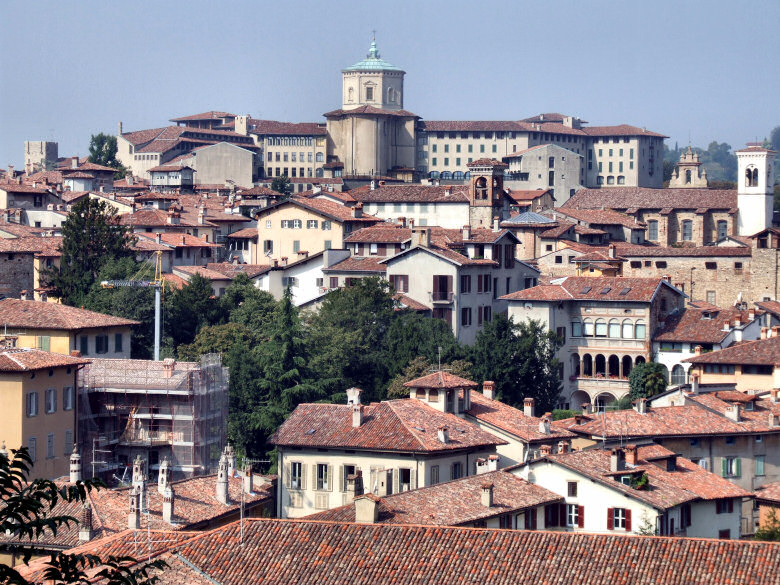
St Alexander Gate - Inner Courtyard - Bergamo
Europe,
Italy,
Bergamo,
Porta Sant’Alessandro, one of the most fascinating and historically rich places in the city of Bergamo. This gate, which marks the entrance to the upper city, represents an important element of Bergamasque identity. Built in the 16th century during the rule of the Republic of Venice, Porta Sant’Alessandro is known not only for its architecture but also for the role it played in the defense of the city over the centuries. The gate is a symbol of transition between the past and the present, reflecting the architectural influences of a crucial historical period.Origins and HistoryPorta Sant’Alessandro was constructed between 1580 and 1583, under the direction of architect Giovanni Battista Della Torre. The construction is part of a broader context of fortifications that characterized Bergamo during the Venetian era. The city, located in a strategic position between Milan and the rest of Europe, required adequate defenses to protect itself from external attacks.In the following centuries, Porta Sant’Alessandro underwent various interventions and restorations. Between the 19th and 20th centuries, with the advent of industrialization and changes in the urban context, it was adapted to meet the new needs of the population. The gate witnessed significant historical events, including the Napoleonic occupation and the unification of Italy. During the years of the fascist regime, it underwent further modifications, but many of its original features were fortunately preserved.In 1932, a restoration aimed at returning it to the glory of past times led to the discovery of some internal decorations and structures that were no longer visible. These discoveries have allowed for a better understanding not only of the architecture of the gate but also of its strategic and symbolic significance for the city.What to ObserveAs you approach Porta Sant’Alessandro, what immediately strikes you is its facade, characterized by an elegant architraved portal. At the top, you can notice a stone coat of arms, the symbol of the Republic of Venice, as a testament to the period when the city was under its rule. This decoration is not just an aesthetic element; it represents the political and military power of Venice in the 16th century.Inside, the courtyard offers a suggestive view. Here, on both sides, you can admire the ancient defensive walls, built with carefully arranged bricks and adorned with battlements. These elements not only represent a form of defense but also convey the architectural prestige of the era.In the courtyard, take a moment to observe the remnants of some ancient inscriptions and engravings on the walls. They tell stories of the people who have passed through over the centuries. Each graffiti could narrate an anecdote, a silent testimony of a past rich in events.Moving towards a corner of the courtyard, you will have the opportunity to discover a small staircase that leads to an upper terrace. Here, the view extends over the lower city and the surrounding hills. This is a privileged viewpoint that offers a unique perspective, not only of the city but also of the natural wonders of the surroundings.Also observe the details of the windows: the worked stone frames display an elaborate design typical of Venetian architecture of the period. These elements are a demonstration of the craftsmanship and attention to detail that characterized the builders of the time.Finally, do not forget to explore the lesser-known corners of the courtyard. Small niches may reveal fountains and other decorative elements that should be looked at closely to uncover the profound essence of this place.Context and ConnectionsPorta Sant’Alessandro is not just an isolated monument; it is part of an urban context rich in history. It is located in the district of the Città Alta, which is a true open-air museum. Walking nearby, you can visit the beautiful Piazza Vecchia, the pulsating heart of social and cultural life in Bergamo. Here, the facade of the Palazzo della Ragione and the Campanone are also symbols of ancient Bergamo.Not far from Porta Sant’Alessandro, you will also find the Basilica of Santa Maria Maggiore, a masterpiece of Romanesque architecture and one of the most representative places of worship in the city. Here you can admire works of art by both local and non-local artists, making the visit an excellent opportunity to further explore the history and culture of the city.Finally, if you have time, we recommend visiting the Museum of Natural Sciences of Bergamo, located in a historic villa. This museum offers an interesting exhibition of artifacts that tell not only the natural history of the Bergamo area but also its connection with humanity over the centuries.CuriositiesAn interesting curiosity concerns the ancient uses of Porta Sant’Alessandro. In the past, the gate was not only a point of access but also a place of commercial exchange. Merchants would gather here to negotiate and barter goods, making the gate a vital center for the local economy.Additionally, it is worth noting that over the centuries, Porta Sant’Alessandro has been used as a lookout and defense point. Soldiers often found themselves here, ready to intervene in case of attacks. This triggered stories of courage and refusal of the enemy that resonate in the legacy of this place.Another fascinating aspect is the symbolism of certain architectural elements. For example, the merlon found at the top of the gate serves not only a defensive function; it also represents a symbol of power and nobility, recalling ancient military traditions.We invite you to further discover the surrounding area, immersing yourself in Bergamo’s culture through a visit to Piazza Vecchia and the Basilica of Santa Maria Maggiore. Every corner of this city tells stories waiting to be narrated. Happy exploring!
Read More