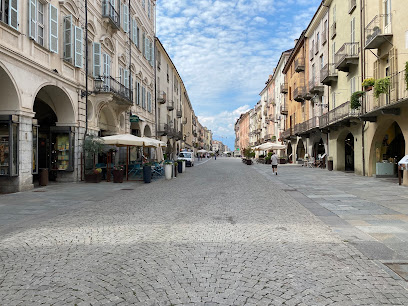
Rome Street – Cuneo
Europe,
Italy,
Cuneo,
Welcome to Cuneo, a city rich in history and charm. Today we focus our attention on Via Roma, a vital artery, not only for its roadway function but also for its historical and cultural significance. The porticoes of Via Roma date back to the end of the 19th century and represent a fine example of commercial architecture. This place has witnessed important episodes in Cuneo’s history and continues to be the vibrant heart of urban life. Even today, Via Roma is known for its shops, cafes, and restaurants that overlook the elegant columns characterizing its porticoes. The origin of Via Roma is closely linked to the urban development of Cuneo, which expanded significantly during the 19th century. After the Unification of Italy, Cuneo experienced rapid economic and demographic growth due to its important commercial role. This transformation period required the modernization of infrastructures and the creation of roads suitable for the needs of the expanding population. The construction of the porticoes of Via Roma began in 1878, aimed at ensuring not only aesthetic improvement but also practical advantages by creating a covered space for pedestrians, favorable to trade. The porticoes were designed in a neoclassical style, an architectural movement that drew on the canons of ancient Greek and Roman civilizations. This style is characterized by its symmetry, use of columns, and references to elements of great formal rigor. Over the years, Via Roma has undergone several transformations. In the 1930s, the fascist government promoted a series of beautification projects in Italian cities, and Cuneo was no exception. During this period, many buildings were renovated, and the porticoes were kept in excellent condition. With World War II, Cuneo was affected by bombings that hit various buildings, but fortunately, the porticoes largely remained intact, preserving the integrity of the historical heritage. In the post-war period, Via Roma became an increasingly vital commercial center, with shops and restaurants contributing to the vibrant atmosphere of the street. In the 1980s, restoration work was initiated to safeguard the beauty and structure of the porticoes, which today, like then, represent not only a passageway but also a testimony to Cuneo’s history and identity. As we walk along Via Roma, there are several elements not to be missed. Just as you enter the street, on the left, you can notice the elegant columns supporting the portico: these Doric-style columns are a testament to classical architectural tradition and add a sense of grandeur to the environment. Continuing along the portico, on the right, pay attention to the facades of the buildings facing the street. Here you will find a mix of architectural styles, from neoclassical to rationalism, that tell the story of the city’s evolution over the centuries. If you keep walking, you will reach the “Piazzetta dei Musei,” where there are some small spaces dedicated to local art and culture. This is a great spot to stop and reflect on the role that Via Roma has played in the city’s cultural life. Halfway down, you will find a particularly interesting building: the Palazzo Pavesi, a notable example of civil architecture, distinguished by its elegant balcony. This palace is emblematic of the historical period when the porticoes were built and, despite renovations, retains its architectural beauty intact. As we conclude our journey, don’t forget to observe the shop windows. Here, tradition and innovation intertwine, offering a wide range of products, from local culinary specialties to crafts. Via Roma fits into a rich and articulated urban context. In fact, by continuing on for about five minutes on foot, you will find Piazza Galimberti, another fundamental landmark of the city. This square, bustling with events and markets, acts as a catalyst for Cuneo’s social life. Not far from Via Roma, you can also visit the Church of San Francesco, an example of Baroque architecture that deserves a visit. The church houses significant works of art that narrate the spirituality and art of the region. Finally, I recommend taking a stroll to the Parco della Resistenza, a green area that offers a panoramic view of the city and a place for reflection on Italy’s recent history. An interesting aspect is that during the period when the porticoes were constructed, a regulation was adopted that required shopkeepers to keep their spaces clean and decent. This demonstrates an awareness of the importance of aesthetics for attracting customers even at that time. Additionally, during a time of increasing social and political tensions, Via Roma also became a place of meeting and discussion, a focal point for the peaceful demonstrations that characterized 20th-century Cuneo. Finally, the porticoes of Via Roma have been a set for some films, thanks to their beauty and uniqueness, thus becoming a kind of local cinema star. We invite you to further discover Cuneo, immersing yourself in its history through the numerous charming corners and places of interest the city offers. Happy exploring!
Read More