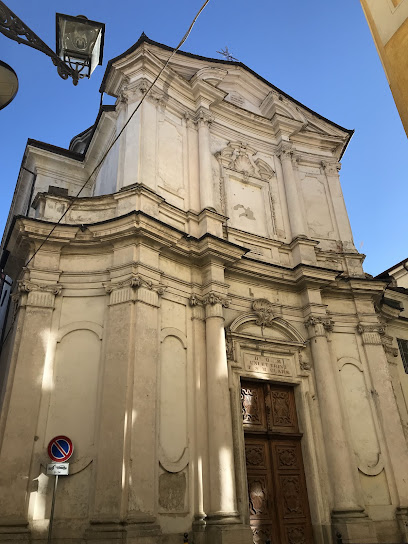
Church of St. Clare – Cuneo
Europe,
Italy,
Cuneo,
Welcome to the Church of Santa Chiara, a jewel of the city of Cuneo, located in the heart of the historic center. This church, dating back to the 18th century, is known for its Baroque architecture and its important role in the cultural and spiritual life of the Cuneo community. Santa Chiara is not just a place of worship but also a symbol of the city’s history and artistic evolution, representing the spirituality and identity of its citizens. Construction began in 1705 and was completed in 1725, a period during which Cuneo was growing and asserting itself as a regional center. Inside, you will find extraordinary works of art that bear witness to the religious fervor of the time and the mastery of local artists. The Church of Santa Chiara was built at the request of the Poor Clare nuns, a mendicant order founded by Saint Clare of Assisi. The nuns moved to Cuneo in 1582, initiating a building project that lasted several decades. The church was designed by the architect Francesco Gallo, a prominent figure of Piedmontese Baroque, known for his ability to combine elegance and functionality. The origins of the church are intertwined with the history of the city. In the 17th century, Cuneo was in a period of great economic and cultural development, marked by population growth and the construction of new religious buildings. The decision to dedicate the church to Saint Clare was significant, as it represented an ideal of religious life and community that mirrored the aspirations of the women of Cuneo at that time. Construction of the church began in 1705 and took nearly twenty years to complete. The work was characterized by numerous interventions and modifications, so much so that in 1725 the church was finally consecrated. During the construction period, the nuns continued to provide hospitality and educate local girls, keeping alive the tradition of their order focused on the welfare of the community. In 1810, with the Napoleonic reforms, the convent of the Poor Clares was suppressed, and the church became parochial. This change led to new transformations within the structure, adapting to the needs of the local community. The 19th century also saw some restorations aimed at keeping the church in good condition and updating the internal decorations, while still preserving its Baroque essence. Throughout the 20th century, the Church of Santa Chiara underwent further restoration efforts, continuing to play an important role in the religious life of Cuneo. Today, it is an active place of worship where religious functions and cultural events are held, maintaining that historical connection to its origins. As you step over the threshold of the Church of Santa Chiara, you will be struck by the majesty of the façade, which features an elegant play of volumes and geometries typical of the Baroque style. The façade is characterized by a main portal surmounted by a large curvilinear tympanum adorned with busts of saints and angels, a testament to the great care taken with the details. Once inside, you will find yourself in an environment rich in stuccos and decorations. The ceiling is splendid, adorned with frescoes depicting scenes from the life of Saint Clare and other religious figures. These frescoes, created by local artists, date back to the early 1700s and are a testament to the Piedmontese painting tradition. On the right side of the nave, you can see an altar dedicated to the Madonna, made of polychrome marble. This altar is flanked by statues of saints, reflecting the deep religious fervor of the community. The care and dedication with which these works of art were created are indicative of a period of intense artistic creativity. On the opposite side, to the left, is the main altar, a true masterpiece. This altar is dedicated to Saint Clare and features a large painting of her, surrounded by a golden frame that highlights the saint’s figure. The painting is the work of an artist active in Cuneo in the 18th century and demonstrates the importance of Saint Clare to the community. As you continue down the central nave, do not forget to look up at the beautifully carved wooden choir. This choir, which dates back to the early 1700s, is an example of the craftsmanship and artistry that characterized the period. The details of the carvings are so intricate that they show the passion and dedication of the artisans of the time. Finally, do not miss the view of the crypt, a lesser-known but historically significant part. The crypt, accessible from the back of the church, houses tombs and relics that tell the story of many Cuneo families. Here you will find the atmosphere of contemplation that characterizes places of worship, inviting you to reflect on the history that permeates the walls of this church. As you approach the exit, be sure to take one last look at the frescoes and decorative details that adorn the entire space. Every corner of the Church of Santa Chiara tells a story, a deep connection to the faith and culture of Cuneo. The Church of Santa Chiara is located in the heart of Cuneo’s historic center, a strategic position that makes it an integral part of city life. This neighborhood is characterized by a rich architectural history, with various buildings that testify to past eras. Next to Santa Chiara, you can visit the Town Hall, a building dating back to the 17th century and representing an important example of civil architecture. Similarly, not far away, you will find the Teatro Toselli, a place of culture and entertainment that continues to pulsate with life and activity. Another institution of great value is the Civic Museum of Cuneo, which offers an important collection of works of art and historical artifacts, providing better context for the city’s cultural heritage. As you stroll through the streets near the church, you can feel a unique atmosphere, the result of the convergence of history, art, and daily life. This is an invitation to explore not only the Church of Santa Chiara but also the many stories woven into the city’s fabric. The Church of Santa Chiara is not only a place of worship but also has a number of curiosities related to its history. For example, during World War II, the church was used as a shelter for many Cuneo citizens fleeing the bombings. Its imposing structure offered refuge and safety during a time of great uncertainty. An interesting feature of the church is its acoustics. The nave is designed to amplify the voice of the priest during services, making the experience of participating in the mass profoundly engaging. Finally, the church has undergone numerous restorations but has retained its original beauty. As you walk through the naves, you may notice the signs of time in the small imperfections of the decorations, which tell the story of a lived-in place.
Read More