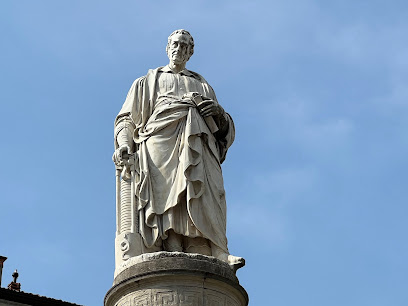
Statue of Alessandro Volta, Como
Europe,
Italy,
Como,
Welcome to Como, a charming city situated on the shores of the lake of the same name, famous not only for its natural beauty but also for its rich history and illustrious citizens. Today, we will focus on an emblematic monument: the Statue of Alessandro Volta. This sculpture, inaugurated in 1892, celebrates the figure of the great scientist from Como, known for his discoveries in the field of electricity, particularly for the invention of the electric battery, the first electrical generator. The statue is located in a privileged position, in the heart of Como, just a few steps from the lake. Alessandro Volta, born in 1745 and died in 1827, is not only a symbol for the city but also an important representative of the history of world science. His legacy lives on through his studies and inventions, which have revolutionized the way we understand electricity. The creation of the statue of Alessandro Volta is the result of a long process that reflects not only the desire to commemorate a great scientist but also the importance of science during a time of great technological and industrial development. The decision to erect a monument in his honor was made in 1882, coinciding with the centenary of his discovery of the battery. The commission for the statue was entrusted to the local sculptor Giovanni Battista Comolli, known for other notable works in the city. The statue was made of bronze and rests on a tall granite base, designed to elevate Volta’s image and make it visible from afar. Volta’s pose is dignified and proud; he holds in his right hand a model of the battery, symbol of his most famous invention. The inauguration took place on May 20, 1892, in the presence of various local authorities and citizens who came to pay tribute to their illustrious fellow citizen. Over the years, the statue has undergone various restoration interventions. One significant restoration took place in the 1980s, when it was necessary to restore some of its most damaged parts due to weather conditions. This was part of a broader project to enhance the cultural assets of the city, which led to renewed attention to Volta’s legacy and its impact on science. The figure of Alessandro Volta has gained increasing importance in the educational and cultural context of the city of Como, so much so that in 1936, on the centenary of his death, a school dedicated to him was established. This is certainly not an isolated case; Volta has been celebrated in numerous ways over time, with events, manifestations, and even the establishment of a scientific award named after him, to honor those who have excelled in the field of sciences. Now, as we approach the statue, you can notice several elements that deserve special attention. The monument is located in Piazza Volta, a square that Volta himself helped make famous in the world. The Facade of the Statue The main facade of the statue has been designed with great care. Volta is represented in academic robes, emphasizing his role not only as an inventor but also as a scholar and professor. The imposing statue, over four meters tall, immediately captures attention. Iconographic Details As we get closer, you can notice the model of the battery he holds in his right hand. This is a fundamental representation of his invention, which in the 1800s changed the course of the history of physics and engineering. The battery is considered the first true generator of artificially produced electric current. The Base The granite base on which the statue stands is another important element. It was designed in a neoclassical style, typical of late 19th-century architecture. The commemorative inscriptions engraved on the stone tell the life and works of Volta, making the statue not only a work of art but also a historical testimony. The Environmental Context If you turn around, you can appreciate the beauty of the square, which is set in a green context, delightfully adorned with plants and flowers. This makes Volta’s statue not only a cultural landmark but also a place of relaxation for visitors. The Light and the Play of Shadows Another interesting aspect is the play of light on the surfaces of the statue. During the day, the sun creates reflections that animate the bronze, and at different times of the day, the statue will appear ever different. This theatrical aspect provides yet another reason to stop and admire the monument from various angles. Surrounding Works Finally, let us not forget that in the immediate vicinity of the statue are other significant works. In particular, the Monument to the Fallen and the Garden of Villa Olmo, which make this area of Como a real open-air museum, where history, art, and nature intertwine harmoniously. Piazza Volta is not only the place where the statue stands, but it is also a gateway to an area rich in history and culture. A few steps from the statue, you will find the Educational Silk Museum, dedicated to one of Como’s traditional activities, silk production. This museum offers an interesting insight into the connection between the city and this industry, which dates back to medieval times. In the opposite direction, toward the lake, you will find the Voltiano Temple, a museum dedicated to the memory of Alessandro Volta and his scientific discoveries. Inaugurated in 1928, this neoclassical building houses a collection of scientific instruments and works of art that celebrate his contribution to science. Of course, we cannot forget the nearby Teatro Sociale, another cultural landmark of Como, known for its exceptional acoustics and vibrant cultural programming. Every visit to Como is enriched by the opportunity to discover connections between art, science, and history, all alive in the urban fabric. 1. The Volta Prize: Every year, in honor of Alessandro Volta, a prize is awarded that celebrates the best research in the fields of science and engineering. This prize continues to encourage scientific innovation and technological progress. 2. The term “volt”: The volt, the unit of measurement for electric voltage, was officially renamed in honor of Volta in 1881. This is a tangible example of the lasting impact of his discoveries in the scientific world. 3. Symbols of Electricity: Volta’s battery is not just a scientific object. It has become a symbol of the struggle for innovation and progress, inspiring generations of scientists and engineers to pursue new discoveries. We invite everyone to continue their exploration of Como by visiting the Educational Silk Museum and the Voltiano Temple, both places that offer a fascinating insight into the life and works of Alessandro Volta and the blend of art and science that characterizes this beautiful city.
Read More