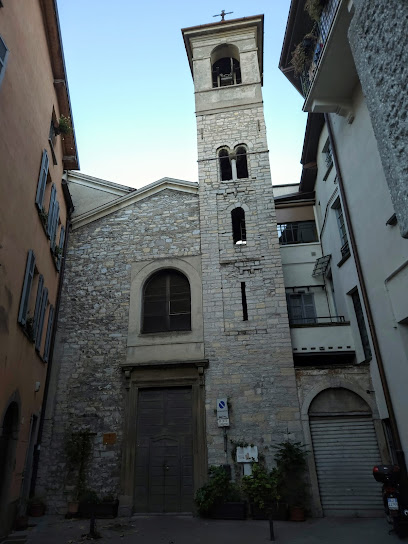
Church of Saint Provino, Como
Europe,
Italy,
Como,
The Church of San Provino, located in the heart of Como, is an architectural treasure that embodies the spirituality and history of this fascinating city. Founded as early as the 8th century, it represents an important landmark not only religiously but also culturally and artistically. Its Romanesque structure is a testimony to the artistic and religious influences that have characterized the Larian territory over the centuries. It is known for its wonderful interior decorations and the atmosphere of reflection that it conveys to visitors. This church is an example of how faith can be expressed through art and architecture, and deserves to be discovered with care and curiosity. The origins of the Church of San Provino date back to the 8th century when it was erected in honor of San Provino, the first bishop of Como, revered by the local community. This church represents one of the earliest Christian architectural testimonies in the region, a time when Christianity was deeply taking root in the social and cultural fabric of the area. Over the centuries, the church has undergone numerous transformations, both due to functional necessities and as a result of significant historical events. During the medieval period, its structure was partially modified, and documents attest to restorations and expansions carried out between the 14th and 15th centuries, coinciding with the demographic growth of the city and the increasing importance of ecclesiastical life. An in-depth look at the restoration of the church is particularly interesting: in the 19th century, thanks to the work of architect Luigi Pellas, consolidation and renovation works were undertaken that led to a renewed splendor of the church. Neo-Romanesque styles were chosen, reintegrating existing elements and giving the structure a double significance: historical and modern, a product of the artistic sensitivity of the time. Moreover, in the 20th century, the Church of San Provino saw another restoration intervention, which helped preserve its integrity and made certain parts of the building more accessible, always respecting the primitive architecture. Between 1945 and 1950, for example, significant restoration work was carried out on the internal frescoes and the high altar, also restoring the original colors of the decorations. When approaching the Church of San Provino, one is immediately struck by its Romanesque façade, characterized by an arched portal and carved decorations. Note the interesting rose window above the portal, which illuminates the interior with unique plays of light, creating an almost mystical atmosphere. Upon entering, you are struck by the central nave, divided by columns that support the Gothic vaults. These columns are not only elegant but also reference the architectural language of Christian basilicas. The light filtering through the stained glass tells stories of saints and biblical episodes, enriching your view with meanings and colors. At the end of the nave, you will find the high altar, a masterpiece decorated with a series of frescoes dating from different eras, reflecting stylistic changes throughout the centuries. On one side, you can observe sculptures depicting scenes from the life of San Provino, a symbol of the religious devotion of the community of Como. As you continue inside, do not forget to gaze up at the ceiling. Here, the stucco decoration represents various scenes from the life of Christ and Mary, executed by local artists. The refinement of the details and the skillful use of light offered by the openings contribute to creating a spiritual dimension that invites meditation. Another fascinating element is the side chapels, dedicated to various saints. Each of them houses significant artworks and relics, celebrating different aspects of faith and devotion. In one of these chapels, you will even find an ancient crucifix, a testament to a past rich in spirituality and sacred art. It is not just the art that makes this church unique but also its location. The Church of San Provino stands in an area that offers a panoramic view of the city of Como. While you are there, take a moment to observe the exterior, the urban context that surrounds it, and how it interfaces with the natural beauty of Lake Como. The Church of San Provino is located in one of Como’s historic neighborhoods, rich in charm and tradition. Its strategic position makes it not only a place of worship but also a landmark for exploring the surrounding architecture and the city’s cultural heritage. Nearby, within walking distance, you can visit other attractions of great interest. On one side, the Cathedral of Como, a masterpiece of Gothic architecture, embodies the heart of the city and represents its history. On the other side, not far away, is the Civic Museum, where you can admire works of art that tell the local history from prehistory to today. Both of these places are easily reachable on foot, providing an ideal path for a day of discovery. Furthermore, do not forget to visit the Volta Temple, dedicated to Alessandro Volta, which is located nearby. This museum is a tribute to the illustrious scientist from Como and further enriches the cultural landscape of the area, creating a perfect itinerary of historical and artistic depth. Although the Church of San Provino is less known compared to other attractions in Como, it has particular features that deserve to be highlighted. For example, it is interesting to note how the liturgical celebrations here have remained very traditional, keeping alive customs and practices that date back centuries. This is a distinctive element that makes it a lively and active place of worship. Moreover, the church is associated with the cult of San Provino, whose feast is celebrated every year, attracting faithful and visitors who wish to honor the memory of this saint. The bond with the figure of the saint is so strong that various local popular legends are hidden within the walls of the church, enhancing its charm and importance within the community. Finally, historical documents testify that the Church of San Provino has undergone various adaptations and modifications over the centuries, including the addition of new altars and works of art, but it has always maintained its original character, uniting the past and present in a harmonious embrace.
Read More