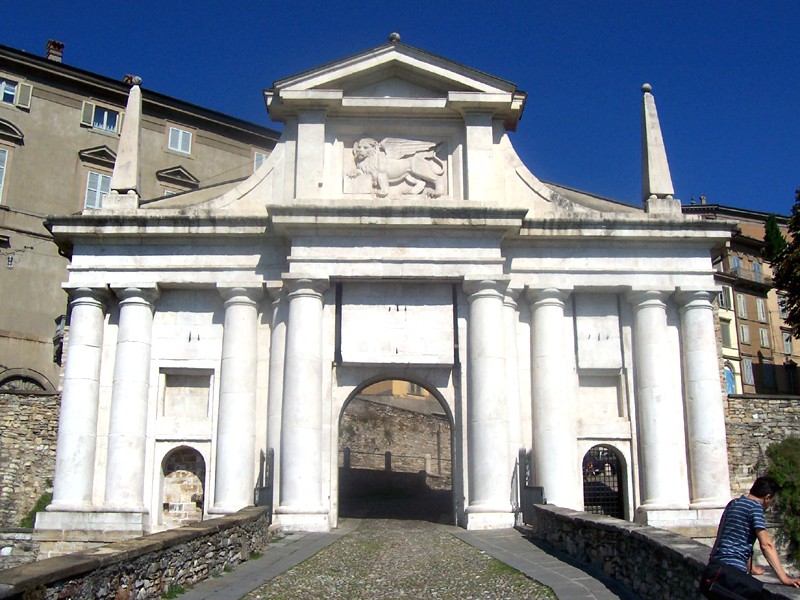
Arch of Porta San Giacomo - Loggia - Bergamo
Europe,
Italy,
Bergamo,
The Arch of Porta San Giacomo is one of the most fascinating historical entrances in the city of Bergamo, particularly in its Città Alta. It is located in a strategic position, serving as a gateway between the medieval world and the city’s Renaissance heritage. This gate, built between 1598 and 1600, is not just a simple access point, but a symbol of the history and identity of Bergamo. With its elegant loggia, the arch represents an important architectural testimony, known for its role in the city’s fortifications and as a connecting point between the ancient and the modern.Origins and HistoryThe history of the Arch of Porta San Giacomo is closely linked to the evolution of the walls of Bergamo. The walls surrounding the Città Alta date back to the 15th century, a period of great development for Bergamo, under the domination of the Republic of Venice. However, the construction of the arch took place in a specific historical context, during a transition towards the Baroque era.In 1592, the Republic of Venice commissioned the architect Giovanni Battista Basilio to design a reinforcement system for the city’s gates. Porta San Giacomo, previously a simple opening in the wall, was then transformed into an imposing architectural work. Repairs and embellishments took place in subsequent centuries, but its original appearance has largely been preserved thanks to restorations carried out in the 19th century.In this era, Bergamo was a commercial and cultural crossroads, and the arch not only allowed access to the city but also provided the first impression that travelers had of the beauty and history of the place. The arch is a clear example of the dialogue between functionality and art, reflecting the intention of the Republic of Venice to equip its cities with representative works of its power.In 1814, following the fall of Napoleonic rule, Bergamo returned under Austrian control. The arch, as a symbol of the city, underwent further modifications to adapt to the new government regimes but always maintained those architectural features that distinguish it.What to ObserveAs you approach the Arch of Porta San Giacomo, you will notice its majestic facade, adorned with classical elements that denote its era of construction. The arch is characterized by a large central opening and two small lateral openings, along with a series of terminal columns, which give a sense of lightness and grace to the entire structure.LoggiaOn the architrave of the arch, there is a loggia, an architectural element that not only beautifies but also offers a protected space. This loggia is supported by elegant columns that echo the Corinthian style, rich in vegetal decorations. The covered decorations on the loggia testify to the skill of the artisans of the time and their desire to embellish the access to the city.SculpturesEntering under the arch, to the left and right, you will notice two statues representing St. James, the protector of Bergamo, and St. Francis. These sculptures not only serve to adorn the entrance but also tell stories of devotion and local tradition, reflecting the spirituality of the city.FrescoesThe walls of the arch are decorated with frescoes, which give it a captivating atmosphere. These frescoes depict biblical stories and local legends, adding another layer of meaning to the structure. Looking closely, you can spot details that evoke the culture and popular beliefs of Bergamo.Panoramic ViewFrom the arch, there is an extraordinary view of the lower city and the surrounding hills. This viewpoint once allowed for monitoring access to the city and defending the territory. Today, it represents a unique opportunity to capture the essence of Bergamo and discover the beauty of its landscapes.Urban ContextThe Arch of Porta San Giacomo is not just an isolated work but fits into an urban context rich in history. From its position, you can see how medieval and Renaissance architecture meet, creating a unique landscape where every building tells a different story.Architectural DetailsFinally, by observing the architectural details, you will notice the abundance of symbols and decorative elements typical of the Baroque. The floral motifs and carved frames are emblematic of architecture in transition, seeking to transcend the rigor of the past through more fluid and dynamic forms.Context and ConnectionsThe area around the Arch of Porta San Giacomo is equally rich in history and culture. Continuing the visit, you can head toward the nearby Palazzo della Ragione, a symbol of Bergamo’s ancient civic power. This palace, built in the 13th century, is a fascinating place to explore, with its splendid hall and historic traditions.Another must-see is the Basilica of Santa Maria Maggiore, located not far away. This basilica is considered a jewel of Romanesque and Renaissance architecture. Its extraordinary internal decorations and frescoes merit a closer visit and provide a splendid contrast to the functionality and simplicity of the arch.Finally, a walk towards the Rocca of Bergamo offers the chance to immerse yourself even more in the history of the city, helping to understand how the Arch of Porta San Giacomo fits into the defensive and architectural context of Bergamo, uniting past and present in a single vision.CuriositiesNot everyone knows that the Arch of Porta San Giacomo has been the passage point for many significant historical events. During the various dominations, it represented not only an access gate but also a place where official celebrations took place.Moreover, the beauty of the Baroque architecture of Porta San Giacomo has inspired several local artists, who have immortalized its magnificence in paintings and graphic works.Finally, it is important to note that the arch, as part of the complex system of the walls of Bergamo, was declared a UNESCO World Heritage Site in 2017, thereby recognizing its cultural and historical value on a global level.
Read More