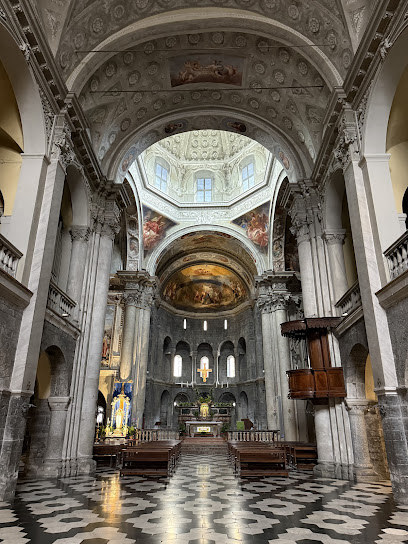
Basilica of Saint Fidelis, Como
Europe,
Italy,
Como,
The Basilica of San Fedele, located in the heart of Como, is one of the most significant religious buildings in the city, as well as a precious example of Romanesque architecture. This place of worship represents an important landmark in the cultural and historical identity of the area. Built between the 11th and 12th centuries, the basilica is known for its fascinating structures and rich artistic heritage. With its elegant architectural lines and the striking bell tower, San Fedele is a silent witness to the history of Como, its traditions, and its transformations over the centuries. The history of the Basilica of San Fedele began in the Romanesque period, around 1070, when it was commissioned as a church dedicated to the martyr Saint Fedele. Its name indeed derives from Saint Fedele, a Christian who suffered martyrdom in the early Christian era. The basilica was probably built on an already existing place of worship, a meeting point for the faithful of the city. In the 12th century, the basilica adorned itself with a remarkable façade, characterized by decorative elements typical of Lombard Romanesque architecture. The structure is made of local stone, giving it a robust yet elegant appearance. Among the various historical events that marked San Fedele, the consecration of the church in 1170 is noteworthy. During the 13th century, the basilica faced various challenges, including damage from fires and wars. However, despite these difficulties, the local community worked hard to preserve and restore the place. In the 15th century, the basilica underwent significant changes with the addition of Gothic elements, further enhancing its architectural importance. The most significant restorations took place over the centuries, particularly in the 19th century, when a radical restoration was carried out by architect Giuseppe Bovara, who sought to restore the basilica to its former glory. These interventions have made San Fedele not only an important religious landmark but also a symbol of the city of Como. Let us begin our visit to the Basilica of San Fedele, focusing on key elements that deserve your attention. As we conclude our entrance, before us rises the façade, characterized by a sumptuous portal decorated with sculptures depicting scenes from the life of Christ and the figure of Saint Fedele. The sculptures, crafted with great mastery, showcase the refinement of Romanesque art. We notice the balance between the rigor of the lines and the carefully crafted details, which make this façade one of the most representative examples of Lombardy. Inside, the first thing that catches the eye is the imposing trussed ceiling that extends over the entire central nave. This particular structure in raw wood gives a sense of grandeur and warmth to the environment. We invite you to look up to admire the beauty of the ceiling, which is a clear example of the building tradition of the era. Proceeding along the nave, to your right, you will observe the main altar, made of polychrome marble, which represents the spiritual heart of the basilica. Its decoration is the result of various interventions in later eras, presenting itself as a symbol of the growth and evolution of the cult. The altar is dedicated to Saint Fedele and contains a precious relic, making it a pilgrimage site for the faithful. Let us move towards the left side of the basilica, where you will find the chapel of Saint Roch. This small chapel is adorned with sixteenth-century frescoes that depict the life of the saint. The frescoes, unfortunately damaged over time, still give us an idea of the artistic richness of the period and the devotion of the faithful towards Saint Roch, the protector against plagues and epidemics. Another fascinating aspect is the bell tower, approximately 60 meters tall, which stands next to the basilica. Built in the 12th century and partly restored in the 19th century, it offers a panoramic view of the city of Como and the lake. The bell tower is equipped with a belfry containing several bells, which are of great importance for the communal life of the city, and remains a reference symbol for the people of Como. We cannot forget the external architectural details. The façade, with its hanging arches and elegant columns, is a triumph of decorations that showcase the craftsmanship of the artisans of the time. The ornamental themes not only decorate but also tell stories of saints, fantastic animals, and religious symbols, making the basilica a true stone book to explore. Finally, we invite you to visit the cloister. Although not always accessible, this space represents a corner of quiet and contemplation. Built in Romanesque style, the cloister features arches and columns that frame a small garden, inviting reflection. The details of the capitals, decorated with plant and geometric motifs, testify to the skill of the local artisans. The Basilica of San Fedele harmoniously fits into the urban context of Como, which is rich in history and culture. It is located a short distance from other points of interest, such as the Cathedral of Como, famous for its extraordinary marble façade and wonderful stained glass. This proximity between the two places of worship is emblematic of the city’s religious tradition. Nearby the basilica is also the Paolo Giovio Archaeological Museum, which houses historical artifacts dating from the Roman era to the Middle Ages. Here, visitors can further explore local history and better understand the context in which structures like the Basilica of San Fedele arose. Finally, it is worth visiting the Volta Museum, dedicated to the famous scientist Alessandro Volta, who was born in Como. This museum offers an interesting perspective on the scientific history of the city, making the area around the basilica a true cultural hub. San Fedele is not just an important place of worship but also a symbol of the community’s resilience in difficult times. During the war periods, the basilica has represented a shelter for the population of Como. Moreover, the bell tower is known for housing a clock that has marked the hours for centuries; it is one of the few historical clocks still in operation that can boast such longevity. The basilica hosts important religious celebrations, including the feast of Saint Fedele, which takes place every year on January 24 and attracts many visitors and worshippers.
Read More