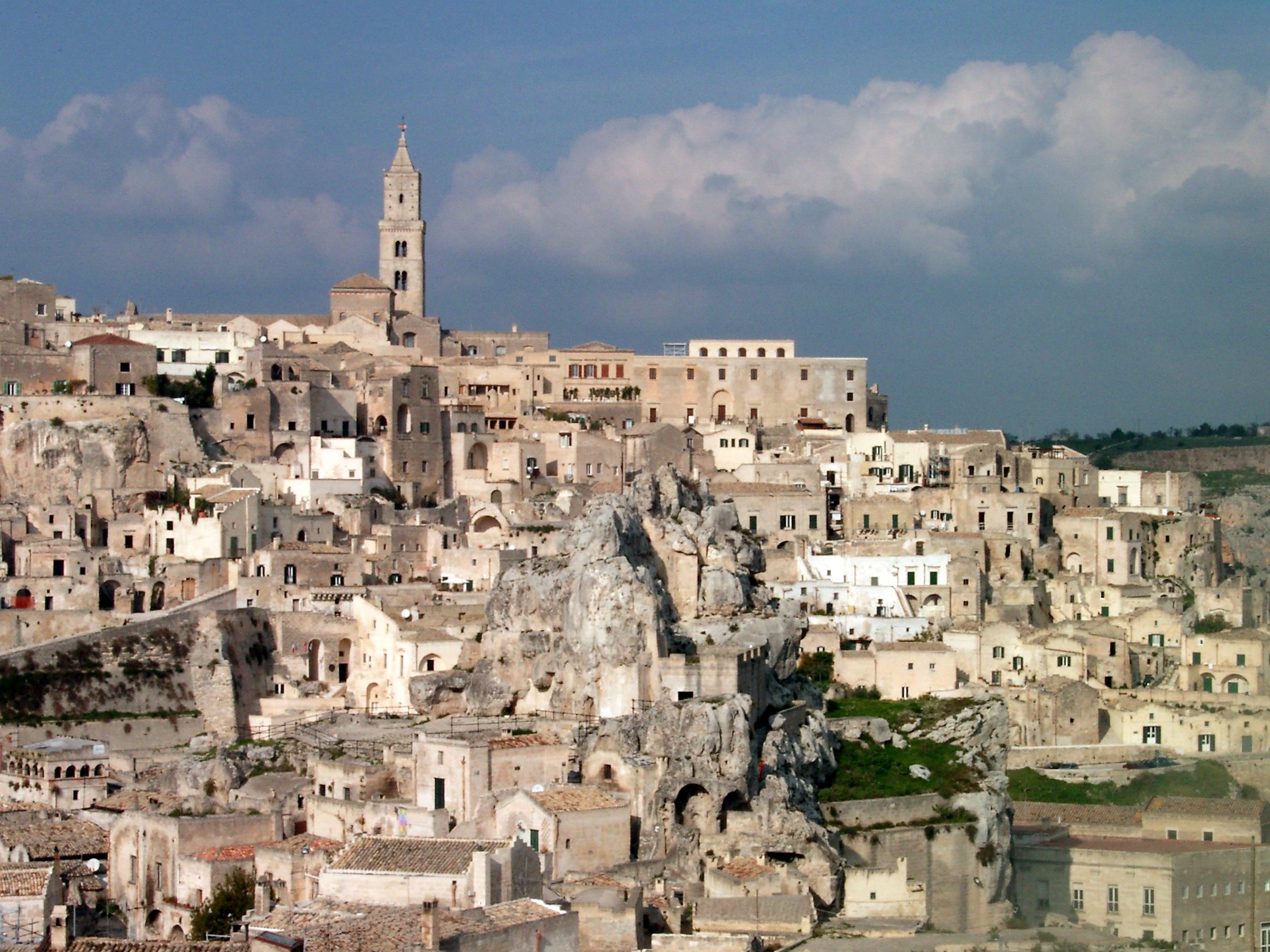
Cathedral Basilica of Matera "Maria Santissima della Bruna"
Europe,
Italy,
citta, Matera,
Centro
The Cathedral Basilica of Matera, officially named “Maria Santissima della Bruna e di Sant’Eustachio,” represents a focal point in the religious and artistic history of the city. Its construction, started in 1230 and completed in 1270, took place under the direction of Emperor Frederick II of Swabia and Bishop Andrea of Acerenza. The cathedral is located on the Civita, the highest point in Matera, offering a panoramic view of the famous Sassi, the ancient cave dwellings of the city.
The architecture of the cathedral is a classic example of Apulian Romanesque style, characterized by simple and functional lines. The facade is dominated by an imposing rose window with sixteen rays, symbolizing the wheel of fortune, and a bell tower 52 meters high. The external decorations include a series of statues sculpted by Altobello Persio in 1540, depicting the Madonna della Bruna, Saint Peter, and Saint Paul. Another prominent feature is the “Door of the Lions,” named after the two lion sculptures that adorn it.The interior of the cathedral, in the shape of a Latin cross, has three naves separated by round arches supported by columns with stone capitals. The contrast between the austerity of the exterior and the richness of the interior is evident: the Baroque style left a significant mark during the restorations of the 17th and 18th centuries, adding golden stuccoes, elaborate frames, and intricate frescoes. Among these stand out the magnificent golden ceiling and the main altar, surmounted by an altarpiece by Fabrizio Santafede depicting the Virgin with the Saints.A remarkable piece of sacred art preserved in the cathedral is the wooden choir, carved in 1453 by Giovanni Tantino from Ariano Irpino. This choir, composed of sixty solid walnut stalls, is an excellent example of the craftsmanship of the time. In the side chapel, you can admire a fresco of the Last Judgment, attributed to Rinaldo da Taranto and dated to the late 13th century, rediscovered during recent restoration works.A particularly interesting element is the 14th-century stone-carved nativity scene, located in the Nativity Chapel. This chapel also contains Renaissance frescoes depicting the Nativity, offering visitors a glimpse of popular devotion and religious art of the period.The history of the cathedral is closely intertwined with that of Matera. Originally dedicated to Santa Maria di Matera, it was later dedicated to Santa Maria dell’Episcopio and, finally, in 1389, to Santa Maria della Bruna at the behest of Pope Urban VI. This change in name reflects the growing importance of the Visitation feast, established by Pope Urban VI himself, which is still one of the most heartfelt celebrations in the Matera community.In 1962, Pope John XXIII elevated the cathedral to the dignity of a minor basilica, recognizing its historical and spiritual significance. In 1991, the basilica received a visit from Pope John Paul II, an event that further strengthened the bond between the city and the Vatican.Between 2003 and 2016, the cathedral underwent an extensive restoration program, made possible also thanks to funds from the Italian National Lottery. These works included the consolidation of structures, cleaning of facades, and restoration of interior decorations. The reopening for worship in 2016, officiated by Cardinal Pietro Parolin, Secretary of State of the Vatican, was a moment of great celebration for the local community.
Read More