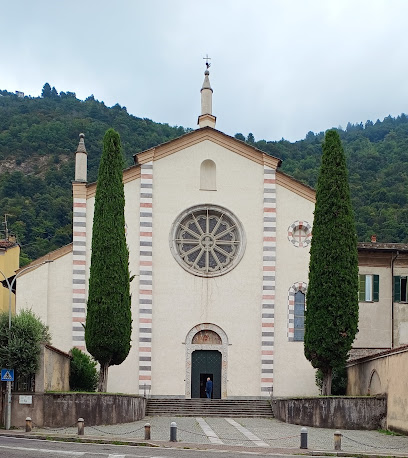
Church of Saint Augustine, Como
Europe,
Italy,
Como,
The Church of Sant’Agostino is one of the artistic and spiritual gems of Como, a city located on the shore of the lake of the same name. This place of worship, built in the 13th century, is known not only for its architectural beauty but also for its rich history connected to the Order of Augustinians. The church reflects the stylistic evolution that has characterized the city over the centuries, offering an important testimony to the religious and cultural past of the region. In the heart of Como, Sant’Agostino is an area of peace and contemplation, a true refuge from the hustle and bustle of everyday life surrounding this historic city. The construction of the Church of Sant’Agostino began in 1260, in the midst of a time of great upheaval for the city of Como, which was experiencing flourishing economic growth due to trade and craftsmanship. The church was dedicated to Saint Augustine, the famous theologian and philosopher, and became an important center of spirituality for the Augustinian community, which settled in the area in the following decades. Throughout the 14th century, Sant’Agostino became a landmark not only religiously but also culturally, thanks to the presence of many intellectuals and artists. The church underwent various transformations in its architectural appearance, from the 9th century to the 17th century. During the Renaissance, in fact, the structure was enhanced with frescoes and works of art that further elevated its prestige. A significant renovation took place in 1833, when the church was restored according to neoclassical standards, removing some Gothic elements. This intervention, although controversial, helped preserve the church, keeping it in good condition up to the present day. In the 20th century, the Church of Sant’Agostino underwent another renovation period: between the 1970s and 1980s, new restoration work was carried out to bring the ancient splendor of the frescoes to light and improve the functionality of the building. The church is now the venue for important cultural and spiritual events and continues to be a significant attraction for both the faithful and visitors. As you approach the Church of Sant’Agostino, the first element that captures attention is its façade, characterized by Romanesque-Lombard style. The façade is adorned with a simple stone portal and two beautiful Gothic windows, framing the main entrance. At the top, a small triforium offers a suggestive view of the interior space. Upon entering the church, you will immediately notice the atmosphere of tranquility that pervades the environment. To the left of the entrance is one of the most fascinating features: a large fresco depicting the Madonna with Child, a 15th-century work. This fresco is an excellent example of the artistic tradition of Como at the time, and the use of vibrant colors showcases the talent of local artists. Continuing the visit, head towards the main altar. The altar, beautifully decorated and made of multicolored marbles, is a magnificent example of Como Baroque. It is accompanied by a panel featuring a painting representing Saint Augustine. This serves as an important recognition of the figure of the saint, who inspired the spirituality of the Augustinian order. Moving towards the right side aisle, we encounter a chapel dedicated to Saint Monica, mother of Saint Augustine. Here you can admire another fresco narrating the life of the saint, surrounded by a frame of statues that highlight the prominence of the biblical story. As you proceed along the left aisle, you will arrive at an interesting area dedicated to various saints, with a charming colored stained-glass window that seems to tell the stories of each sacred character. The stained-glass windows, through the skillful use of light, create an almost mystical atmosphere within the church, allowing visitors to appreciate the technical quality of the artisans of the past. Don’t forget to look up at the ceiling: here you will find stucco decorations and 17th-century frescoes representing religious scenes, a true exhibition of the artistic culture of the time. Finally, a striking visual element is the wooden choir, made in the 16th century, which demonstrates the high level of craftsmanship reached in the city. This choir represents not only a work of great artistic value but also an important container of history, witnessing the liturgical use of the church. The Church of Sant’Agostino is situated in an urban context rich in history and culture. Located in the center of Como, it is surrounded by other historic buildings that merit a visit. For example, not far from it is the Cathedral of Como, a masterpiece of Gothic architecture that recounts the historical deeds of the city within. Another point of interest nearby is the Museum of the History of Como, which offers an immersion into the city’s history, from its Roman origins to the present day. The museum is just a short walk from the church and serves as an excellent addition to your visit. Finally, one must not miss the Lakeside of Como, which offers breathtaking views of the lake and the surrounding mountains. Here you can stroll, reflecting on the beauty of the landscape and the historical significance of the city that you have just explored. 1. The Church of Sant’Agostino has been an important center for theological studies over time, especially in the late Middle Ages, attracting students from various parts of Italy. 2. During the wars between Guelphs and Ghibellines, the church suffered damage due to the conflicts between different factions, highlighting the political importance of the site in Como’s history. 3. The structure has been the subject of various decorative modifications over the centuries, with the aim of adapting it to the religious and spiritual needs of the community. In conclusion, the Church of Sant’Agostino is a fundamental part of the history and culture of Como. We invite visitors to discover this enchanting place and explore the surrounding treasures, from the artistic wonders of the Cathedral to the scenic walks along Lake Como.
Read More