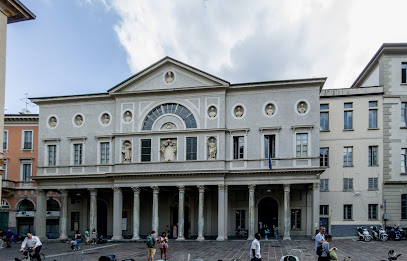
Church of Saint Cecilia, Como
Europe,
Italy,
Como,
The Church of Santa Cecilia is a jewel of religious architecture located in the heart of Como. An building that embodies not only Christian spirituality but also an important part of the history and identity of the city. Built between the 13th and 14th centuries, it is known for its Gothic architecture and the frescoes that narrate the history of Christianity. This church, dedicated to Santa Cecilia, the patroness of music, represents a cultural and artistic landmark, as well as a place of gathering for the faithful and visitors alike. The origins of the Church of Santa Cecilia date back to the 13th century. It is likely that its construction began around 1260, during a time of great religious and cultural ferment in Como. The church was founded at the behest of a community of Franciscan friars who desired a place of worship that could also serve as a reference point for the dissemination of sacred music. This initiative fits into a broader context of spiritual renewal typical of the Middle Ages, which saw music as a privileged means of approaching the divine. In the following centuries, the Church of Santa Cecilia underwent various transformations. In the 15th century, the building was expanded and improved with the addition of new chapels and decorations. Between 1470 and 1500, significant embellishment work occurred under the supervision of local artists, leading to the creation of frescoes of great artistic value that would remain as a testament to the Lombard Gothic style. A crucial moment for the church occurred in 1798 when, following the suppressions related to the Napoleonic occupation, it was closed. It was only in 1805 that the church reopened its doors for worship. During the 19th century, the Church of Santa Cecilia underwent careful restoration, carried out by architects and artists who aimed to preserve its originality. In the 1950s, further recovery efforts were undertaken to restore the church to its former glory. The work focused primarily on the frescoes and internal decorations, which required thorough restoration. These efforts have preserved the artistic integrity of the building, allowing it to remain intact to the present day. When you enter the Church of Santa Cecilia, the first element that captures your attention is the facade. It stands out for its Gothic style, characterized by pointed arches and elaborate details. Notice how the materials used, mainly local stone, give a solemn and austere appearance. Above all, notice the entrance portal, decorated with sculptures depicting religious scenes. As soon as you enter, to your right, you can admire the bell tower that rises high, also in the Gothic style. It is a distinctive feature of Como’s skyline, made of exposed stone, and its height symbolizes the spiritual greatness of the church and the community that has embraced it. Continuing inside, you will find yourself surrounded by frescoes that adorn the walls and the ceiling. These frescoes, created between the 15th and 16th centuries, depict episodes from the life of Santa Cecilia and various biblical scenes. The artists who worked here used vibrant colors that infuse life into the stories told. Don’t forget to approach the main altar: a masterpiece of sacred art, which hosts an altarpiece depicting Santa Cecilia, a work that embodies the devotion and artistry of the Renaissance period. Additionally, observe the wooden choir, located in the presbytery area. This choir is a fine example of local craftsmanship, with carvings that tell stories of faith and piety. As you get closer, you can notice the finely crafted details that decorate the benches and the backs, a testament to the care with which it was made. Another point of great interest is the baptismal font, located near the entrance. You will notice its simple yet elegant design, typical of the medieval style. This element is not only functional but represents one of the fundamental symbols of Christian life. Finally, don’t forget to look up at the raftered ceiling, which shows the original structure of the building. Here, the simplicity of the lines and the beauty of the materials express a sense of peace and serenity, inviting reflection. The Church of Santa Cecilia is located in a central area of Como, near squares and other significant historical and cultural landmarks. Continuing your visit, you might venture towards the Cathedral of Santa Maria Assunta, which is just a few minutes’ walk away. This cathedral, a true symbol of the city, represents a wonderful example of Gothic and Renaissance art. Adorned with refined details, it also houses works of great artistic value. Another place not to be missed nearby is the Civic Museum of Como, where you can delve into the history of the city through a rich collection of artworks and archaeological finds. This museum offers a fascinating journey through time, allowing visitors to better understand the historical context of the Church of Santa Cecilia and its transformations over the centuries. Moreover, don’t forget to take a walk along the medieval walls of the city, another element of Como’s history that speaks of defense, protection, and identity. These walls perfectly complement the serene beauty of the Church, as well as the dynamism of the city center. An interesting curiosity regarding the Church of Santa Cecilia is its connection to music. The choice of the patron saint of music is not a coincidence. Since its foundation, the church has hosted musical events and concerts, becoming a reference point for local artists and musicians. Additionally, the fact that this church has gone through various phases of restoration over the centuries makes it a significant example of how religious buildings can evolve and change, responding not only to spiritual needs but also to the cultural requirements of a community. Finally, it is estimated that the number of visitors to the Church of Santa Cecilia has significantly increased in recent years, thanks also to a growing interest in art and culture in relation to the city’s historical heritage. This influx has benefited not only the church itself but has also stimulated a renewed interest in sacred music. Thank you for listening to this audio guide about the Church of Santa Cecilia. We invite you to discover the treasures of Como, visiting the nearby Cathedral of Santa Maria Assunta and the Civic Museum, both rich in history and culture. Happy exploring!
Read More