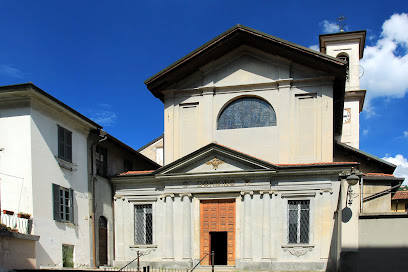
Church of Saint Domninus, Como
Europe,
Italy,
Como,
Welcome to the Church of San Donnino, a fascinating testament to the artistic and cultural heritage of Como. This church, located in the heart of the city, represents an important landmark both religiously and historically. Built in the medieval period, specifically in the 12th century, San Donnino is known for its Romanesque style and for housing works of art of considerable value. The building, dedicated to San Donnino, a Christian martyr, has played a significant role in the local community for centuries, serving not only as a place of worship but also as a center for social gathering. The origins of the Church of San Donnino date back to the 12th century. It is believed that construction began around 1180, during a time when Como was thriving due to its strategic location between Lake Como and the Alps. The church was built on a previous place of worship dating back to the Roman period, thus highlighting the continuity of this site as a spiritual center. Over the centuries, the church has undergone numerous transformations and restorations. In the 15th century, for example, it was enlarged and embellished with frescoes, many of which are still visible today. An important restoration took place in the 20th century, particularly in the 1930s, when efforts were made to conserve and enhance the building, which was showing signs of decay. The church is dedicated to San Donnino, a Christian martyr who, according to tradition, lived in the 3rd century. His figure is significant not only for religion but also for local culture and history, as he is considered the patron saint of the community. The church has provided a spiritual refuge for generations and has welcomed countless faithful and visitors through its doors. As you arrive at the Church of San Donnino, you will notice the Romanesque-style façade, characterized by a beautiful decorated entrance portal. The columns and capitals, adorned with floral and symbolic motifs, tell stories of faith and tradition. Also, take a look at the central rose window, which once illuminated by sunlight, creates a suggestive atmosphere inside. Upon entering the church, to your right you will find a beautiful main altar made of marble. This altar, created in the 18th century, is adorned with stuccos and frescoes that celebrate the life and martyrdom of San Donnino. The delicate play of light and shadow on the altar creates a contemplative atmosphere perfect for meditation. In the central nave, take a look at the frescoes that adorn the walls. These works, dating mainly from the 15th century, depict biblical scenes and saints, serving as testimonies of sacred art from that era. The artists of the time, with their vibrant colors and expressive style, managed to convey not only religious devotion but also the technical skill of Renaissance art. As you move towards the apse, notice the harmonious architecture that rises upward, creating an effect of great verticality. The apse is decorated with a cycle of frescoes illustrating the life of the Virgin Mary, leading to reflections on motherhood and the sacred. Another element not to miss is the bell tower, which stands proudly next to the church. Built in the 13th century, this Romanesque bell tower is a classic example of medieval architecture and offers a panoramic view of the city and the enchanting Lake Como. If you have the opportunity, climb its steps to enjoy this spectacle. For lovers of architectural details, be sure to observe the symbols and decorations on the capitals of the columns. These details often tell silent stories that convey religious and cultural messages, adding a profound dimension to your visit. Finally, take a moment to explore the adjacent cloister. Although not always accessible, this tranquil place, with its arches and inner garden, offers a perfect contrast to the vibrancy of the outside world. Here, time seems to stand still, allowing for quiet reflection. The Church of San Donnino is located in a vibrant neighborhood of Como, rich in history and culture. The surrounding buildings reflect Lombard architecture, offering an interesting contrast to the Romanesque structure of the church. Not far away is the Cathedral of Como, a masterpiece of Lombard Gothic architecture, easily recognizable for its white marble façade and majestic bell tower. Nearby is also the Broletto, an ancient town hall dating back to the 13th century, which now hosts cultural events and exhibitions. These places, together with the Church of San Donnino, create an ideal path for a complete immersion in the history of Como. Every step in this neighborhood is a discovery, where past and present intertwine. Recent excavations have revealed ancient Roman structures beneath the church, indicative of a continuous habitation that dates back centuries. These findings have contributed to rethinking the historical significance of this location. Moreover, the Church of San Donnino has been the setting for important religious and civil events throughout history, such as baptisms and weddings, reflecting its central role in the life of the community. Finally, the choice of San Donnino as the patron saint is interesting: his feast is celebrated in various locations in Lombardy, a sign of how deeply rooted his figure is in popular culture. We invite you to explore these fascinating places, such as the Cathedral of Como and the Broletto, for a complete experience of the history of this extraordinary city. Enjoy your visit!
Read More