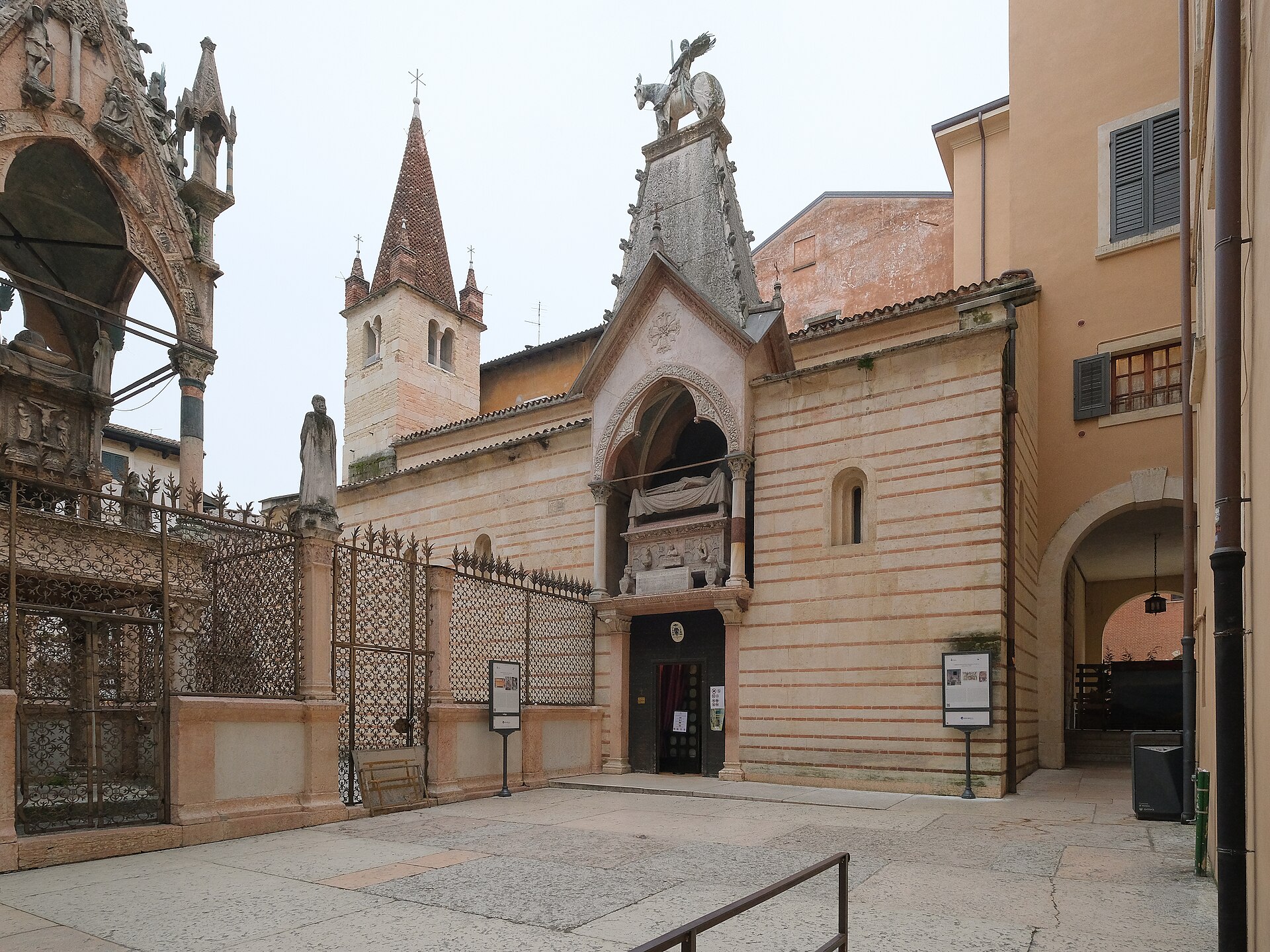
Church of Santa Maria Antica
Europe,
Italy,
Verona,
Cittadella
The Church of Santa Maria Antica, located in the heart of the ancient city of Verona, represents a masterpiece of Romanesque architecture and an important place of worship with a history dating back to the 7th century. Its current construction dates back to the 8th century, commissioned by the Lombard kings, although the church underwent numerous renovation and expansion interventions over the following centuries.
The church became particularly famous in the 13th century, when the powerful Scaligeri family, who ruled Verona, chose Santa Maria Antica as their private chapel and burial place. The connection with the Scaligeri is evident not only for the presence of the famous Scaliger tombs, but also for its location next to the majestic funerary complex of the family, the Scaliger Tombs, which represent an extraordinary example of Italian Gothic. These funerary monuments, with their elaborate decorations and sculptures, testify to the power and wealth of the family that dominated Verona for over a century.Upon entering the church, one is struck by the simplicity and purity of the Romanesque lines. The single-nave interior, with a semicircular apse, maintains an atmosphere of contemplation and spirituality. Among the works of art preserved in the church, a wooden crucifix from the 13th century stands out, considered one of the oldest in the city. This crucifix, with its sober and austere style, reflects medieval spirituality and represents an important testimony of the devotion of the time.The church is also famous for its bell tower, a classic example of a Romanesque bell tower with bifores and trifores that accentuate its verticality and elegance. The bell tower, visible from various points in the city, serves as a reference point and symbol of the church’s long history.The political and social importance of Santa Maria Antica during the Middle Ages cannot be underestimated. Its proximity to the residence of the Scaligeri made it a strategic location for official ceremonies and religious celebrations related to the ruling family. This connection is further strengthened by the presence of the sarcophagus of Cangrande I della Scala, one of the most important members of the dynasty, known for his military skills and cultural patronage.The church has undergone several restoration interventions over the centuries, but has preserved its original structure and ancient charm. The most significant restorations date back to the 19th and 20th centuries, when efforts were made to restore the original Romanesque appearance, removing the Baroque and Neoclassical additions that had been made over time.From an artistic point of view, Santa Maria Antica offers a fascinating insight into the evolution of sacred art in Verona. In addition to the wooden crucifix, the church preserves frescoes and sculptures that testify to the influence of the various artistic styles that have succeeded over the centuries. Among these, the sculptures of the Scaliger Tombs deserve special mention, representing a masterpiece of Veronese Gothic art.
Read More