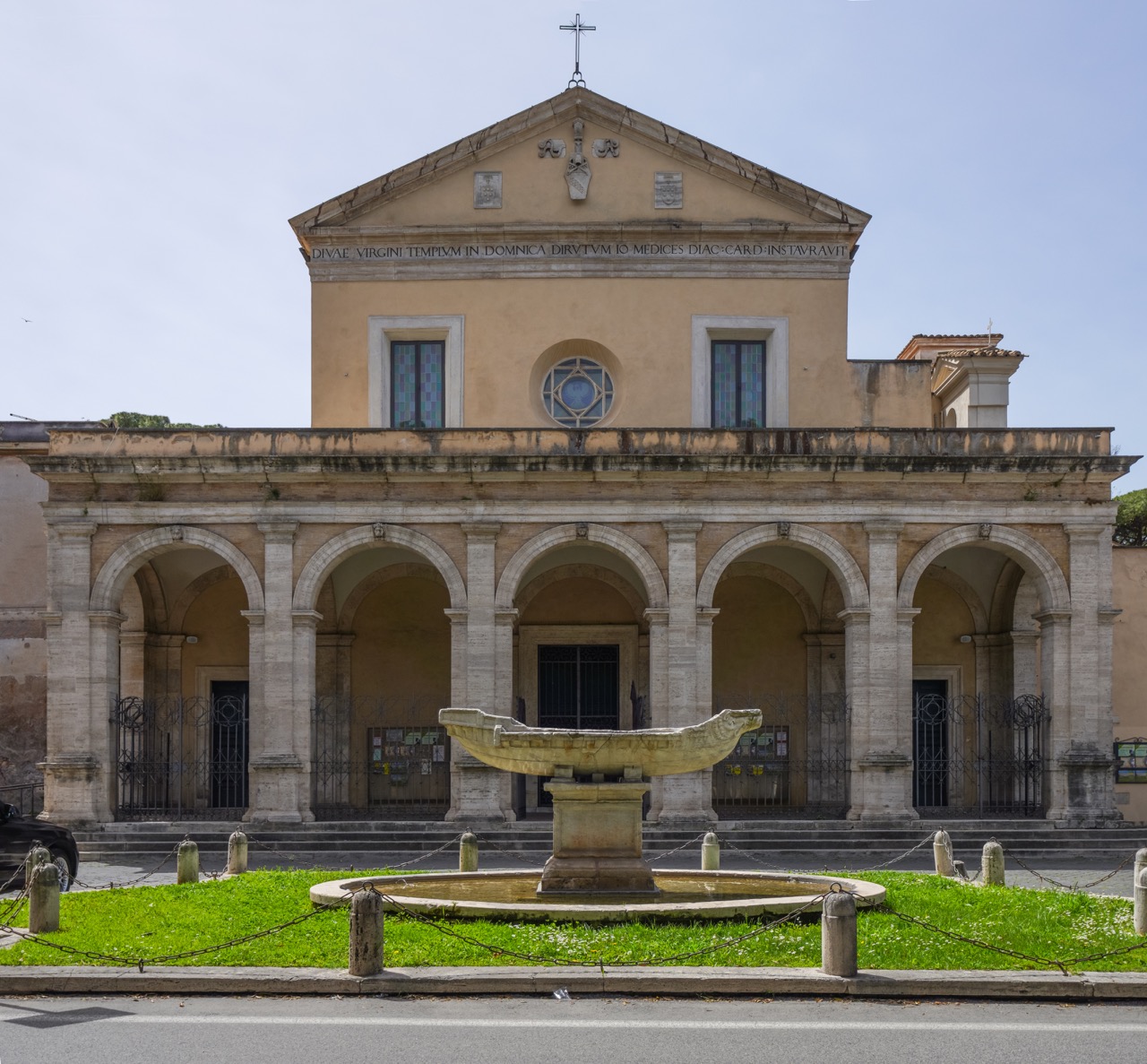
Church of Santa Maria in Domnica alla Navicella
Europe,
Italy,
citta,
Rione XIX - Celio
The Basilica of Santa Maria in Domnica, also known as Santa Maria alla Navicella, is a fascinating example of early Christian, Renaissance, and Baroque architecture, located on the top of the Caelian Hill in Rome. Its origins date back to the 4th century, but it was rebuilt in the 9th century by Pope Paschal I, who adorned it with a remarkable mosaic decoration. Subsequently, it was restored and modified in the 16th and 19th centuries.
The current facade, designed by Andrea Sansovino between 1513 and 1514, is a perfect example of Renaissance style. It features an airy portico with five arches separated by travertine pilasters, topped by two windows on either side of the original central rose window. The marble coats of arms of Innocent VIII and the cardinals Giovanni and Ferdinando de’ Medici enrich the tympanum. The sail bell tower, located along the right side, houses an ancient bell dating back to 1288.The interior of the basilica retains the original 9th-century plan, with three equally long naves separated by two rows of nine spolia columns each. The central nave is decorated along the walls with frescoes by Lazzaro Baldi and features a coffered ceiling commissioned in 1566 by Ferdinando de’ Medici. The ceiling, repainted in the 19th century, displays the Medici coat of arms in the center and, in the other two main panels, depicts the ship of Leo X as Noah’s ark and as a Eucharistic temple.One of the most precious elements of the basilica is the mosaics from the time of Pope Paschal I, decorating the apse and the apse arch. The mosaic in the apse depicts the Madonna enthroned between two rows of angels, with Pope Paschal I kneeling at her feet, recognizable by the square blue nimbus, typical of the living. The figures are two-dimensional, without naturalistic features, following Byzantine canons. Above the arch, the Savior is depicted between two rows of apostles, with Moses and Elijah below.The main altar, created by Andrea Sansovino, is a Renaissance masterpiece. The choir on the opposite side, dating back to 1930, houses a pipe organ built by Natale Balbiani in 1910 for the military hospital chapel of the Caelian Hill and transferred to the basilica twenty years later. The organ, restored in 2011, is a pneumatic-tubular transmission with a single keyboard of 58 notes and a straight pedalboard of 27.The church portico, restored at the end of the 19th century, along with the construction of the current gate, was part of an intervention aimed at addressing serious moisture infiltration and repairing damages, as well as restoring the portico itself. This restoration, led by Busiri Vici and architect Gaetano Bonoli, was sponsored by Cardinal Consolini and funded by Propaganda Fide.In 1958, a semicircular confession was built under the apse, while the current arrangement of the presbytery dates back to 1985. The basilica is the seat of the Titulus S. Mariae in Domnica, established in 678 by Pope Agatho, and has a historical connection with the Medici, titular cardinals of the basilica in the 16th century.
Read More