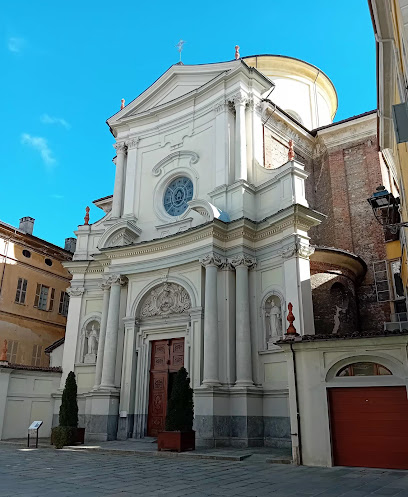
Church of St. Ambrose – Cuneo
Europe,
Italy,
Cuneo,
The Church of Saint Ambrose is a fundamental symbol of the cultural and religious identity of Cuneo. Located in the heart of the city, it dates back to a period between the 14th and 15th centuries and is known for its splendid Gothic style and the works of art it houses inside. With its bell tower soaring towards the sky, the church represents not only a place of worship but also a historical landmark for the local community. Throughout the centuries, it has undergone various transformations and restorations, yet maintaining its original essence. Every visit to the Church of Saint Ambrose offers the opportunity to immerse oneself in the history and artistic beauty of one of Cuneo’s gems. The origins of the Church of Saint Ambrose are rooted in the medieval history of Cuneo. Its construction began in 1320, commissioned by members of the local community eager for a place of worship that could reflect the spirituality and art of the time. The architecture of the church features Gothic style, with elements reminiscent of 13th and 14th-century cathedrals in Europe. In the mid-15th century, the church underwent significant expansions, with the addition of side aisles that enriched its structure. In the 16th century, with the reform of the Catholic Church, the Church of Saint Ambrose played a significant role in supporting the religious practices characteristic of this period. At the time, the city of Cuneo was an important commercial and cultural center, and the church also established itself as a place for celebrating local festivities. Over the centuries, the church underwent various restorations, including one in the 19th century, when it was decided to restructure it to preserve its artistic and architectural integrity. These interventions were accompanied by a rediscovery of its history and importance for the community. The church was subjected to further restoration work in the 1980s, aimed at keeping the precious frescoes inside in excellent condition. Today, the Church of Saint Ambrose is not just a place of worship but a true treasure trove of history and art. Its origins and ongoing evolution testify to the profound bond between the community of Cuneo and its spiritual dimension. 1. Facade As one approaches the Church of Saint Ambrose, the first thing that strikes the visitor is its Gothic-style facade. Made of local stone, the facade features pointed arches and decorations sculpted with great mastery. Notice, in particular, the central rose window, surrounded by a series of small statues depicting saints, and next to it, the entrance doors adorned with finely crafted capitals. 2. Interiors Upon entering the church, one is welcomed by an atmosphere of great sacredness. The wooden beam ceilings and the frescoed walls take the visitor on a journey through time. On the left side, a fresco dating back to the 15th century depicts scenes from the life of Saint Ambrose, the church’s patron. These frescoes are significant examples of the region’s artistic tradition. 3. The Main Altar Continuing towards the main altar, one can admire a work of great artistic and spiritual importance. The altar is enriched with stuccos and gilding and hosts a retable depicting the Madonna and Child, surrounded by angels and saints. This work dates back to around the 17th century and represents an important example of Marian devotion. 4. Side Chapels Don’t forget to explore the side chapels, each with its own peculiarity. In one of these, you’ll find an altarpiece representing the Holy Family, created by a local artist in the 18th century. Each chapel tells a story connected to episodes of the lives of saints or Christian mysteries. 5. Bell Tower The bell tower is one of the most iconic elements of the Church of Saint Ambrose. Tall and slender, it was built in the 18th century and overlooks Piazza Galimberti. Its architecture features arched windows through which the melodies of bells resonate, marking the daily life of the community. 6. Architectural Details Carefully observe the architectural details, such as the pillars that support the naves, each with decorated capitals. These little artistic wonders are the work of skilled craftsmen. Don’t forget to look at the natural light filtering through the stained glass windows, creating a unique atmosphere inside the church. 7. The Cloister Finally, move towards the cloister, accessible from the church. This space is a corner of tranquility, with stone columns and well-kept gardens that offer a moment for reflection. It is an ideal place to appreciate the architectural beauty and immerse oneself in the spirituality of the site. The Church of Saint Ambrose is located in the heart of Cuneo, a city rich in history and culture. Its San Paolo district is characterized by cobblestone streets and historic buildings that can be explored leisurely. In the vicinity, there are other institutions worth visiting, such as the Civic Museum, which exhibits works from prehistory to the modern era, and Palazzo Salmatoris, famous for its 17th-century architecture and artistic exhibitions. An ideal route for those visiting the church might include a stop at the beautiful Piazza Galimberti, which delights visitors with markets and cultural events, further enhancing the bond with the community. 1. The Church of Saint Ambrose is home to numerous liturgical and traditional celebrations of the city, such as the Feast of Saint Ambrose, which is held every year on December 7, in honor of its patron. 2. Over the years, many local artists have found inspiration in the church, including several painters and sculptors who have created works there, contributing to its artistic growth. 3. During the Napoleonic period, the church was used as a storage facility, an event that marked a difficult moment for its preservation, but subsequent restorations returned it to its original splendor.
Read More