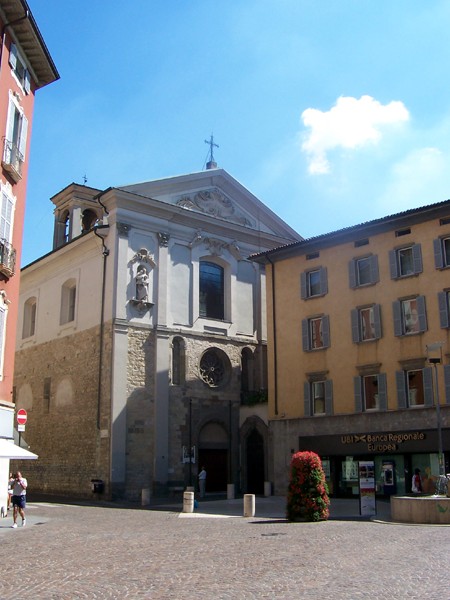
Church of St Leonard - Bergamo
Europe,
Italy,
Bergamo,
The Church of San Leonardo, a fascinating corner of Bergamo’s history and architecture. Situated in a context that reflects the city’s cultural and religious wealth, this church is a true gem of the medieval period. Famous for its architecture and the artworks within, San Leonardo is also known for its strategic position near the ancient Roman road. Founded in the 12th century, the church is an example of the various transformations it has undergone over the centuries, while still maintaining its distinctive character.Origins and HistoryThe Church of San Leonardo was built in 1150 at the initiative of the local community, which desired a place of worship dedicated to San Leonardo, a highly venerated saint. This saint was considered the protector of prisoners and people in difficulty, reflecting the church’s importance as a social reference point.Over the centuries, the church has undergone numerous restorations and renovations. For example, in the 14th century, it was expanded with the addition of some side chapels to accommodate a larger number of parishioners and meet the needs of the growing community. These interventions led to a renewal of the architecture, introducing Gothic elements that mixed with the already present Romanesque features.Later, in the 16th century, the church was once again renovated and enriched with Baroque works, evident in the internal decorations. The facade, which originally had a simple style, was adorned with decorations that reflect Renaissance aesthetics. During the period of Napoleonic occupation, the church suffered a series of looting and damage, but fortunately, in the 19th century, restoration efforts began to try to restore its ancient splendor.A significant part of the history of the Church of San Leonardo is linked to its connections with the community. Over the centuries, it has hosted important religious and civil events, such as weddings, baptisms, and liturgical celebrations. Furthermore, it has witnessed the historical events of the city, including events during the wars and conflicts that affected Bergamo.Today, the church represents not only a place of worship but also an important tourist site. Its history is closely tied to that of Bergamo and continues to attract visitors from all over the world, eager to discover the artistic and spiritual richness of this place.What to ObserveEntering the Church of San Leonardo, you are immediately struck by its elegant facade, characterized by an arched portal and a central rose window that brings reflections of light inside. The facade is decorated with images and symbols that evoke the spiritual dimension of the place.Once inside, to your right, you will find the first of the many side altars. This altar is dedicated to San Leonardo and features a series of frescoes depicting the life of the saint, created by local artists in the 14th century. The frescoes are an important testament to popular devotion and the religious art of the period.Continuing along the central nave, you can admire the beautiful ribbed vaults, decorated with geometric and floral motifs. These architectural details not only beautify the environment but also tell stories of past eras, revealing the techniques used by the artisans of the time.At the end of the church, you will find the presbytery, adorned with a magnificent main altar in marble. This altar is an example of how sacred art was used to elevate the spirituality of the place. The presence of candlesticks and carved wooden panels completes an atmosphere of holiness and beauty.On the left side, pay attention to another altar, dedicated to the Madonna, which features a statue that is considered miraculous by the faithful. This statue is shrouded in an aura of veneration and history, testifying to the community’s interest in the Marian figure.Another noteworthy element is the splendid wooden choir, located behind the main altar. This choir is an example of local craftsmanship and dates back to the Renaissance period. Observe the carved details in the wood, which represent biblical scenes and symbolic motifs; each piece tells a story, a connection between art and faith.Finally, don’t miss the opportunity to admire the stained glass windows. These works of art not only filter light evocatively but also tell stories of saints and biblical episodes, contributing to create a contemplative and reflective atmosphere within the church.Context and ConnectionsThe Church of San Leonardo is located in one of the historic areas of Bergamo, not far from the lively Piazza Vecchia, the beating heart of the city. This strategic position makes it an integral part of a neighborhood rich in history, art, and culture.In the surroundings, you can visit other significant attractions. A must-see is the Basilica of Santa Maria Maggiore, which is just a few steps away and features one of the finest examples of Romanesque-Gothic art in Lombardy. The basilica is famous for its incredible frescoed ceiling and its mosaics that depict sacred stories.Another unmissable stop is the Campanone, a symbol of Bergamo Alta, which towers over the city and offers breathtaking panoramic views. Its history is intertwined with that of the Church of San Leonardo and represents yet another important piece of the local cultural heritage.Lastly, don’t forget to visit the Rocca, a fortress that has dominated the landscape of Bergamo for centuries. The Rocca offers not only a journey into the military history of the city but also the opportunity to enjoy an impressive panoramic view of the surrounding valleys.CuriositiesOne of the most interesting curiosities regarding the Church of San Leonardo is its fame linked to miracles. Throughout history, there have been many accounts of extraordinary events that occurred in this place, attracting visitors and pilgrims. Some of these events have been recorded in ecclesiastical documents of the time.Moreover, the church preserves several relics of saints, which are displayed during religious festivities. These sacred objects are a testament to the deep spirituality of the community and the rich traditions of worship.The restoration of the church in the 19th century was led by prestigious local architects, who sought to respect the original characteristics of the building while introducing some new elements. This balance between ancient and modern is today appreciated by both the faithful and tourists.At one point in its history, the Church of San Leonardo also hosted important cultural events, such as concerts and theatrical performances, demonstrating its role not only as a place of worship but also as a site of cultural meeting and exchange.
Read More