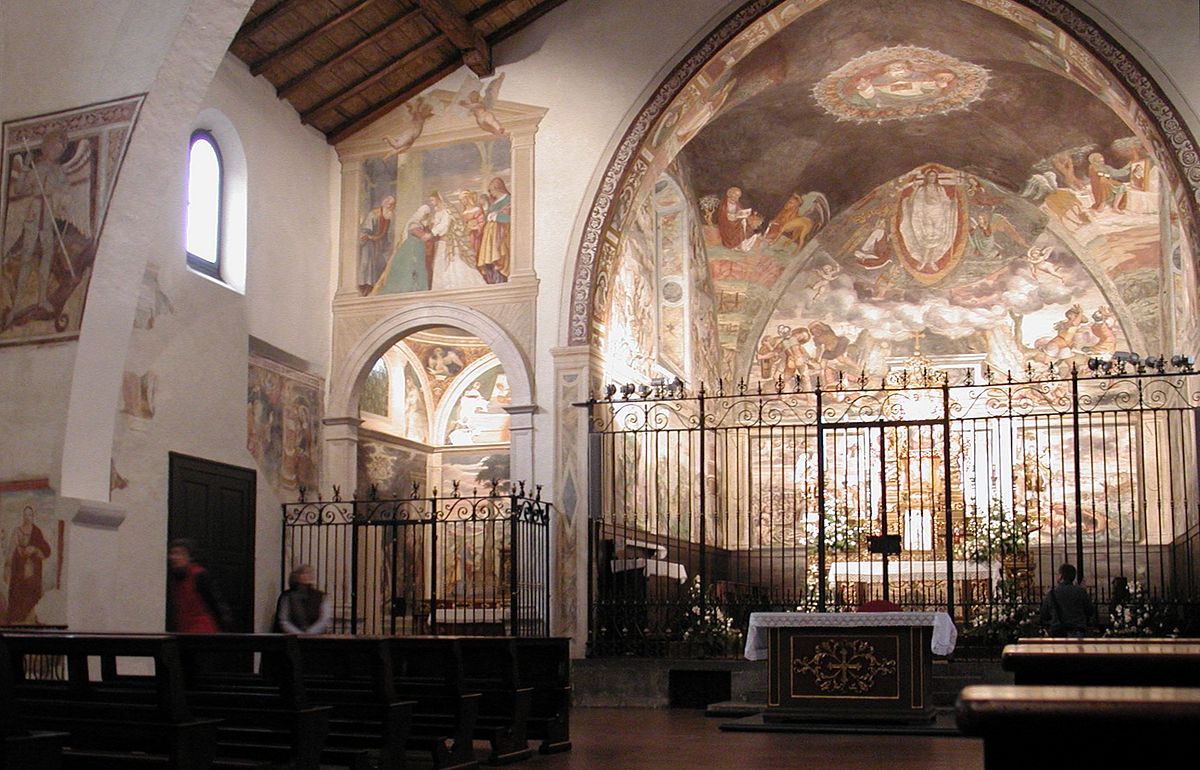
Church of St Michael at the White Well - Frescoes - Bergamo
Europe,
Italy,
Bergamo,
The Church of San Michele al Pozzo Bianco, a hidden gem in the heart of Bergamo, is known for its splendid frescoes and captivating architecture. This church, celebrated for its artistic and historical heritage, is rooted in the cultural identity of the city. Evidence of its origins dates back to at least the 12th century, and the structure has undergone numerous transformations over the centuries. The frescoes, created by the most renowned artists from Bergamo, make it not only a place of worship but also a very important open-air museum.Origins and HistoryThe origins of the Church of San Michele al Pozzo Bianco are intertwined with the history of Bergamo itself. Documented for the first time in 1179, the church was built during a period when the city was experiencing significant artistic and cultural development. Historical documents indicate that it was erected by Benedictine monks, who initiated a renovation and expansion project in the 13th century.During the 14th century, frescoes began to characterize the interior of the church, making it one of the richest in decorations of its time. This was made possible by the work of local artists such as Giovanni da Campione and Bartolomeo Durante, who left an indelible mark in the history of art. In 1449, the church was further enlarged thanks to an important restoration desired by the local community, which wanted to preserve the beauty and sanctity of the place.In the 16th and 17th centuries, the Church of San Michele al Pozzo Bianco underwent further architectural modifications and expansions. During this period, new Baroque styles emerged that profoundly influenced the internal decorations. The restorations, which continued into the 20th century, led to the discovery of ancient frescoes that had been covered or damaged over time.The last significant restructuring took place in 1950, when a recovery intervention was carried out aimed at preserving the painted works and enhancing the interior spaces. Today, the church is not only a place of worship but has also become an important destination for art and history enthusiasts.What to ObserveAs soon as you enter the Church of San Michele al Pozzo Bianco, you will be welcomed by an atmosphere of sanctity and beauty.Let’s begin exploring the key elements. The first thing that captures attention is the façade. Characterized by a simple Romanesque portal, it reflects the medieval taste of the time of its construction. The white and gray stone of the structure, combined with a play of shadows, gives it an elegant yet sober appearance.Inside, on your right, you can admire frescoes depicting biblical scenes. These masterpieces, created in the 15th century, are of extraordinary beauty. In particular, the fresco cycle of the life of St. Michael is considered one of the most important in Lombardy. Here, vibrant colors and detailed human figures tell stories of spirituality and devotion.Moving toward the altar, you will find the wooden choir, a fine example of 17th-century craftsmanship. Made of carved wood, the choir is adorned with floral motifs and figures of saints, a testament to the skill of the artisans of the time. Don’t forget to look at the ceiling: the frescoed vaults feature various Marian scenes and depictions of celestial angels, offering another element of wonder.Continuing along the left nave, you will notice an important altarpiece, also created by a local artist. The painting, dedicated to the Saints, is a perfect example of sacred Bergamasque art from the 16th century. This painting not only enriches the environment but also represents an important testimony of the faith of the people of Bergamo.Do not forget to observe the architectural details. The Roman columns and capitals feature unique decorations, integrating Gothic and Renaissance elements. This dormitory of styles reflects the various eras during which the church was built and restored.Finally, to your left, you will find a chapel dedicated to St. John the Baptist. Here, you will find frescoes portraying the life of the saint. These well-preserved works symbolically represent the struggle between good and evil, typical of religious narratives of the time.Context and ConnectionsThe Church of San Michele al Pozzo Bianco is set in an urban context characterized by great historical and cultural wealth. Located in the lower town, this church is surrounded by other important institutions, making the visit an even more enriching experience.Nearby is the historic Piazza Matteotti, the bustling heart of the city, where the Town Hall and other historic buildings tell the story of Bergamo. Within a short distance, you can visit the Church of Santa Maria Maggiore, another unmissable example of Bergamasque sacred architecture that houses works by renowned artists. Additionally, the Donizetti Theatre is another close destination: it is dedicated to the famous composer Gaetano Donizetti, born in Bergamo, and is an important center for music and culture.CuriositiesDid you know that the Church of San Michele al Pozzo Bianco has also been involved in significant historical events? During the conflict between the Guelphs and Ghibellines, the church played a crucial role as a refuge for the faithful. Its strategic location made it a landmark for many.Moreover, the frescoes of the church are the subject of studies by art historians who consider them among the most complete in Lombardy. These works not only preserve the essence of an era but also provide insights into the artistic and religious practices of the time.Lastly, we cannot forget the legend surrounding St. Michael, the patron saint of the church. It is said that he appeared in a dream to an artisan, inspiring him in the creation of one of the frescoes dedicated to him. This story exemplifies how faith and art have been connected in the daily lives of the people of Bergamo.We invite you to further explore the neighborhood by visiting the nearby Church of Santa Maria al Zebedia, famous for its frescoes, and the “Enrico Caffi” Natural Sciences Museum, an important institution that illustrates the biodiversity and natural history of the region. Enjoy your exploration!
Read More