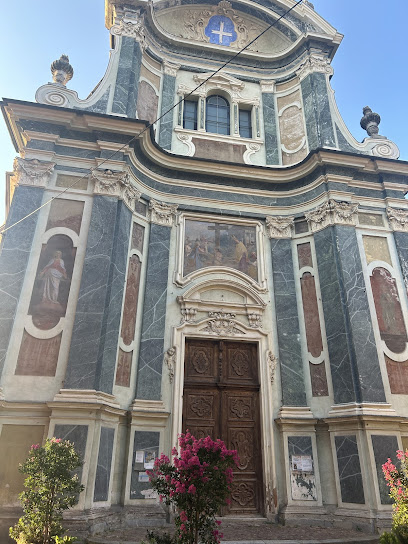
Church of the Holy Cross – Cuneo
Europe,
Italy,
Cuneo,
The Church of Santa Croce, located in the heart of Cuneo, represents a fundamental pillar of the city’s cultural and religious identity. Built between the 17th and 18th centuries, it is known for its majestic Baroque facade and the artistically valuable frescoes that adorn its interiors. This place of worship is not only an example of religious architecture, but also a gathering center for the Cuneo community, with a history that spans centuries and tells of Cuneo’s spiritual and cultural fervor. The Church of Santa Croce was founded in 1621 thanks to the work of the Franciscan friars, who aimed to create a place of worship for the faithful and a center of assistance for the needy. The original project was conceived by a local architect, and the works began immediately after the laying of the first stone, which officially took place in 1625. The building exhibits significant stylistic evolution: the influence of the Counter-Reformation is evident in the decoration and arrangement of the interior spaces, designed to facilitate the liturgy. In 1682, the church was enlarged and enhanced through various restoration campaigns. Important frescoes were commissioned from notable artists of the time, such as the painter Francesco Gallo, whose main work can be admired in the presbytery. Over the years, the Church of Santa Croce has undergone various transformations. In the 18th century, important restoration and decoration works were undertaken to renew the building’s splendor, contributing to making it one of the most cherished sacred places in the city. In the 19th century, it was restored again, particularly after the damage suffered during the events of 1848. Today, the Church of Santa Croce is recognized not only for its Baroque architecture but also for the valuable collection of artworks inside, which testify to the cultural richness of the Cuneo community. The sacred space is not merely a place of worship but a true treasure chest of history and spirituality. As we approach the Church of Santa Croce, the first thing that strikes us is the majestic Baroque facade, which rises before us with elegance. The facade is adorned with ornamental motifs and statues representing saints and biblical figures, creating an impression of grandeur and holiness. Notice how the Corinthian columns, with their elaborate details, impart a sense of movement and dynamism to the architecture. Upon entering the church, you will immediately notice the warm and welcoming illumination of the interiors. On the left side, there is an imposing chapel dedicated to Saint Francis. Here, you can admire a cycle of frescoes depicting the life of the saint, created by local artists of the 17th century, which captivates attention for its vibrant portrayal of Franciscan spirituality. Continuing inside, we can observe the main altar, striking for its grandeur and the richness of the materials used. The altar is covered with precious marbles and topped by a large carved wooden cross, a strong symbol of faith and a focal point for the faithful gathering in prayer. One of the most famous works within the church is the painting of the “Madonna with Child among the Saints,” located on the right wall. This painting, attributed to an artist of the 18th century, is admired not only for the beauty of the subject but also for the mastery of the painting technique, which offers an interesting glimpse into Baroque style. We cannot forget the frescoed ceiling, which dominates the interior of the church. The frescoes, depicting skies and angels, invite the gaze upward, each serving as an example of artistic skill that tells stories of faith and devotion. The attention to detail and the vibrancy of the colors make this ceiling a highly captivating element. Completing the visit is the crypt, located beneath the main altar. Here, the memory of the deceased lives on through historic tombs and reliefs that offer a glimpse into the spiritual and cultural life of the city over the centuries. This place invites reflection and remembrance. The Church of Santa Croce is situated in an area rich in history and culture, deserving of careful visit. Not far away is Piazza Galimberti, a nerve center of Cuneo’s social and commercial life, with its famous central fountain. Further along, you will have the opportunity to visit the Diocesan Museum, which houses a collection of religious artworks and historical documents that recount the history of the Church and the city. Just a short walk from the church, we find the Town Hall, a notable example of civil architecture that provides insight into Cuneo’s political and social history, further enriching the cultural context of the visit. An interesting tidbit is that the Church of Santa Croce was an important center for collecting goods during epidemics. This demonstrates how the church was not only a place of worship but also a support point for the community. In addition, the church has been the protagonist of numerous religious events that have involved the Cuneo population, such as processions during festivals. These events are testament to a strong bond between the community and its religious history. Finally, for music lovers, let us not forget that the Church of Santa Croce is also the venue for concerts and musical events, thus uniting art, music, and spirituality in one place. The Church of Santa Croce is not just a place of worship but an experience that invites reflection on the history and culture of Cuneo. We invite you to continue your discovery by visiting the nearby Piazza Galimberti and the Diocesan Museum, to immerse yourself even further in the essence of this unique city.
Read More