Church of the Reformed
Europe,
France,
Marseille,
La Canebière
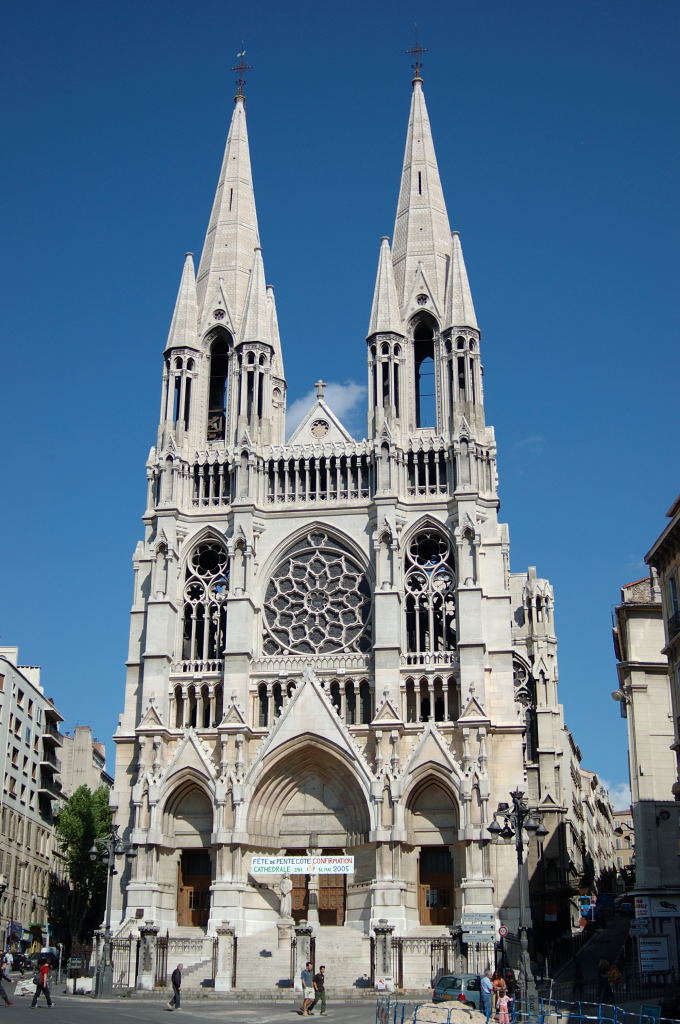
The Church of the Reformed, officially known as the Church of Saint-Vincent-de-Paul, is one of the most iconic structures in Marseille, located at the end of the famous Canebière. This neo-Gothic church, with its imposing towers reaching 70 meters in height, is a symbol of the religious and architectural renewal of the city in the 19th century.
The history of the Church of the Reformed begins with the decision to build a new church on the site of an old chapel belonging to the reformed Augustinian friars. These monks had founded a chapel in 1611, during the period of the Duke of Guise as governor of Provence. However, the chapel was demolished in 1868, after the end of the Concordat between Napoleon and the Pope, which had reorganized the French dioceses.The construction of the new church was initially entrusted to the architect François Reybaud, with the first stone laid by Monsignor Eugène de Mazenod in 1855. However, the work was later completed under the direction of Abbé Joseph Pougnet, after various financial problems that required significant fundraising from the local community. The construction lasted over thirty years, with the inauguration taking place in 1886 and the official consecration in 1888.Architecturally, the Church of the Reformed is a magnificent example of ogival Gothic style, inspired by the great medieval cathedrals. The main façade is characterized by two tall twin towers and a central rose window. The imposing wooden doors, adorned with bronze panels, introduce visitors to an equally grand interior, with ribbed vaults and stained glass windows creating an atmosphere of spirituality and solemnity.One of the most distinctive elements of the church is the statue of Joan of Arc, created by Botinelly in 1943, welcoming visitors at the entrance. This choice symbolizes the deep connection between the Catholic faith and the French national identity, represented by the figure of Joan of Arc as a heroine and saint.Throughout the 20th century, the church went through periods of decline and revival. In the 1980s, due to a decrease in attendance, there was even consideration of demolishing it. However, the arrival of Father Michel-Marie Zanotti-Sorkine in 2005 led to a spiritual and cultural revival of the building, which was subsequently declared a historical monument in 2014. This recognition has helped preserve the church as an integral part of Marseille’s cultural heritage.
Read More