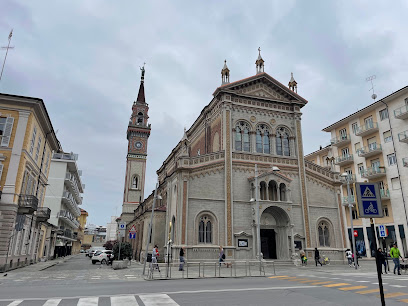
Church of the Sacred Heart of Jesus – Cuneo
Europe,
Italy,
Cuneo,
The Church of the Sacred Heart of Jesus, located in Cuneo, represents one of the most significant landmarks of the city. Built between the 19th and 20th centuries, it is known for its neo-Gothic architecture and the important religious function it serves. This church is a symbol of the devotion of the local community, but also an example of how religious art can engage with architectural beauty. Despite historical challenges, the church has maintained its charm, becoming a place of gathering and spirituality for the people of Cuneo. Its construction began in 1890 and was completed in 1900, a period when neo-Gothic style was already beginning to spread in Italy. The origin of the Church of the Sacred Heart of Jesus is closely linked to the growth of the Cuneo community in the second half of the 19th century. Its design was commissioned by the Bishop of Cuneo, who desired a place of worship dedicated to the Sacred Heart, a symbol of love and compassion. Construction began in 1890, following an architectural project inspired by neo-Gothic style, characterized by pointed arches, spires, and large colored stained glass windows. This church was built over an existing chapel dedicated to the Sacred Heart, demonstrating the intention to give greater importance to this devotion. The structure stands out for its slender lines and the use of materials typical of the period, such as exposed brick, which provides a robust yet elegant appearance. The official consecration took place in 1900, and since its opening, the church has played a central role in the religious life of the city. Over the years, the Church of the Sacred Heart has undergone various transformations and restorations. An important restoration work was carried out in the 1990s to preserve the beauty and integrity of the structure. During these interventions, particular attention was paid to the internal decorative details, as well as the artistic stained glass windows that tell biblical stories and reflect the spirituality of the place. Throughout the years, the church has not only witnessed religious celebrations but has also hosted cultural events. The community within it has continued to promote social and religious activities, making it a true center of gathering. Now let’s delve into the essence of our visit. As you cross the threshold, you will find yourself facing the imposing central nave. Its internal architecture is fascinating and evocative. The vaulted ceilings, supported by slender columns, create a sense of verticality that invites you to look upwards. The wall decorations are enhanced by frescoes and stuccoes that depict the lives of saints, inviting contemplation. Moving towards the altar, we notice that this area is particularly solemn. The main altar is made of fine marble and houses a large wooden cross, the central symbol of the Christian faith. The light filtering through the colored stained glass creates a play of colors that further enriches the environment, making the liturgy a unique visual and spiritual experience. On the right side of the nave, there is the chapel dedicated to the Madonna, characterized by a beautiful fresco depicting the Virgin. This chapel is a place for silent prayer and is often visited by the faithful in search of comfort and guidance. Continuing along the left side of the church, you can notice an interesting series of artistic stained glass windows. These windows are crafted using a traditional technique that allows light to filter through in a suggestive manner. Each window tells a biblical story, and the vibrancy of the colors serves as a reminder of the believers’ devotion. Don’t forget to look up at the ceiling. Here you can admire the ornamental decorations that enrich the architecture. The floral motifs and figures of saints intertwine, creating an atmosphere of great beauty and spirituality. Finally, just outside the church, you will find yourself in front of the main façade. This features a series of neo-Gothic elements, such as the large arches and the central rose window, which can be admired from a distance. The symmetry of the façade is impressive and invites reflection on the message of stability and welcome, typical of the religious conception of the period. The Church of the Sacred Heart of Jesus is situated in an urban context rich in history and culture. Cuneo, with its cobblestone streets and beautiful historic buildings, offers many opportunities for exploration. In the surroundings, I recommend visiting the Town Hall, an example of medieval architecture in the heart of the city, and Piazza Galimberti, a lively center of gathering and culture. Not far from the church, there is also Consolata, a historic church dedicated to an important figure in the local religious tradition. This place, along with the Church of the Sacred Heart, forms a sort of spiritual path that deserves to be explored at leisure. With a short walk towards the center, you can also discover the Civic Museum of Cuneo, which houses a collection of works of art and historical artifacts that tell the history of the city and the surrounding territory. The Church of the Sacred Heart of Jesus is an example of how art can reflect the anxieties and hopes of an era. In particular, the decorative motifs tell not only of faith but also of a period of great cultural ferment. It is interesting to note that the choice of the Sacred Heart as the main subject of the church reflects the expansion of Marian and Christological devotions in the 19th century. This symbol of love and redemption has become fundamental for many communities. Moreover, the church has attracted numerous religious and civic events over the years, demonstrating its importance not only as a place of worship but also as a space for community gathering and celebration.
Read More