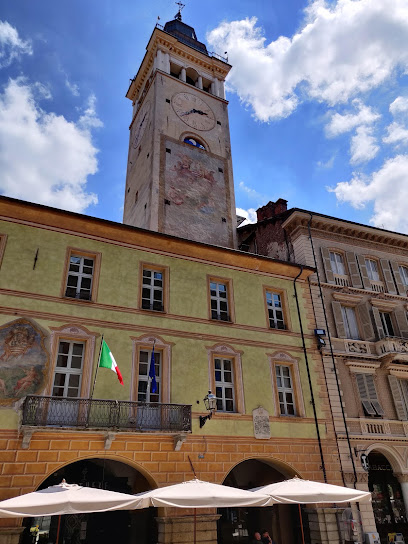
Civic Tower – Cuneo
Europe,
Italy,
Cuneo,
The Civic Tower of Cuneo, an emblematic symbol of the city, plays a crucial role in the historical and cultural identity of the place. This extraordinary bell tower stands majestically in the heart of the historic center, a silent witness to centuries of history. Its construction dates back to the 14th century, specifically to 1387, when it was built as part of the city’s municipal complex. The Tower is known for its clock, one of the oldest in the region, and for the panoramic view it offers over the city and the surrounding Alps. Today, it represents a strong symbol of Cuneo’s autonomy and civic spirit. The Civic Tower was built during a period of great change for Cuneo, a city that was beginning to emerge as an important commercial and administrative center. The construction period, the 14th century, marks the start of an urban expansion phase for Cuneo. The tower was completed in 1390 and was designed to house the bell tower of the church of San Francesco, but over the years it has taken on various functions. The Tower was built at the behest of local governors and notable citizens of Cuneo, at a time when the city sought to reinforce its power and autonomy against the surrounding kingdoms, particularly the Duchy of Savoy. Its structure, standing about 45 meters tall, exhibits a Gothic style with elements of transition to the Renaissance, making it particularly interesting from an architectural standpoint. Over the centuries, the Tower has undergone numerous restoration and maintenance interventions. One of the most significant events occurred in 1700 when a fire heavily damaged the original structure. In the following centuries, renovations were carried out that preserved the medieval appearance while strengthening the tower’s stability. In the 19th century, with the advent of industrialization, the Tower maintained its symbolic and historical value. It was during this period that the clock was installed, making it a landmark not only for the citizens but also for passing travelers. In 1923, the Civic Tower was declared a national monument, further highlighting its significant historical value. Today, the Civic Tower is not only a memorial to the history of Cuneo but also a meeting place. Every year, it hosts cultural events and celebrations, keeping alive its tradition as a center of civic life. The Tower stands as a beacon, inviting people to discover the city and the richness of its history. As you approach the Civic Tower, the first striking element is its imposing brick façade, characterized by elegant Gothic arches. As you enter the square, you can observe the lower part of the Tower, where a series of twin windows, arched openings divided into two semicircles, can be found. This architectural element is typical of the Gothic style and indicates the period of construction. Ascending the Tower’s stairway, which consists of about 150 steps, you will notice the different sections that reveal the architectural evolution over time. Already on the first floor, an extraordinary view presents itself through the small windows: a panorama of the historic Piazza Galimberti and the surrounding buildings. Upon reaching the second floor, you will be captivated by the mechanics of the clock, one of the oldest in the province. It dates back to 1898 and represents an example of high-quality mechanical engineering for its time. Its presence is a clear reminder of the importance that time had—and continues to have—in the daily life of the city. Continuing your ascent, you arrive at the bell chamber, where the bells ring out the time for the inhabitants of Cuneo. The bells, made of bronze, vary in weight and tone and were cast between the 18th and 19th centuries. The sound of the bells is an integral part of city life, often used during festive or important occasions. Finally, when you reach the top of the Tower, you can enjoy a breathtaking view. The panorama stretches from the Maritime Alps to Monviso, affectionately known as the “King of Stone.” On a clear day, the view is simply stunning and provides a unique opportunity to appreciate the natural and urban geography of Cuneo. The Civic Tower is located in Piazza Galimberti, an important square in the center of Cuneo. This area is lively and offers many other historical and cultural attractions. One of the most significant is the Town Hall, a building that houses the city administration and is known for its architecture and the frescoes that decorate its walls. Just a short walk from the Tower is the Church of San Francesco, a magnificent example of Gothic architecture that deserves a visit. Here, you can admire frescoes and works of art dating back to the 14th century. Another place of great importance is the Covered Market, famous for its offer of local products and for the lively atmosphere that reigns there, making it a gathering point for residents and visitors alike. These places contribute to creating a rich and varied cultural fabric around the Civic Tower, making Cuneo a city worth exploring in its entirety, not just through the bell tower, but also in its squares, churches, and markets. An interesting fact about the Civic Tower is that it has been used as a lookout point during historical events, allowing for the spotting of potential warning signals in the surroundings, such as fires or invasions. Additionally, the Tower has inspired many artists, photographers, and writers over the years, often becoming the subject of artworks that depict Cuneo. Its silhouette against the backdrop of the Alps is recognizable and iconic. Finally, during New Year’s celebrations, the Tower offers a unique moment: the tradition of the midnight “boati,” in which the bells ring incessantly to celebrate the arrival of the new year, involving all citizens in a festive collective participation. We conclude this journey by inviting you to explore the other treasures of Cuneo, such as the Town Hall and the Church of San Francesco. Each stop will enrich your cultural and historical experience in this fascinating city. Happy exploring!
Read More