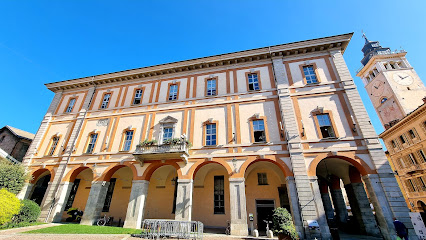
Cuneo City Hall – Cuneo
Europe,
Italy,
Cuneo,
Welcome to Cuneo, a city rich in history and charm. Today we find ourselves in front of an emblematic building: the Town Hall. This place is a symbol of the city’s identity and has represented the core of political and administrative decisions over the centuries. Built in the 14th century, the palace is known for its imposing architecture and the beauty of its decorated interiors. Throughout the centuries, it has witnessed significant historical events, becoming a witness to the social and economic transformations of the city. Let us discover its origins and history to better understand its central role in Cuneo. The origins of the Town Hall date back to 1300. At that time, Cuneo was an important commercial and political center. Its strategic location at the foot of the Alps made it a passage point for merchants and travelers. The first core of the palace was built to host municipal assemblies and governing bodies. Over the years, this building expanded and underwent modifications, reflecting changes in institutional and architectural needs. In 1370, the Palace underwent its first significant renovation. In the early 15th century, the construction was expanded with the addition of new rooms and an impactful façade characterized by elegant arches. In 1618, an important renovation led to the erection of a new floor, contributing to giving the palace the look that we can admire today. A further restoration took place during the 19th century when it was necessary to adapt the spaces to new administrative needs. During this period, the Town Hall became a symbol of authority, representing not only the strength of the municipality but also the pride of the citizens of Cuneo. Throughout the 20th century, the palace continued to be a hub for the public life of the city. It also witnessed moments of great turmoil, such as the two world wars, which put Cuneo to the test. In recent years, conservation interventions have been carried out to preserve the structure and its precious interiors. Now that we have explored the origins and history of the Town Hall, let us immerse ourselves in the visit. As we approach, we will notice the main façade, characterized by an elegant portico with semicircular arches. These arches provide a refreshing passage, perfect for the warmer days. On the left side of the entrance, we can observe the coat of arms of the municipality, a symbol of the city of Cuneo. Entering the palace, we find ourselves in front of the atrium, where experienced eyes will notice the coffered ceiling. This architectural detail, enriched by frescoes, is typical of public buildings from the Renaissance period. The frescoes depict significant moments in the city’s history, and with a careful look, one can spot representations of important local figures. Continuing on, to the right is the Council Hall, a space of great importance. This is the beating heart of Cuneo’s political life. The walls are decorated with historical paintings that recount the deeds of the citizens of Cuneo during crucial moments. The attention to detail is evident in the marbles and fine woods used for the furnishings. Let’s move towards the Executive Hall, another important area. Here, the furniture is elegant and sober, reflecting the city’s administrative tradition. In this hall, we also find works of art that celebrate local history, representing not only the distinctive features of Cuneo but also the evolution of its governance. Don’t forget to look up at the ceiling during the visit. The decorative motifs, crafted with mastery, tell us about the ambitions and dreams of the citizens of Cuneo. Each of these details has been designed to inspire a sense of belonging and pride. Having completed our explorations inside, we can turn our attention towards the outside. In front of the palace extends a lively square, the ideal place to grasp the vibrancy of city life. Here, public events and markets take place regularly, making this area a meeting point for residents and visitors. The Town Hall is located in the heart of Cuneo, in an area rich in history and culture. Continuing our exploration, we can discover other institutions that deserve our attention. A short walk away, we find the Church of San Francesco, a fascinating testimony to Gothic art, which offers an interesting contrast to the architecture of the Palace. Another nearby attraction is the Teatro Toselli, a gem of 19th-century architecture, where the cultural life of Cuneo unfolds with theatrical events and concerts. Moreover, it is worth visiting the Covered Market, also a short distance away, where you can savor local products and immerse yourself in the authentic atmosphere of the city. If you’ve ever wondered how the palace faced the challenges of time, it’s interesting to note that during World War II, the Town Hall was used as a refuge for citizens. This function underscores its role as a political center, as well as a symbol of resilience and protection for the community. Another curiosity concerns the system of frescoes that decorate the halls of the Palace. Many of these works of art were restored in the 19th century, rediscovering ancient techniques to preserve the artistic heritage of the city. These interventions have reinforced the historical and cultural importance of the building, allowing visitors to enjoy the beauty of works that tell stories of a rich and varied past. Finally, it is worth mentioning how, over the years, the Town Hall has become a symbol for campaigns of solidarity and social commitment. Indeed, it is common to see local initiatives taking place in front of this building, highlighting its role not only as a place of administration, but also as a center for community gathering. We hope this visit to the Town Hall of Cuneo has inspired you to discover even more about this magnificent city and its treasures. Happy exploring!
Read More