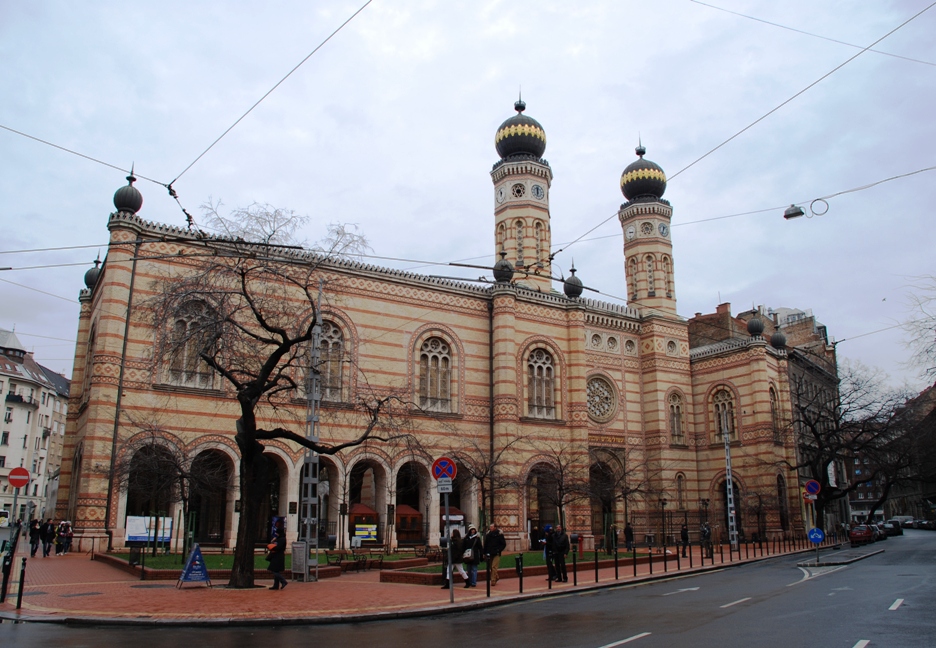
Dohány Street Synagogue
Europe,
Hungary,
Budapest, citta,
Erzsébetváros
The Dohány Street Synagogue, located in the heart of the Jewish quarter of Budapest, is the largest synagogue in Europe and one of the largest in the world. Also known as the Great Synagogue, it represents not only a place of worship but also an important historical and cultural symbol for the Hungarian Jewish community and the entire city.
Built between 1854 and 1859, the synagogue was designed by the Austrian architect Ludwig Förster. Inspired by Moorish style, Förster created a monumental building that blended Islamic, Christian, and Jewish architectural elements. This unique style is characterized by elaborate facades, onion domes, and a richly decorated interior. The main facade, adorned with red and yellow bricks and a large central rose window, is particularly impressive and represents an extraordinary example of 19th-century architecture.The interior of the synagogue is equally grand, with a capacity to accommodate up to 3,000 people. The vast interior space is divided into a central nave and two side aisles, with an elegant gallery for women on the upper floor. The bimah, or pulpit, is located in the center of the central nave, while the Aron Kodesh, the sacred ark containing the Torah scrolls, is situated in the apse. The interior is decorated with stuccoes, stained glass windows, and magnificent chandeliers, creating a solemn and evocative atmosphere.The history of the Dohány Street Synagogue is closely linked to the events of the Jewish community in Budapest and Hungary. During World War II, the building was severely damaged by bombings and later used as a collection center for Jews before their deportation to concentration camps. In the synagogue’s courtyard, a memorial commemorates the thousands of Hungarian Jews who lost their lives during the Holocaust.One of the most moving elements of the synagogue complex is the Jewish cemetery and the Raoul Wallenberg Holocaust Memorial, located in the adjacent garden. The memorial consists of a metal tree of life, whose leaves bear the names of Holocaust victims engraved on them. The monument is dedicated to Raoul Wallenberg, the Swedish diplomat who saved thousands of Hungarian Jews during the war.The Dohány Street Synagogue is also home to the Hungarian Jewish Museum, which provides an overview of the rich history and culture of Hungarian Jews. The museum houses a vast collection of artifacts, including religious objects, historical documents, and artworks that tell the story of the Jewish community in Hungary through the centuries.The restoration of the synagogue, initiated in the 1990s and completed in 1996, was a significant project that restored the building to its original splendor. This restoration allowed the synagogue to once again become not only a place of worship but also an internationally important cultural and tourist center.An interesting anecdote concerns the role of the synagogue during the Hungarian Revolution of 1956. During this period of turmoil, the building was used as a shelter for the wounded and as a medical assistance center. This episode further emphasizes the importance of the synagogue as a symbol of hope and refuge in times of crisis.The location of the synagogue in the vibrant Jewish quarter of Budapest, known as Erzsébetváros, adds to its charm. This neighborhood is rich in history and culture, with numerous kosher restaurants, cafes, and shops that reflect the daily life of the Jewish community. The Dohány Street Synagogue is the beating heart of this neighborhood, a landmark for residents and visitors.
Read More